Common pests of orchids include thrips and scale insects.
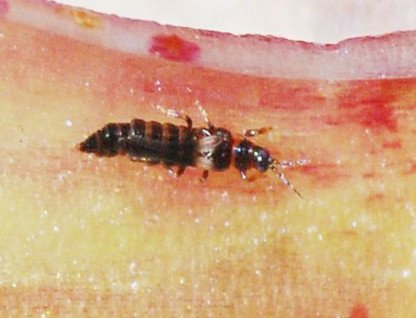
Scale insects
Common species of scale insects include six types: Icerya purchasi, Pseudaonidia duplex, Pseudococcus comstocki, Eulecanium koreanum, Pseudaulacaspis pentagona, and Planococcus kraunhiae. They have strong reproductive capacity and produce multiple generations a year. They mainly damage leaves, branches, and fruits, living permanently on branches, leaves, or fruits, causing leaves to turn yellow, branch tips to wither, tree vigor to decline, and they easily induce sooty mold. They have strong resistance to pesticides, and general chemicals find it difficult to penetrate their bodies, making control relatively difficult. Therefore, once they appear, they are not easy to completely eliminate.
Orchids grown in poor ventilation are prone to scale insects in summer, which affects both orchid growth and ornamental value. Usually, when only a small number occur, they can be removed with a toothpick or toothbrush. Severe infestations are not easy to eradicate. A fellow orchid grower read an article in a magazine about cleverly eliminating scale insects and was inspired; I then used it to eliminate scale insects on orchids, and the effect was very good. Now I introduce it to fellow orchid growers: take some edible Sichuan pepper, add water, and boil for 60 minutes. Remove the liquid and let it cool, then add water at 100 times the volume, and spray it onto the affected orchid plants with a sprayer. Generally, two applications are enough to eradicate them. The sprayer should be cleaned promptly after use. Interested fellow orchid growers can try it when scale insects appear.
Clever way to eliminate scale insects: use 39-degree baijiu, add half as much water, and spray on the leaf surface once every three days; two applications are enough.
With the continuous progress and development of the pesticide market, the pesticide resistance of pests has also increased. Therefore, on the basis of traditional control, we must constantly seek more scientific and more rapid control methods.
1. Manual control: During the process of cultivating flowers, if scale insects are found on individual branches or leaves, they can be gently brushed off with a soft brush, or the insect-infested branches and leaves can be cut off together with pruning. It is required to brush them clean, cut them clean, and burn them in a centralized manner. Do not throw them away carelessly.
2. Chemical control: According to the various occurrence conditions of scale insects, spray pesticide during the peak period of nymphs. Because at this time most nymphs have just hatched, the body surface has not yet secreted wax, and the scale shell has not yet formed, so pesticide is still likely to kill them. Apply a 1000-times dilution of Hushu Jiangjun to places on the tree body where there are eggs to suffocate and kill the eggs. You can use a 1000-times dilution of 40% omethoate, or a 1500-times dilution of 50% malathion, or a 1000-times dilution of 255 imidacloprid? No, imidacloprid is not right here; use 255 phosmet 1000-times dilution, or a 1000-times dilution of 50% dichlorvos, or a 3000-times dilution of 2.5% deltamethrin, and spray. Spray once every 7-10 days, for 2-3 consecutive times. The pesticides introduced above have a strong odor and cause great harm to people and orchids. For many years I have used my own self-prepared Lan Jie Ling to kill scale insects, with obvious results and long-lasting effect.