Orchid mycorrhiza
A tissue-cultured hybrid variety of Jianlan (Cymbidium ensifolium), a cross between Mifenlan (Cymbidium floribundum) and Jianlan, also known as "Daguo". It has a pendulous leaf habit, fairly soft and glossy leaves, with white claw markings along the leaf margins and snow-white variegation. If grown strong, the leaf shape becomes larger and the variegation decreases; it almost never blooms. It is inexpensive, about 5 yuan per shoot. It is mostly sold in general flower, bird and fish markets.
The root system of orchids differs from that of ordinary plants. It grows directly from the pseudobulb as clustered or scattered roots of the same form, grayish-white, with a prominent root cap, and without distinction into main roots, branch roots or fine roots, and also without root hairs. If it encounters an obstacle or is damaged, it may also produce several branch roots, but their form remains the same as the original root. The structure of the root is divided into an inner and an outer layer. The inner layer, as thin as steel wire, is called the central column; it has quite strong mechanical tissue and is not easy to break, serving to anchor the orchid plant and also as the channel for transporting water and nutrients. The outer layer is the cellular epidermis, with root velamen tissue, brittle and easily broken, storing water and nutrients; when full of water, it acts to prevent drought and protect the inner layer. On the outer surface of the velamen there are also small green dots, which are the air chambers unique to orchid roots.
Within the root tissue of orchids and in the soil surrounding the rhizosphere, there usually lives a kind of root fungus called orchid mycorrhiza. The mycelium of these orchid fungi invades the cortical tissue inside the orchid root, forming a symbiotic relationship. The nutrients and water within the cortical tissue of the orchid root create the necessary living conditions for the orchid fungi, enabling them to reproduce and develop; at the same time, mycelium is constantly decomposed and absorbed by the orchid as nutrients, prompting the orchid to grow roots, sprout, bloom and fruit. The vitality of orchid fungi is stronger than that of other harmful fungi and bacteria; their massive reproduction forms a kind of physical barrier that prevents infection by pathogens carried in the soil by the orchid plant. When orchid roots lack orchid fungi, they are difficult to grow.
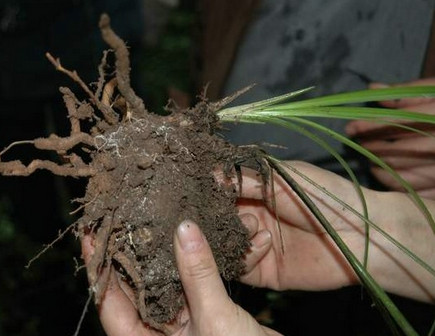
White mycelium