Zheng Sixiao's Inseparable Orchid Obsession
"Strange rocks and thorny thickets, keep them to accompany the Ancestor of Fragrance. How one sighs for the old man Suonan, who painted orchids but never painted the soil." This is a poem inscribed by Wu Changshuo, the famous calligrapher, painter and seal carver of the late Qing and early Republic, on an orchid scroll signed "the Daoist of Fou," expressing the author's deep feeling of longing for Zheng Sixiao, a loyalist of the Southern Song, through the painting of orchids. Zheng Sixiao (1241-1318), ...
"Strange rocks and thorny thickets, keep them to accompany the Ancestor of Fragrance. How one sighs for the old man Suonan, who painted orchids but never painted the soil."
This is a poem inscribed by Wu Changshuo, the famous calligrapher, painter and seal carver of the late Qing and early Republic, on an orchid scroll signed "the Daoist of Fou," expressing the author's deep feeling of longing for Zheng Sixiao, a loyalist of the Southern Song, through the painting of orchids.
Zheng Sixiao (1241-1318), originally named Shaoyin①, changed his name to Sixiao after the fall of the Southern Song; his courtesy name was Yiweng, his sobriquet Suonan, and he called himself the Man of Jushan, the Poet of Jingding, the Wild Man of the Three Outer Realms, the Old Man of the Three Outer Realms, and so on. His ancestral home was Dongdao Village, Toubao, Lianjiang County (now Tangli Village). In the thirteenth year of the Jiading era of Emperor Ningzong of Song (1220), his father Zheng Zhen brought his family out of Fujian and settled in Lin'an (present-day Hangzhou), the capital of the Southern Song. In the second year of the Baoyou era of Emperor Lizong of Song (1254), the family moved again to Suzhou. Sixiao was born in the first year of the Chunyou era of the Southern Song (1241) on the shore of West Lake in Hangzhou. From childhood he studied at his father's side, deeply influenced by his family, and early on he understood how to temper his integrity. At the age of 14 he passed the xiucai examination and began to travel and study widely. Later, as a senior student of the Imperial College, he sat for the erudite and macro-literary examination and was appointed mountain chief of Hejing Academy. He was "broadly learned and skilled in many things, and never wrote in draft form," "firm and upright, with a sense of integrity," and, living in troubled times, he worried over the decline of the nation's fortunes. During the Xianchun era of the Southern Song, when the nation's situation was as precarious as a stack of eggs, in the fifth year of Xianchun (1269), Sixiao, as an Imperial College student, offered the court a plan to resist the enemy, but because his "words were blunt and direct, offending the new prohibitions," those in power rejected it and did not adopt it.
After the fall of the Song, Zheng Sixiao lived in seclusion at Chengtian Temple in Suzhou, devoting himself to creation. Throughout the latter half of his life, a full forty years of wretched existence as a former-subject loyalist, he always maintained his national integrity, vowing never to serve a second dynasty and never to become an obedient subject of the Yuan, and so he changed his name to "Sixiao," meaning "thinking of Zhao"; his courtesy name "Yiweng" meant never forgetting his ancestors and his homeland; his sobriquet "Suonan" also meant that "south" was where he settled and made his stand, and that he would never face north and serve the Mongol people as a subject. In daily life he always sat and lay facing south, and at seasonal sacrifices he would weep toward the southern wilds; he vowed not to associate with northerners, and upon hearing northern speech he would cover his ears and hurry away. The plaque in his dwelling read "The World of Benxue," for by placing the "ten" from the character "ben" into the character "xue," one gets the two characters "Great Song." He wrote the "Great Wugong Shikong Sutra," for the character "kong" without "gong" plus "shi" also forms the character "Song," that is, the "Great Song Sutra." He especially hated officials who served the Yuan and refused all dealings with them. Zhao Mengfu, a calligrapher and painter of considerable fame at the time, once came to visit him out of admiration, but Sixiao "detested that he was of the imperial clan and yet had accepted appointment under the Yuan," loathed his lack of integrity, and refused to meet him to the end.
As one of the "Four Gentlemen" among traditional Chinese painting subjects, the orchid is a regular guest of Chinese bird-and-flower painting. Though the orchid is a plant, for literati painters it is a cultural symbol, a vehicle through which they express their feelings. In the eyes of most ancient Chinese literati painters, the orchid is a fragrant herb, symbolizing an ideal; it can serve as a representation of the pursuit of integrity and virtue, and can also serve as an objectification of aesthetic feeling. Literati often painted such subjects to convey the symbolism of loftiness, integrity, and firm, upright resilience. The earliest orchid work can be traced back to about the Northern Song period, to Su Shi's "Orchid, Bamboo and Vast Cliffs," after which orchids appeared frequently at the brushes of painters through the ages. At the end of the Song and the beginning of the Yuan, China had two famous orchid painters: one was Zhao Mengjian (1199-c. 1267), and the other was Zheng Sixiao. Both were renowned in the world for their skill at painting orchids and for their unyielding loyalty, and the ancients commented that "Zhao Mengjian captured the manner of the orchid, Zheng Sixiao conveyed the essence of the orchid," whence the praise that "orchids come from Zheng and Zhao." Their spring orchid paintings are the oldest orchid scrolls we can see today. From Zhao Mengjian and Zheng Sixiao onward, the orchid became a symbol of loyalty, nobility and purity, and came to be loved by the Chinese people.
Among Zheng Sixiao's many paintings, very few survive; today only four scrolls of "Ink Orchid" attributed to Zheng Sixiao remain, all ink on paper. Two of them are held by the Osaka Municipal Museum of Art in Japan and Yale University in the United States. The version in the Osaka Municipal Museum of Art is an ink monochrome freehand painting, 25.7 cm in height and 42.4 cm in width, executed on the fifteenth day of the first month, the Lantern Festival, in the tenth year of the Dade era of the Yuan (1306). In the picture two orchids face each other, embracing a single flower between them; the stems are short and the flower secluded, yet with an air of unfolding, which makes its elegant, rich fragrance and enduring, unwithering vitality all the more evident. The entire scroll is painted in burnt ink, with vigorous, seasoned brushwork as sharp as a sword, expressing an unyielding spirit. On the right, the painting bears a self-inscribed poem: "Of old I bowed my head and asked Fu Xi, who are you, that you come to this land; before there was painting, the nostrils opened, and ancient fragrance floated across the whole sky." The painting also bears a leisure seal reading "Seek it and you will not get it, do not seek it and perhaps it will be given, old eyes vast and empty, pure breeze through all ages," which serves to "dot the eyes" of the inner meaning of this flower work and reflects the painter's character. On the left, a colophon reads: "On the fifteenth day of the first month of the bingwu year I made this one scroll." "Bingwu" is 1306 CE. At that time the Song had already fallen for twenty-six years, Sixiao was nearly seventy, and had long been a Southern Song loyalist painter living under the Yuan. The thoughts expressed in all of Sixiao's "Ink Orchid" poems and paintings are precisely a portrayal of this deep emotion in his later years. According to the record in "Wuxi Ji," when Zheng Sixiao was living in seclusion painting orchids and had become famous in Gusu, a certain county official asked Sixiao for an orchid painting, and Zheng Sixiao replied: "The orchid is noble and pure in character; only the virtuous and talented deserve to be its companion." The official caught the implication, was greatly enraged, and, seeing that he could not obtain the painting, threatened him with "taxes and corvée" in an attempt to force him to paint an ink orchid. Sixiao, with an unyielding backbone, was furious at this: "My head may be cut off, but the orchid shall not be obtained!" The county official had no choice but to release him. This spirit of Zheng Sixiao, unyielding in the face of force and upright without flattery, has ever since been admired by the world.
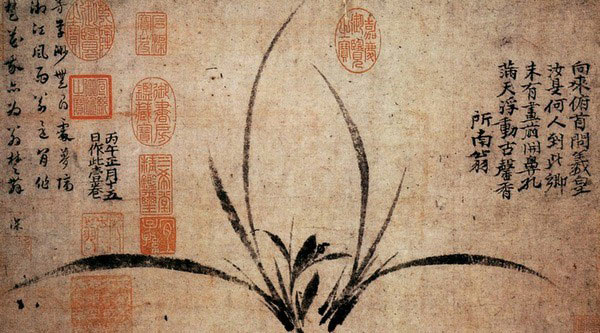
Zheng Sixiao painted a great many ink orchids in his lifetime, most of them inscribed with poetry and prose that was either obscure and indirect or open and clear. Another paper scroll of "Ink Orchid," now held in the Yale University Art Gallery in the United States, depicts a single orchid with a single flower; the ink tones are light and elegant, the leaves slender, thin and resilient, proudly extending leaves and putting forth buds, showing a cold, utterly unworldly charm. The picture bears a self-inscription: "The fragrance of a whole nation, the mourning of a whole nation, I think of that King Huai, who brought glory to Chu. Suonan." This painting is a long handscroll. The grief and indignation of a lost homeland, whose depths words could hardly reach, was thus aptly expressed through a clump of strange, soil-less orchids, a clever fusion of Zheng Sixiao's artistic ingenuity with his thoughts and feelings. Originally, making use of the natural qualities of flowers and trees, such as the Four Gentlemen's defiance of frost and endurance of cold, as a support for expressing emotion and mood, in order to compare them to human virtue and temperament, was a conception long established in flower painting. By the Yuan dynasty, under foreign oppression, the use of this creative method developed as never before, and painters often personified plum, orchid, bamboo and chrysanthemum to express their innermost feelings that could not be fully put into words. As a Southern Song loyalist painter, Zheng Sixiao was skilled at employing this technique. Just as he said in his orchid inscription poems, "all are perilous, strange, subtle and singular, for they serve to vent his pent-up feelings," so his soil-less, bare-rooted orchids, like his poetry and prose, entrust the deep sentiments of "longing for the former country" and "the sound of a fallen nation," showing his resistance to foreign rule. The famous High Tang poet Cui Hao wrote: "To repay one's country one goes to face calamity; since ancient times it has always been so." The thought of patriotism, the pain of patriotism, is the most sacred feeling in the world, the one most able to connect people. And this pain of patriotism, in a man of letters, can only be embodied in his every action and in his calligraphy and painting.
Zheng Sixiao also painted an ink orchid scroll more than one zhang long and five cun high, innocent and unrestrained, transcending the outward form, which likewise bore an inscribed poem: "Pure are all gentlemen, no petty men at all; deep in the mountains, heaven is taken as spring." The orchids he painted had no soil and no roots, floating in the air. According to "Yimin Lu," he "excelled at ink orchids, and after the change of dynasty, when he painted he did not paint the soil, so the roots had nothing to rely on. Everyone was astonished and puzzled, and when people asked him why, he answered: 'The soil has been seized by the foreigners; how could I bear to paint it?'" It can thus be seen that Zheng Sixiao's ink orchids were by no means a game of brush and ink in idle leisure. In his painting he sought to take his stand on the strange image of the ink orchid, to express his inner bitterness over the fall of the Southern Song, and to give voice to his integrity and character, utterly refusing to be classed with others though he lived in adversity.
Zheng Sixiao was skilled at painting throughout his life, especially excelling at ink orchids, and also painting ink bamboo. In his creations, his conceptions and ideas mostly drew on the natural qualities of orchids, bamboo, flowers and trees in defying frost and enduring cold, to entrust his secluded, fragrant and noble sentiments, as well as his integrity in not drifting with the world after the fall of his homeland. Sixiao's conduct in chanting orchids to keep his resolve also became a model for later loyalists. Ni Zan (1308-1374), one of the four great painters of the Yuan dynasty, after the fall of the Yuan once drifted through rivers and lakes in a small boat with a bamboo-hat, and his poem "Inscribed on Zheng Suonan's Orchids" reads: "The autumn wind turns orchids and thoroughworts to weeds, the southern land is desolate, its spirit already gone. Only Suonan's heart remains unchanged, weeping springs mixed with ink to write the 'Li Sao.'" The lines affectionately recreate the image of Zheng Sixiao's steadfast unyieldingness.
In short, Zheng Sixiao's poems and paintings, "whose principal style is like Old Du's profound sorrow and indignation," "bitter words flowing out from between the lungs and liver," read like the bleak autumn wind and leave one dejected and heartbroken. His orchid obsession manifested the national righteousness and patriotic spirit of a particular historical period, and to a certain extent expressed the voice and wishes of the people, which is undoubtedly rare and commendable.
Note ①: Sixiao's childhood name is unverifiable; according to the "Shangzheng Genealogy" revised in the Daoguang era of the Qing in Lianjiang County, which once published the "Supplementary Engraved Full Text of the Biography of Lord Suonan," it contains a record that Sixiao was "originally named Shaoyin."