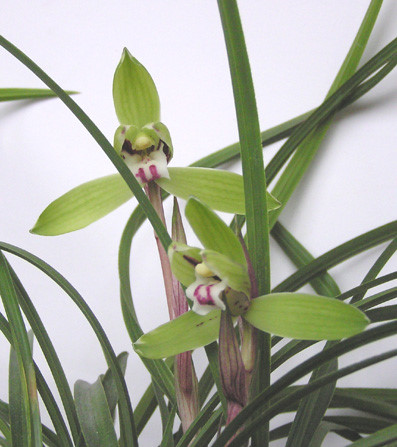
The Cymbidium goeringii cultivar Old Xiaochun is also known as Jiangnan Xiaochun
Orchids0 views
In the spring of 1919, Wang Kun of Zihong Mountain, Lanting, Shaoxing, found it on his way to offer incense at Xiaohe Mountain in Hangzhou, and later sold it to Jiufeng Pavilion in Hangzhou. The three outer petals have rounded tips and thick flesh, the pollinia are silkworm-moth shaped, and the petal lips bear red dots. It has a Liu Hai tongue, level flower shoulders, bright flower color, and a tall flower scape. For this reason, the lay Buddhist Yidao, Wu Chunbai, said: "The delicate flower, smiling with dimples, keeps spring," and this line of poetry seems to portray this flower....
In the spring of 1919, Wang Kun of Zihong Mountain, Lanting, Shaoxing, found it on his way to offer incense at Xiaohe Mountain in Hangzhou, and later sold it to Jiufeng Pavilion in Hangzhou. The three outer petals have rounded tips and thick flesh, the pollinia are silkworm-moth shaped, and the petal lips bear red dots. It has a Liu Hai tongue, level flower shoulders, bright flower color, and a tall flower scape. For this reason, the lay Buddhist Yidao, Wu Chunbai, said: "The delicate flower, smiling with dimples, keeps spring," and this line of poetry seems to portray this flower. Hence it was named "Xiaochun." The flowering form of Old Xiaochun varies: some bloom as plum-type narcissus, and some bloom as ordinary narcissus; when it blooms as ordinary narcissus, it also has the name "Changzi," but in fact the two are the same thing.