|
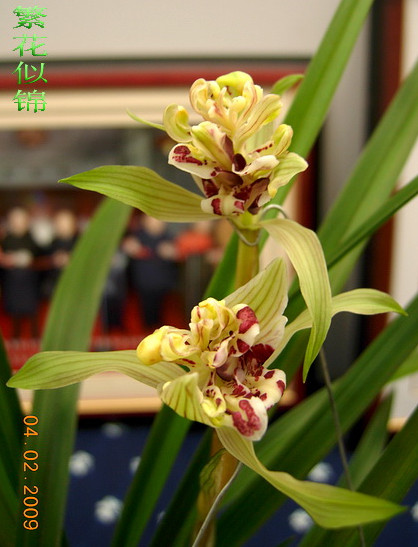
Chunjian. Sanxing Yihun In the spring of 2001, an orchid exhibition was held in Deyang City, Sichuan Province. A pot of Chunjian. Fulushouxing Qihua, named by Professor Liu Qingyong after the ancient cultural site of Sanxingdui based on its meaning, caused a sensation throughout the entire orchid world. Everyone who saw this flower praised it, and ultimately at a high price of several hundred thousand yuan per seedling, it was reluctantly given up by Peng Qiyun, chairman of the Deyang City Orchid Association, to Mr. Qian Dengrong of Chengdu. Later, Peng Qiyun and Qian Dengrong renamed it "Sanxing Yihun", which for a time sparked widespread discussion among orchid enthusiasts: "Sanxing Yihun" - what exactly is good about it? What is unusual about it? And from what angle should it be appreciated? Here I want to discuss the evaluation and value of unusual flowers. A Chinese orchid unusual flower should possess specificity, symmetry, consistency, stability and ornamental value before it can be called a good unusual flower variety. First is specificity, which means this kind of unusual flower must have a variation with individual characteristics. Accidental mutilation and sudden redundant cumbersome-type unusual flowers are definitely not rare varieties, and they cannot possibly possess the following characteristics: The appreciation of Chinese orchids places great emphasis on symmetry, and the evaluation of unusual flowers is no exception. Most unusual flowers have deformed sepals or petals, or an increase or decrease in the number of tepals, which breaks the original symmetrical format. The format changes, yet symmetry cannot be changed. Therefore it can be said that unusual flowers are definitely not rudimentary flowers. The more unusual, the harder it is to achieve symmetry; the more symmetrical, the more precious. Taking the flower stalk as the central axis, the number of flowers on the left and right sides must be equal, the size of the petals must be uniform, the unfolding posture of the petals must be symmetrical, and the red spots on the petals must be symmetrical.
|