Introduction to the Characteristics and Cultivation Techniques of the Wan Guang Chunlan Variety
In November 1980, during a checkpoint inspection, the Agriculture and Forestry Bureau seized a tractor-load of wild-collected orchids packed in burlap sacks. To properly handle this batch of orchids, they were sent to the Forestry Science Institute for cultivation. At that time, Mr. Gu Xuejing was the captain of the first ornamental plant team at the Forestry Science Institute, and he was put in charge of handling this batch of wild-collected orchids. At that time, very few people in Zhoushan cultivated or understood orchids...
In November 1980, during a checkpoint inspection, the Agriculture and Forestry Bureau seized a tractor-load of wild-collected orchids packed in burlap sacks. To properly handle this batch of orchids, they were sent to the Forestry Science Institute for cultivation. At that time, Mr. Gu Xuejing was the captain of the first ornamental plant team at the Forestry Science Institute, and he was put in charge of handling this batch of wild-collected orchids.
At that time, very few people in Zhoushan cultivated or understood orchids. Mr. Gu had not been growing orchids for long either. In order to cultivate this batch of orchids well and to screen them before planting, perhaps one or two named varieties could be selected from them, so Mr. Gu invited Mr. Ding Yiqing, a pioneer of orchid cultivation in Zhoushan, to help with the selection.
The orchids poured out of the burlap sacks were haphazardly bundled, with broken roots and broken leaves tangled together. In the cold wind, one could almost hear their wailing cries. Gently untying the bundled orchids, carefully sorting them out, trimming rotten roots and withered leaves, and separating large clumps of orchids. They busied themselves from morning until afternoon, and apart from selecting a few solid-colored flowers, there were no exciting discoveries.
Hard work pays off. From one bundle that was untied, four or five seedlings with unusual characteristics scattered out from the clump and caught Mr. Gu's attention. Looking closely at the plant: the leaf posture was slanting-upright or semi-drooping, leaves about 20 cm long and about 0.8 cm wide, with prominent leaf surface grooves, leaf margins edged in gold, and a plump flower bud nestled at the pseudobulb. Mr. Ding examined it carefully and said happily: "This plant is no inferior to Japan's 'Teikan'!" Thus Zhoushan's first gold-edged orchid was discovered.
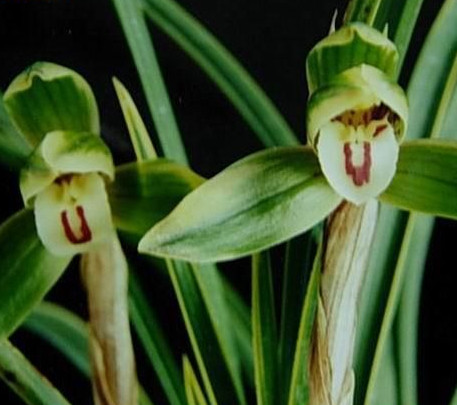
At that time, the orchid was cultivated by Mr. Gu and Mr. Ding. The following year, the orchid bloomed again, and what was seen was this: the flower scape was round and upright, the stalk 15 cm tall, the three outer petals of lotus type, with thick and glutinous petal texture, contracted at the base and broad at the corners, petals green with gold edging, the main petal in an upper-covering shape, though unfortunately the two sepals drooped at the shoulders; the petals shaped like clam shells, also edged in gold, the lip a large spreading tongue, curling backward, with a brilliant "U"-shaped red marking on the lip surface; this flower had a long blooming period and excellent flower retention, not losing its shape long after opening. When in bloom, it had a subtle, mellow fragrance, making it a rare fine specimen with both leaf and flower artistry.
In the early 1990s, Zhoushan orchid grower Mr. Wang Zefu took the first character from a couplet hanging on his wall: "All things observed in stillness are naturally content; a lifelong passion is naturalness itself." and embedded it into this flower's name, naming it "Wan Guang." Before and after this time, this couplet was always associated with the naming of Zhoushan orchids; the famous "Tian Yi He" and "Tian Shi He" both came from this couplet.
The "Wan Guang" plant is easy to grow, easy to strengthen, easy to flower, and easy to propagate; if grown well, it can even produce striped variegation. For ten years, this plant circulated only among a small number of orchid enthusiasts in Zhoushan, and it was not until 1991 that it began to flow outward to places like Ningbo and Shaoxing.