Orchid Culture: Starting from the Story of Confucius Praising Orchids
Number: (Orchid) No. 0356 Name: Qixiang Yushu (Douban Orchid) Latin name: Cymbidiumserratum CV. 'QiXiangYuShu' Namer: Chen Jun Registrar: Ma Xuannan (Tianqi Orchid Garden, Shilin County, Kunming) Registration date: March 26, 2011 Expert comments: This variety was selected from Shilin, Yunnan...
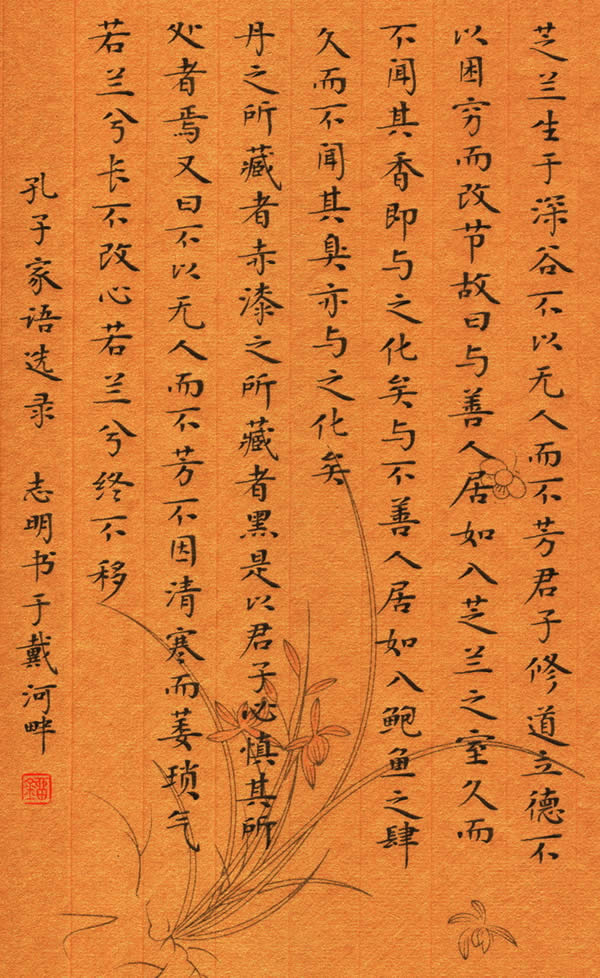
What is stored in cinnabar turns red, and what is stored in lacquer turns black; therefore the gentleman must be careful about where he places himself. It is also said: Not ceasing to be fragrant because no one is there, not withering into pettiness because of cold and hardship; the spirit like an orchid never changes, the heart like an orchid never wavers.
Confucius, whose personal name was Qiu and whose courtesy name was Zhongni, was a man of the State of Lu during the Spring and Autumn period. He was the founder of the Confucian school in our country and a great ancient thinker and educator. His time was the late period of the slave system, when "rites were collapsed and music was ruined." He traveled through the various states, hoping to persuade rulers with his political doctrines, but not one ruler accepted them; in the end he had no choice but to return to Lu, where he established a school and taught disciples for the rest of his life. The core of Confucius's thought is "benevolence" and "rites," and his main ideas are all reflected in his immortal work The Analects.
Confucius was very fond of orchids, and The Family Sayings of Confucius records a celebrated story of Confucius praising orchids. Confucius said to Zengzi: "After my death, Shang will improve day by day, and Ci will decline day by day." Zengzi said: "What does that mean?" The Master said: "Shang likes to associate with those who are wiser than himself, while Ci likes to speak with those who are not his equals. If you do not know a son, look at his father; if you do not know a person, look at his friends; if you do not know a ruler, look at those he employs; if you do not know a place, look at its grasses and trees. Therefore, to dwell with a good person is like entering a room of zhilan orchids; after a long time one no longer smells their fragrance, for one has already become one with them. To dwell with a bad person is like entering a shop selling salted fish; after a long time one no longer smells their stench, for one has also become one with them. What is stored in cinnabar turns red, and what is stored in lacquer turns black; therefore the gentleman must be careful about where he places himself." (The Family Sayings of Confucius, Six Roots, Volume Four) In the text, Shang is Confucius's student Zixia, and Ci is Zigong; both were famous disciples of Confucius. The meaning of these two statements is that Zixia loved to be with people wiser than himself, so his moral cultivation would improve day by day; Zigong liked to associate with people whose talents were inferior to his own, so his moral cultivation would decline day by day. What was the reason? Thereupon Confucius gave a series of metaphors to explain the influence of friends and environment on a person's character, and finally, with the contrasting examples "to dwell with a good person is like entering a room of zhilan orchids; after a long time one no longer smells their fragrance, for one has already become one with them" and "to dwell with a bad person is like entering a shop selling salted fish," he concluded that "the gentleman must be careful about where he places himself." From then on, "a room of zhilan orchids" became a byword for a good environment and an idiom praising and beautifying orchids.