Why Shen Yuanru Is Called the Orchid King of Jiangnan
Shen Yuanru (1905-1979) came from a distinguished and wealthy family, whose ancestors were from Anhui. The family built a large, deep-walled residence at Yingya Pavilion. His forebears acquired property and established factories and businesses, and by the early years of the Republic of China they owned thirteen joint-stock factories in the Shanghai and Nanjing areas, mainly in textiles and department stores. It was said that the Shen family possessed 5,700 taels of silver...
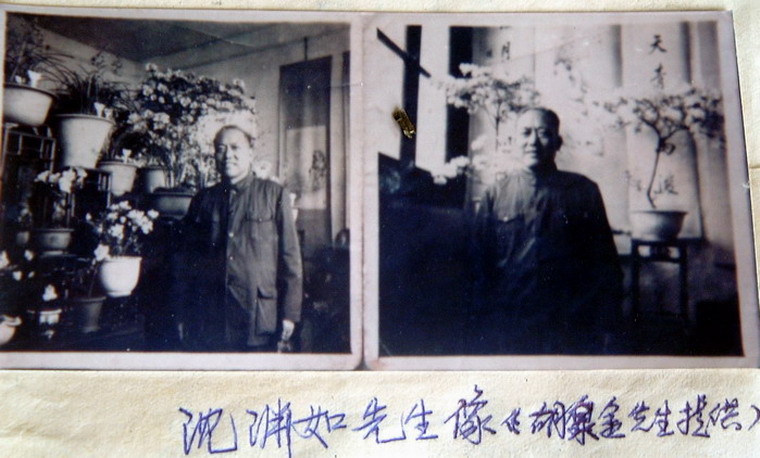
Recently, taking advantage of the return to Wuxi to visit relatives by Shen Yinchun, son of the "Orchid King of Jiangnan" Shen Yuanru, the author sat with the elder Shen in the afternoon sunlight and talked for a whole afternoon, listening to him recount the little-known, mist-like bygone days of the great Shen family residence in Wuxi.
The Shen family was one of the distinguished clans of Wuxi, and the site of the present-day Wuxi Grand Orient Department Store is the former location of the great Shen family residence. In Shen Yinchun's memory, the Shen family residence was lush with greenery throughout the courtyard and pleasantly fragrant, and orchid friends often gathered elegantly in the old-style three-bay main hall. Committeeman Zhu De also came here twice to meet Shen Yuanru, and the two exchanged orchids and discussed orchid cultivation.
The Distinguished Shen Family of Wuxi
Shen Yinchun's great-grandfather was originally a salt merchant from Anhui, and during the Taiping Heavenly Kingdom period he moved from Anhui to Wuxi. After gaining a firm foothold in Wuxi, the Shen family focused on businesses dealing in daily necessities, including what was then Wuxi's largest sock factory, Wuxi's largest cloth shop "Jiusheng," the Xinzhong matchstick factory (foreign matches) in Zhenjiang, and a weaving factory; in total, seventeen factories belonged to the Shen family. Shen Yuanru, Shen Yinchun's father, was the eldest son of the family. According to our traditional thinking, he should have inherited his father's business. In fact, that was not the case.
In the old days, wealthy families followed the rule that "the eldest son does not leave the residence," and the eldest son bore the family responsibility of "safeguarding the family property." To keep the eldest son content to stay at home and not run about outside, two methods were generally used to control him: one was to let the eldest son play with antiques and grow flowers, and the other was to let him take up opium. The "opium" method still sounds somewhat bizarre today. However, Shen Yinchun confirmed that this was indeed the case. And so, at the age of 14, Shen Yuanru began tending flowers and plants, and from then on formed a bond with orchids, became infatuated with them, and ultimately became the world-renowned "Orchid King of Jiangnan." Wuxi's Rong Wenqing, Cao Hanmei, and Rong Desheng were all guests of honor, and even the blind musician A Bing was often led by his wife to the door to sing for money.
The Shen family had many rosewood stands specifically used for displaying orchids, and great care was taken in the choice of flower pots. Quite a number of these pots were masterpieces by famous makers collected by Shen Yuanru, such as the natural tree-root pot by Li Zhongfang, a gifted disciple of Shi Dabin; the purple clay basin-shaped pot by Ou Qiwei; the purple clay pot by Xu Youquan; and the purple clay square flower pot by Chen Wenju. At that time, the ordinary flower pots used by the Shen family were all designed and drawn by Shen Yuanru himself and custom-made by Yang Xichun of Dingshan in Yixing; the bottom or feet of the pots bore three seals: "Yuanlu," "Dinghai," and "Made by Yang Xichun." Orchid friends in the circle all considered it an honor to obtain a flower pot from Shen Yuanru.
In fact, Shen Yuanru had profound attainments in horticulture, including azaleas and Chinese roses. It was only because the fame of the "Orchid King" was so great that it overshadowed his talents in other areas. Yet Shen Yuanru's life rose and fell dramatically because of orchids, and he died with regret.
The "Orchid King of Jiangnan" and His Several Orchid Battles with the Japanese
In the early period of the fall of the Northeast, refugees were displaced and poured into the interior in large numbers. In 1933, Shen Yuanru held a "Charity Orchid Exhibition" at the Tonggeng Hall of the Wuxi Public Garden, donating the ticket proceeds to the refugee relief association.
In 1937, the Japanese Obara Eijiro published a work introducing orchid varieties and their cultivation titled "Ranka-fu," which caused a sensation in Japan upon publication. The book was in three volumes, upper, middle, and lower, and most of its materials were provided by Shen Yuanru. "Before this, Obara Eijiro had sent people to negotiate with my father, wanting to take my father's precious orchid varieties back to Japan. Father said, 'I can give you the photo materials, but I will not sell a single orchid plant.'" Seeing that Shen Yuanru would not soften, the Japanese incited local ruffians to persecute him. Shen Yuanru stood firm and unyielding: "I would rather die together with the orchids, and be destroyed together with them."
Seeing that they could do nothing with Shen Yuanru, the Japanese came up with another plan, "buying orchids at high prices," purchasing rare and famous orchids from other orchid friends at the price of "one petal for one tael of gold." Shen Yinchun remembers that his grandfather spoke up at the time, saying, "As long as the Japanese make an offer, we will buy them at double the price." With his father's support, Shen Yuanru told his orchid friends, "If you sell your flowers to the Japanese today, you will not be able to grow orchids again in the future. I will buy the orchids in your hands, and if you want to grow them again later, I can divide the clumps and give you some." Unfortunately, the variety Xishen was still taken by the Japanese, but Donglai, Nanding, and Beichen they were unable to take as they wished. In this way, by the 1940s, the Shen family had gathered almost 99% of the country's rare "literati orchids." Every spring, people came in an endless stream to admire the orchids at the Shen residence.
In 1946, after the victory of the War of Resistance, also at the Tonggeng Hall of the Public Garden, Shen Yuanru gathered fellow orchid enthusiasts to hold another orchid exhibition, and renamed the most famous cymbidium in China at the time, "Caorong Dahe," as "Shengli Dahe" (Victory Dahe). "Caorong Dahe" had been named after its selection in 1924 by the Wuxi orchid masters Cao Ziyu and Rong Wenqing. In 1938, Rong Wenqing entrusted the only two remaining small plants to Shen Yuanru for cultivation, and it was only after twenty-two years that a single flower bud appeared and bloomed in full in spring.
Orchid Rescue During the Ten Years of Turmoil
During the ten years of turmoil, Shen Yuanru naturally did not escape either. Many materials and photographs concerning orchids and orchid exhibitions were torn up and burned, the Shen residence was sealed off, and Shen Yuanru was paraded through the streets and forced to stand in humiliation at struggle sessions, suffering both mentally and physically. Even so, in the dead of night, Shen Yinchun and his father still risked great danger to sneak back into the sealed Shen residence and "steal" out the remaining important materials his father had accumulated over many years, along with some photographs of historical value. "The Shen residence's wall was very high, more than six chi tall. I climbed up by stepping on my father's shoulders and got in along the family's grapevine." No one can fathom the feelings Shen Yinchun and his father had at that time, but such a scene, when one thinks of it, always weighs heavily on the heart.
Obara Eijiro used two photographs of the Shen family's orchid exhibition on the first and second pages of "Ranka-fu," but when using them he cut away entirely the text portion recording the orchid exhibition, leaving only the image content, and called it a Japanese orchid exhibition. Shen Yinchun still keeps the two original photographs rescued from the Shen residence back then, one of which was from the "Huilans" (Cymbidium Society) held in the 20th year of the Republic of China (1933) at the "Rice Milling Trade Association" in Jiangjian, Wuxi, initiated by Jiang Dongfu, the cousin of Kuomintang elder Wu Zhihui; the vast majority of the orchids and azaleas were the Shen family's. In the face of the evidence, the Japanese "claims made on their own" were easily refuted.
To avoid the orchids and cymbidiums meeting the fate of being ransacked and smashed by the Red Guards, he donated most of the precious orchid varieties he had collected over the years to the government. Unexpectedly, three years later, these orchids were actually "auctioned" off cheaply at Nanchan Temple at 3 yuan per pot for cymbidiums and 2 yuan per pot for spring orchids. Seeing this scene, Shen Yuanru, who had loved orchids as his life for a lifetime, suffered a severe mental blow. He would often stand blankly in the desolate empty courtyard strewn with broken pots, deeply dejected, gloomy all day long, and eventually became senile and bedridden. That "Shengli Dahe" also disappeared without a trace in this "auction."
At the time, Shen Yinchun worked as a porter at the Wuxi Aquatic Products Company and a fruit warehouse, working from the morning shift to the middle shift to the night shift without pause, just so he could earn an extra ten yuan in overtime pay and snatch back a couple more pots of the "auctioned" orchids.
At that time, the Shen family's life was quite straitened, and in the most difficult days they relied on the grapevine in the Shen residence to make a living. That grapevine was of a variety called "Jiachuan Sanchi," its main stem as thick as a bowl's mouth, bearing long, large clusters of fruit with a honey-like taste and a rose fragrance. An old Wang in Wuxi's Sanyang area, seeing how hard life was for the Shen family, bought "Jiachuan Sanchi" at a high price. Shen Yinchun has always been grateful to old Wang, but times changed, and after Shen Yinchun went to the United States in 1984, several return visits to Wuxi to see relatives brought no news of old Wang.
The Shen residence also grew a black plum, whose blossoms were a deep purple verging on black. Unfortunately, both "Jiachuan Sanchi" and the black plum vanished along with the Shen family residence into the long river of history.
A Family Tradition Passed Down in Order
A lifetime of loving orchids and cultivating orchids, yet in the end all was desolation. This blow was fatal to Shen Yuanru, so much so that he left his son the dying words, "Do not grow orchids." Shen Yinchun said, "Father said, 'Great talent stands out from the crowd and everyone envies it. The brilliance of the elder generation will overshadow you, just like Mei Lanfang: he was so successful, how could the younger generation surpass him? So you should go and make miniature bonsai.' Father also gave the example of Liu Adou, telling me that Liu Adou seemed foolish and simple-minded but in reality embodied the philosophy of conducting oneself as 'great wisdom appears foolish.'"
And facts proved Shen Yuanru's foresight. Today, with Shen Yinchun's success in miniature bonsai, and with the successive appearance of academic works such as "Azaleas," "The Art of Chinese Potted Plants and Bonsai," and "An Illustrated Guide to the World's Precious Azaleas," Shen Yinchun has become a focal figure in the international horticultural world. In fact, this was inevitable for Shen Yinchun as well. While Shen Yuanru was alive, his research on azaleas, camellias, and Chinese roses was in no way inferior to that on orchids, so it can be considered a family tradition passed down in order. To this day, Shen Yinchun still keeps his father's written records on cultivating "Huangshan Tea" (whose flower color shows golden yellow).
Every spring when Shen Yinchun returns to Wuxi to visit relatives, he spends some time in the small garden of about ten square meters at his brother's home, where dozens of pots of azaleas and orchids are kept, all planted in very ordinary blue-tile flower pots. The azaleas always bloom splendidly, while the several pots of orchids are quite unremarkable. But Shen Yinchun says they were all left by his father Shen Yuanru, and some are quite old. Now he himself is already 78 years old, and he does not know how many more times he can come back.