|
Oriental Pearl (Cymbidium faberi, also known as Zhenzhuta), the new shoots are quite delicate, overall emerald green, full of spirit, with a touch of
bright crimson at the bud tip; when discovered, the leaves were nearly seventy cm long, the leaf shape slanting upright and tall, the leaf tips noticeably thickened, appearing dew-like, the leaf margins
with obvious serrations, especially at the tips; leaf width medium, leaf texture thick and soft, yellow-green (this point resembles the Chunlan Yu Hudie, and may be
a leaf characteristic of strange flowers), the leaf surface has deep V-shaped grooves. The flower scape is upright, red-stemmed, rising above the leaves. This strange flower resembles the jade-tree form, yet is not merely
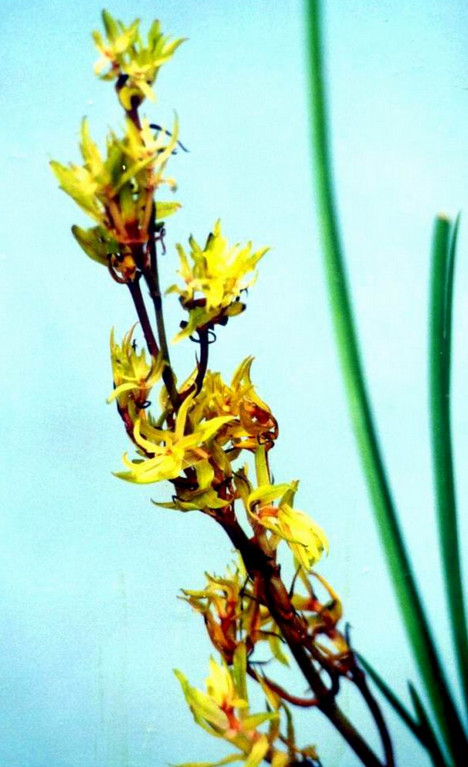
a jade-tree-form strange flower; chrysanthemum form, flowers-on-flowers, and various other strange flower forms are all expressed in this flower. Below, I will introduce Oriental Pearl to everyone one by one together with the pho
tos.
The main characteristics of Oriental Pearl are concentrated in four wonders:
Wonder one, this flower has, from bottom to top, the second and third nodes each with two flowers growing together at the same node on the flower scape. The paired-growing characteristic is
obvious, which is very rare among orchids of the multi-flowered-per-stem type.
Wonder two, it fully conforms to the characteristics of jade-tree-form flowers: the column foot is increased, the sepals, petals, and column are borne on the column
foot, connected below to the ovary, forming "nodes," with petals borne on the nodes, flowers at every node, similar in shape to a tree. This point is the same as Shenzhou
Qi, both being compound racemose inflorescences. (The above description of jade-tree-form strange flowers is based on page 125 of "Three Hundred Questions on Chinese Orchid Art" by Mr. Ding Yongkang of Wuxi)
Wonder three, each flower rises layer by layer upward, and by the topmost flower the outer petals and inner petals become butterfly-petal-like, and number as many as several dozen petals, namely
chrysanthemum petals. Interspersed in the middle are small columns and small lips.
Wonder four, which is also the greatest characteristic distinguishing this flower from ordinary jade-tree-type strange flowers - flowers on flowers. Like a jade tree, when the small flower
scape is about to reach the top, it suddenly forks into three to four tiny flower scapes, and on each of them opens a multi-petaled strange flower, while at the same time some of the more
robust tiny flowers continue to extend another layer of buds, the whole flower like a tiered brocade pavilion, layer upon layer, extraordinarily lovely.
Because this flower was transported through many layers of transfer to Shanghai, the entire stem was wrapped in soft paper for too long, so Oriental Pearl in the photo ap
pears somewhat messy; otherwise, this flower would be even more splendid and enchanting.
Oriental Pearl - truly worthy of being a pearl in the treasure house of Chinese orchids!
Appendix: the experience of Oriental Pearl's appearance:
Discovered in May 1999, altogether 8 seedlings and some old pseudobulbs. Through an intermediary's introduction, Mr. Gu Zhenhua bought 5 seedlings from a person from Shaoxing at the then
sky-high price of 6000 yuan per seedling, while the intermediary, in order to obtain a cluster of pseudobulbs growing in the middle, divided these five seedlings into 3 seedlings
and 2 seedlings, used these pseudobulbs himself to hatch one small seedling, and sold it to Tao Qing for 2500 yuan. At that time, three other orchid
friends in Shanghai, Chen Tingzeng, Wang Zheng, and Ni Yongkang, through acquaintances, obtained the remaining 3 seedlings that the Shaoxing person had kept for breeding at the same price of 600
0 yuan per seedling.
At that time, there was a rumor, and it was published in the book "Yue Lan Xin Pu," saying that Jin Dingxian also had 3 seedlings, but
after Gu Zhenhua contacted him, he admitted on the phone that his plant was different from the one in the hands of the Shanghai orchid friends, and hoped that Gu
Zhenhua would send him a photo after it rebloomed. In order to thoroughly investigate the truth of how this flower was discovered, Mr. Gu Zhenhua sought verification one by one from the orchid merchants
who had handled this flower, and learned that at the time many rather similar strange flowers were discovered before and after this one, namely what orchid friends often call things from the same
mountain, from one litter. The total number of these strange flowers was 20-30 plants, among which the more typical ones included the jade-tree-form strange
flower "Qunying Zhihua," Tang Qin's peony-petal-type strange flower "Yushu Fengwu" (now named: Yu Qilin), Gu Zhenhua's chrysanthemum-petal-type strange flower Longdie,
and so on. Some flowed to Nantong, some were in Shaoxing. Because orchid friends did not understand this flower (and of course some among them deliberately misled), some of the jade-tree-form strange flowers or multi-petaled strange flowers were also called Zhenzhuta, and for a time it seemed Zhenzhuta became synonymous with jade-tree-form strange flowers.
Oriental Pearl (Zhenzhuta) is currently only in the hands of Mr. Gu Zhenhua and me. In order to prevent orchid friends from being fooled again into introducing those so-called Zhenzhuta, I had no choice but to first post it online, so that orchid friends can understand the truth of this flower as soon as possible.
Also, the origin of this flower's naming.
Having obtained such a good flower, everyone was overjoyed. After discussion, we prepared to call this flower Oriental Pearl, and asked Mr. Shen Xin
bao of Shanghai to publish it on our behalf in "Chinese Orchid," but the elderly Mr. Shen Xinbao believed that Oriental Pearl was an inscription by Jiang Zemin and should be tabooed,
and could not be used, so he published it under the name Zhenzhuta. But both Gu Zhenhua and I believed that this is no longer feudal society, and there is
no need to avoid taboo for a ruler, so we still formally named this flower - Oriental Pearl.
The specific form of the flower (from top to bottom):
The first flower (this flower is based on one flower in the usual sense): composed of three small jade-tree-form flowers, among which the most robust
one also extends one flower, unopened.
The second flower: the whole flower is jade-tree-form, and from the jade-tree stalk body grow four small pedicels, and these four small pedicels respectively
bear jade-tree-form strange flowers.
The third flower: same as the second flower
The fourth flower: from the top of one jade-tree-form strange flower extend four small pedicels, each opening one jade-tree-form strange flower.
The fifth and sixth flowers grow at the same node, and are also the two most beautiful flowers. The left flower's pedicel splits into two,
then from each top extend three or four small pedicels, opening small jade-tree-form strange flowers. The right flower splits from the base into three branches
, one branch divides into two flowers, and the other two branches divide into three remaining-type strange flowers, and the most robust flower likewise grows another layer of buds.
The seventh flower is two-layer jade-tree-form, without further branching
The eighth and ninth flowers also grow at the same node at the same time. The left flower is a typical jade-tree-form strange flower, without branching
, without added layers. The right flower splits into two, one opens as jade-tree-form, and one presumably because of insufficient strength, did not open.
The upper part of the tenth flower splits into two, the upper one broke off from collision, and the other is a jade-tree-form strange flower.
|