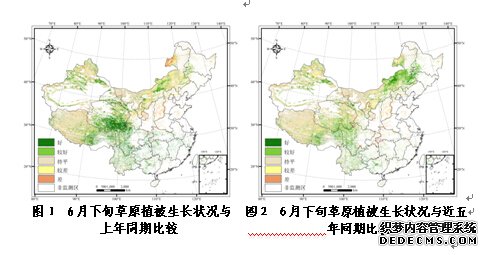
Grassland vegetation growth across the country was generally good in June
Website news The Grassland Supervision Center of the Ministry of Agriculture used satellite remote sensing and ground observation methods, combined with meteorological monitoring information from the National Meteorological Center, to monitor and analyze the national grassland vegetation growth conditions in June of this year. The results showed that: in June, most grasslands across the country received abundant rainfall, and vegetation growth conditions were generally better than the same period in recent years and the same period last year.
1. Meteorological conditions
In June, the country as a whole showed a temperature pattern of hot in the south and cool in the north. Except for a few high-latitude areas such as Hulunbuir in Inner Mongolia, which were affected by low temperatures and insufficient sunlight and where vegetation grew slowly, heat conditions were generally favorable for grassland vegetation growth nationwide. Precipitation in grassland areas across the country was relatively abundant. Among them, grassland precipitation in eastern Xinjiang, central and eastern Inner Mongolia, and western Northeast China was more than 30% above normal, and moisture conditions were relatively favorable for grassland forage growth.
⟦NL> 2. Vegetation conditions
Through comparative analysis of satellite remote sensing images, the national grassland vegetation growth conditions in June were generally better than the same period in recent years and the same period last year. Compared with the same period last year, 29% of grassland vegetation growth conditions nationwide were better, 47% were the same, and 24% were worse; compared with the same period in the past five years, 30% of grassland vegetation growth conditions nationwide were better, 51% were the same, and 19% were worse. Areas with better vegetation growth were mainly distributed in western Northeast China, central and eastern Inner Mongolia, Xinjiang, eastern Qinghai-Tibet Plateau, and central and western Gansu. Areas with worse vegetation growth were mainly distributed in central Tibet and southwestern Inner Mongolia.
From the perspective of major pastoral areas, grassland vegetation growth was relatively good in Hinggan League, Tongliao City, Xilin Gol League, and Ulanqab City in central and eastern Inner Mongolia, but grassland vegetation growth was relatively poor in the eastern Hulunbuir grassland due to low temperatures and insufficient sunlight, and in the western Ordos grassland due to drought and little rain. Xinjiang grasslands generally grew well, among which forage coverage and height in northern Xinjiang grasslands were higher than the same period last year due to abundant precipitation. Qinghai grasslands showed a pattern of better growth in the south and roughly flat but slightly worse growth in the north. Grasslands in eastern and western Tibet grew relatively well, while central Tibet grasslands grew relatively poorly due to drought. Sichuan grasslands generally grew relatively well, among which forage in some areas of northwestern Sichuan entered the flowering period early. Gansu grassland vegetation growth conditions were mainly flat with slight improvement, among which grassland vegetation growth in the central and eastern Hexi Corridor, the Longzhong Loess Plateau area, and central Gannan was better than the same period last year, while the rest of the areas were basically flat or slightly worse than last year.
3. Later situation analysis and recommendations
According to forecasts by the National Meteorological Center, for some time to come, temperatures in most grassland areas across the country will be normal to slightly high, precipitation will be close to the same period in normal years, and meteorological conditions will generally be favorable for forage growth; however, precipitation in western Inner Mongolia, eastern Northwest China, and other places may be more than 20% below normal, and drought conditions may occur in some areas. All localities should reasonably arrange grassland and animal husbandry production management activities according to current forage growth conditions; western Inner Mongolia and other places should do a good job in responding to grassland drought and strengthen grassland-livestock balance management and monitoring and prevention and control of grassland rodents and insect pests.