What causes empty roots in orchids? Cause analysis and solutions
A new red-flowered Cymbidium (Hui orchid) variety with petaloid side lobes, from Guilin, Guangxi. Guilin produces Cymbidium, but good flowers rarely appear there, so producing this butterfly form is truly rare and commendable.
"To grow orchids, first grow the roots" is a saying often on the lips of orchid growers.
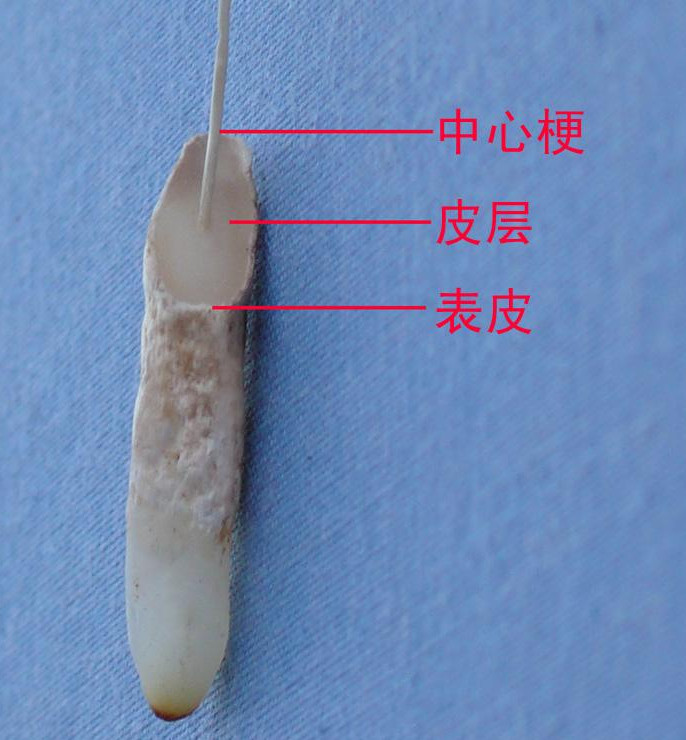
The internal structure of orchid roots is a typical monocotyledon type. The cortical cells are relatively well developed and contain symbiotic root fungi. The cross-section structure can be divided into an outer layer, a middle layer and an inner layer. The outermost layer is the velamen tissue, whose function is to protect the cortex, absorb water, and reduce and protect against the loss of water inside the cortex. The middle layer of the orchid root is the cortical tissue, whose cells are relatively well developed; its main functions are to store water and nutrients and to "digest" the symbiotic fungi. The inner layer of the orchid root is the central cylinder, whose cross-section can in turn be subdivided into the vascular column, formed by the xylem and phloem and the surrounding fibrous tissue, and the pith, composed of thin-walled cells at the center; the water and nutrients absorbed by the root are all transported upward through the vascular bundles of the central cylinder.
Beginners growing orchids often kill them, and after tipping them out of the pot they often find that the orchid roots are nine-tenths rotten and hollow; even veterans who have grown orchids for many years cannot completely eliminate hollow and rotten roots in practice, and sometimes even in orchids that are grown very well, hollow roots may be found when repotting.
It can be said that how to avoid rotten and hollow roots is a subject that orchid growers cannot avoid facing.
So where do the causes of rotten and hollow roots lie?
Our forebears long ago explored this question. The old manuals say, "If a root does not touch the soil, its root will surely become hollow." Under a rough understanding, it seems that orchid roots not making sufficient contact with the growing medium and thus being unable to absorb water is the chief culprit behind hollow roots.
This view has had a profound influence and has been accepted by many orchid growers, ancient and modern.
But is this really so? Probably not!
Orchid growers who have repotting experience know that rotten roots and hollow roots are not necessarily caused by insufficient contact with the growing medium; healthy roots do not necessarily make very sufficient contact with the growing medium either, and even suspended roots completely exposed outside the potting medium are very healthy.
So what is the main cause of rotten and hollow roots?
The answer is simple: microorganisms. If there were no microorganisms, no matter what happened to an orchid root, it would at most become a piece of "dried orchid root" and would never become a rotten or hollow root. This is a truth every modern person understands.
Were the ancients wrong then? Likewise, probably not!
We know that the ancients mostly used mountain soil with strong water absorption and moisture retention but relatively poor air permeability to grow orchids. If the mountain soil did not make good contact with the orchid roots, cavities would form around the roots, and such "cavities" provided a good breeding environment for harmful microorganisms. Although the ancients had no concept of microorganisms, they wisely discovered the microorganism-breeding environment that easily leads to hollow roots, namely "roots not touching the soil."
It seems that people have misunderstood and misinterpreted the ancients' meaning.
Having said all this, how can rotten and hollow roots be avoided?
It is worth learning from the ancients' method, which is "removing the firewood from under the cauldron" - not giving harmful microorganisms any opportunity. Specifically, the following points can be carried out:
1. When introducing plants, be sure to inspect the roots; try not to take seedlings with poor root systems.
2. Choose a growing medium that drains water, retains moisture and allows air flow, creating an in-pot environment suitable for healthy orchid root growth.
3. When tipping orchids out of pots or repotting, act gently, and pay attention to killing pests inside the growing medium. Guard against sudden cold and heat and extreme cold or high temperatures, so as to avoid physical damage to orchid roots.
4. Pay attention to sterilizing the growing medium and pots.
5. Do not apply concentrated fertilizer or raw fertilizer.