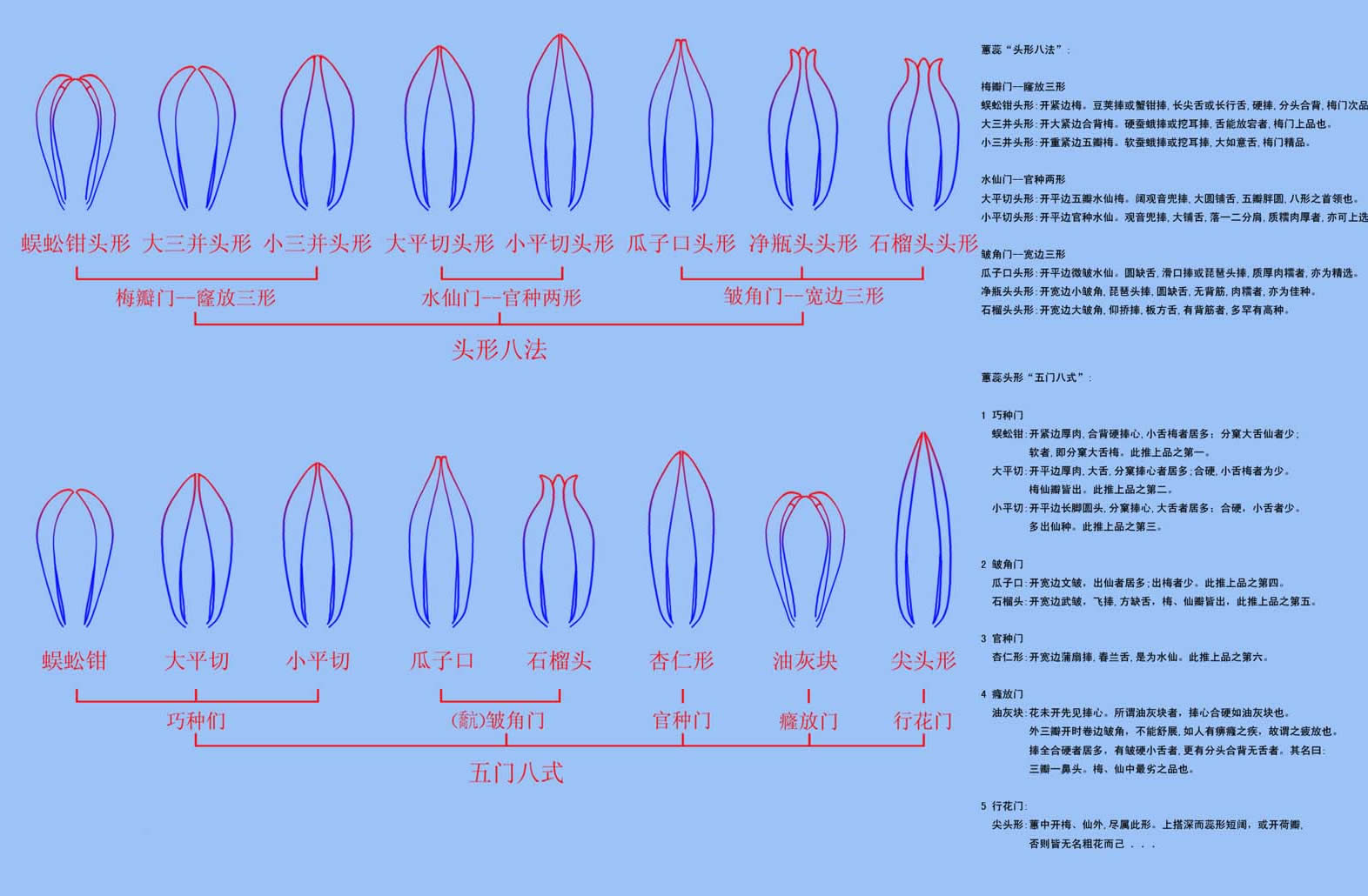
Detailed Explanation of the Eight Head Shapes and the Five Categories and Eight Forms of Cymbidium faberi
The "Five Categories and Eight Forms" of the small bud head shapes of Cymbidium faberi flowers is a summary of valuable experience left by predecessors in selecting superior varieties based on the shape of the small buds of Cymbidium faberi flowers, and is a priceless treasure left to us by our orchid-growing forebears. The "Five Categories and Eight Forms" has spread throughout the world, has had a profound influence in the community, and is an eternal topic often on the lips of orchid enthusiasts. However, because the writings of predecessors were mostly in classical Chinese...
The "Five Categories and Eight Forms" of the small bud head shapes of Cymbidium faberi flowers is a summary of valuable experience left by predecessors in selecting superior varieties based on the shape of the small buds of Cymbidium faberi flowers, and is a priceless treasure left to us by our orchid-growing forebears. The "Five Categories and Eight Forms" has spread throughout the world, has had a profound influence in the community, and is an eternal topic often on the lips of orchid enthusiasts. However, because the writings of predecessors were mostly in classical Chinese, sparing with words, and mixed with numerous specialized terms, jargon and dialect slang, as well as the differences in linguistic context, this has brought great confusion to today's orchid enthusiasts in correctly interpreting them...
The earliest extant written record of the "Five Categories and Eight Forms" of Cymbidium faberi bud head shapes is found in Yuan Shijun's Lan Yan Shu Lue (Brief Account of Orchid Sayings), from the second year of the Guangxu reign of the Qing Dynasty (Bingzi year, 1876 AD). Wu Enyuan's Lan Hui Xiao Shi (A Brief History of Orchids and Cymbidium faberi), completed in the twelfth year of the Republic of China (Guihai year, 1923 AD), also records the "Five Categories and Eight Forms" of the small bud head shapes of Cymbidium faberi flowers. As follows:
"When Cymbidium faberi flowers reach the small bud-row stage, the head shapes fall into five categories, arranged into eight forms, as follows:
Qiao Zhong Category
Centipede Pincer - Mostly opens as tight-edged thick-fleshed outer three petals, united-back hard column, small-lipped plum petal type; fewer open as separated-chamber large-lipped immortal type; the soft ones are separated-chamber large-lipped plum petal type. This is ranked first among superior grades.
Large Flat Cut - Mostly opens as flat-edged thick-fleshed outer three petals, large lip, separated-chamber column; fewer open as united-hard, small-lipped plum petal type; both plum petal and immortal types appear. This is ranked second among superior grades.
Small Flat Cut - Mostly opens as flat-edged, long-stemmed round-headed outer three petals, separated-chamber column, large lip; fewer open as united-hard, small-lipped; mostly produces immortal types. This is ranked third among superior grades.
(Qiao Pi) qiáo Corner Category
Melon Seed Mouth - Opens as broad-edged refined (Qiao Pi); mostly produces immortal types, fewer produce plum petal types. This is ranked fourth among superior grades.
Pomegranate Head - Opens as broad-edged martial (Qiao Pi), flying column with square notched lip; both plum petal and immortal types appear. This is ranked fifth among superior grades.
Guan Zhong Category
Almond Shape - Opens as broad-edged, cattail-leaf column, Spring Orchid lip; this is the narcissus type. This is ranked sixth among superior grades.
Long Fang Category
Oil Putty Lump - The column is visible before the flower opens. What is called an oil putty lump means the column is united and hard like a lump of oil putty. When the outer three petals open, the edges curl and the corners (Qiao Pi), unable to spread out, just like a person suffering from paralysis and impotence, hence it is called Long Fang (retarded opening). Most have the column entirely united and hard; some have (Qiao Pi) hard small lips; still others have split heads, united backs and no lip, called "three petals and one nose." This is the most inferior grade among plum petal and immortal types.
Xing Hua Category
Pointed Head Shape - Among Cymbidium faberi, apart from those opening as plum petal or immortal types, all belong to this shape. If the upper overlap is deep and the bud shape short and broad, it may open as a lotus petal; otherwise they are all nameless coarse flowers.
In addition, there are such names as inverted pine nut shape, jasmine flower shape, startled conch shape, slug head shape, ginkgo shape, sand bean shape, crab pincer shape, bee tail shape, Daoist robe lapel form, olive pit form, incense lamp form, goat horn form, scissors form, and crescent form; they may produce strange flowers, but no fine varieties."
In the "Five Categories and Eight Forms," "category" refers to the class, since they are classified into categories, and "form" needless to say refers to the style. The character (Qiao Pi) must be explained: it is a variant character, with the left half being the traditional character for "qiao" and the right half being the character "pi." Reading half the character gives the sound qiáo. The character (Qiao Pi) is mostly used in Jiangsu-Zhejiang dialect slang to describe the warping and unevenness of flat objects. Some orchid enthusiasts from certain regions may not have an intuitive grasp of the meaning of (Qiao Pi); no matter, you have seen potato chips, right? That thing is a typical (Qiao Pi). Our forebears using this character to describe the flaring and warping of Chinese orchid petals was very apt. After the simplification of Chinese characters, orchid writings mostly replaced (Qiao Pi) with the character "wrinkle." The meaning of "wrinkle" is close to (Qiao Pi), but the uneven form indicated by "wrinkle" still differs from (Qiao Pi), as in the everyday term "wrinkled." For the flaring and warping of Chinese orchid petals, "wrinkle" is far less precise than (Qiao Pi), and reads very awkwardly; it can only be considered a last resort. By comparison, the later term "floating category" is more charming, but here, in order to reflect the "original ecology" of the "Five Categories and Eight Forms," since current character sets do not support it and it cannot be typed, we have no choice but to temporarily use the form "(Qiao Pi)" as a substitute.
In the original text, the term "united back" in the Centipede Pincer section refers to split heads with united backs; "separated chamber" refers to five petals in separate chambers; "the soft ones" refers to the column petals; the term "united hard" in the Large Flat Cut section refers to the split heads with united backs and hard column mentioned in the Centipede Pincer form; "cattail-leaf column" in the Almond Shape section refers to a column with weakened male function, with the column tip slightly hooded or white-edged, rather similar to the bound edge of the cattail-leaf fans used for cooling in the past; "Spring Orchid lip" refers to the lip petal of an ordinary common Spring Orchid. We know that the floral organs of Cymbidium faberi are far more developed than those of Spring Orchid; as for the lip petal, the length of an ordinary Cymbidium faberi lip is about close to 3 times that of an ordinary Spring Orchid. Therefore, compared with Spring Orchid, when our forebears selected Cymbidium faberi flowers, their requirements for the lip (labellum) were noticeably lowered, believing that as long as the Cymbidium faberi lip reached the length-to-width ratio of an ordinary Spring Orchid lip, it could enter the ranks of fine flowers; the oil putty lump in the Oil Putty Lump section refers to the lime mixed with tung oil in the past, mostly used as a putty for repairing and filling the gaps in wooden planks such as wooden boats, which is probably no longer used today; the ailments of paralysis and impotence is a combined term for arthralgia syndrome and urinary retention. In traditional Chinese medicine, arthralgia syndrome is a disease of limb pain or numbness caused by wind, cold, dampness, etc., that is, today's rheumatoid arthritis and rheumatoid arthritis. Urinary retention is today's rickets.
In summary, the "Five Categories and Eight Forms" are explained as follows:
Qiao Zhong Category
Centipede Pincer - After the petals spread, it mostly opens as tight-edged thick-fleshed outer three petals, split heads with united backs and hard column, and small-lipped plum petal type; the probability of opening as separated-chamber column and large-lipped narcissus type is relatively low. For this form, after the small bud spreads its petals, if the column petals are relatively soft, what opens is a five-petal separated-chamber large-lipped plum petal type. The Cymbidium faberi flowers of this bud form should be counted as first among superior grades.
Large Flat Cut - After the petals spread, it mostly opens as flat-edged thick-fleshed outer three petals, large lip, and separated-chamber column; the probability of opening as split heads with united backs and hard column, and small-lipped plum petal type is relatively low. Among the blooms of this form of small bud after the petals spread, there are both plum petal and narcissus types. The Cymbidium faberi flowers of this bud form should be counted as second among superior grades.
Small Flat Cut - After the petals spread, it mostly opens as flat-edged, long-stemmed round-headed outer three petals, separated-chamber column, and large-lipped central chamber; the probability of opening as united-back hard column and small-lipped central chamber is relatively low. After the petals spread, this form of small bud mostly opens as narcissus type. The Cymbidium faberi flowers of this bud form should be counted as third among superior grades.
(Qiao Pi) qiáo Corner Category
Melon Seed Mouth - After the petals spread, it opens as broad-edged outer three petals with petal tips slightly flaring and warping; the probability of opening as narcissus type is relatively high, and the probability of opening as plum petal type is relatively low. The Cymbidium faberi flowers of this bud form should be counted as fourth among superior grades.
Pomegranate Head - After the petals spread, it opens as broad-edged outer three petals with obvious flaring and warping, cat-ear column, and square notched lip. Among the blooms of this form of small bud after the petals spread, there are both plum petal and narcissus types. The Cymbidium faberi flowers of this bud form should be counted as fifth among superior grades.
Guan Zhong Category
Almond Shape - After the petals spread, it opens as broad-edged outer three petals, cattail-leaf column, and Spring Orchid lip, belonging to the narcissus type. The Cymbidium faberi flowers of this bud form should be counted as sixth among superior grades.
Long Fang Category
Oil Putty Lump - The column petals can be seen before the outer petals have opened. The so-called oil putty lump means the column petals are stuck together like a lump of oil putty. When the outer three petals open, the edges curl and the corners warp, unable to spread out, just like a patient suffering from rheumatism and rickets, hence it is called Long Fang. After the petals of this form of small bud spread, the column petals often are completely stuck together; some have flaring, twisted, hard and small lips; still others have the nose and lip stuck together with no lip petal, called "three petals and one nose." The Cymbidium faberi flowers of this bud form are the worst grade among the plum petal and immortal types.
Xing Hua Category
Pointed Head Shape - Among Cymbidium faberi, apart from those opening as plum petal and narcissus types, all belong to this shape. If the upper overlap is deep and the bud shape short and broad, it may open as a lotus petal; otherwise they are all nameless coarse flowers.
In addition, there are also such names as inverted pine nut shape, jasmine flower shape, startled conch shape, slug head shape, ginkgo shape, sand bean shape, crab pincer shape, bee tail shape, Daoist robe lapel form, olive pit form, incense lamp form, goat horn form, scissors form, and crescent form; they may also open as strange flowers, but there are no good varieties.
It is not hard to see that the "Five Categories and Eight Forms" of Cymbidium faberi small buds is a tree-structured framework, with five main branches, namely: Qiao Zhong Category, (Qiao Pi) Corner Category, Guan Zhong Category, Long Fang Category, and Xing Hua Category, five categories in total. These five categories each have branches; among them, Qiao Zhong Category has three branches, namely: Centipede Pincer, Large Flat Cut, and Small Flat Cut; (Qiao Pi) Corner Category has two branches, namely: Melon Seed Mouth and Pomegranate Head; Long Fang Category has only one branch: Oil Putty Lump; Xing Hua Category also has only one branch: Pointed Head Shape. Together they form eight forms.
So, where does the "Five Categories and Eight Forms" of Cymbidium faberi small bud head shapes come from? Tracing it to its source, there is something wonderfully similar in the "Eight Methods of Head Shapes" for Cymbidium faberi buds by Shen Peilin of Xiaoshan, recorded in the appendix of Xu Jilou's Lan Hui Tong Xin Lu (Record of Orchid and Cymbidium faberi Hearts) from the fourth year of the Tongzhi reign of the Qing Dynasty (1865 AD):
"Plum Petal Category - Long Fang Three Shapes
Centipede Pincer Head Shape: Opens as tight-edged plum petal. Bean-pod column or crab-pincer column, long pointed lip or long floating lip. Hard column, split heads with united backs; a secondary grade in the plum petal category.
Large Three-Joined Head Shape: Opens as large tight-edged united-back plum petal. Hard silkworm-moth column or ear-pick column; if the lip can hang loose, it is a superior grade in the plum petal category.
Small Three-Joined Head Shape: Opens as double tight-edged five-petal plum petal. Soft silkworm-moth column or ear-pick column, large ruyi lip; a fine grade in the plum petal category.
Narcissus Category - Guan Zhong Two Shapes
Large Flat Cut Head Shape, opens as flat-edged five-petal narcissus plum petal. Broad Guanyin hood column, large round spread lip, five petals plump and round; the leader of the eight forms.
Small Flat Cut Head Shape, opens as flat-edged Guan Zhong narcissus. Guanyin hood column, large spread lip, with one or two tenths drooping shoulders; if the texture is glutinous and the flesh thick, it can also be an upper choice.
(Qiao Pi) Corner Category - Broad Edge Three Shapes
Melon Seed Mouth Head Shape: Opens as flat-edged slightly (Qiao Pi) narcissus. Round notched lip, smooth-mouth column or pipa-head column; if the texture is thick and the flesh glutinous, it is also a select grade.
Pure Vase Head Shape: Opens as broad-edged small (Qiao Pi) corner, pipa-head column, round notched lip; if there is no dorsal vein and the flesh is glutinous, it is also a fine variety.
Pomegranate Head Shape: Opens as broad-edged large (Qiao Pi) corner, upward-arched column, flat square lip; if there is a dorsal vein, it is mostly rare and a high-grade variety."
If we analyze it, we will find that the essence of the "Eight Methods of Head Shapes" is "Three Categories and Eight Shapes," namely: Plum Petal Category - Long Fang Three Shapes: Centipede Pincer Head Shape, Large Three-Joined Head Shape, Small Three-Joined Head Shape; Narcissus Category - Guan Zhong Two Shapes: Large Flat Cut Head Shape, Small Flat Cut Head Shape; (Qiao Pi) Corner Category - Broad Edge Three Shapes.