The world's only orchid species, the Danxia orchid, appears in Renhua, Shaoguan
This variety has green stems and green flowers, with a large, beautiful and impressive flower shape.
The peculiar "Danxia orchid" never grows leaves in its entire life
The Danxia orchid is a saprophytic orchid belonging to the tribe Calypsoeae in the subfamily Epidendroideae of the family Orchidaceae. Unlike other orchids, its morphological features, such as the double pouch-like structure at the base of the lip and the "Y"-shaped appendage on the lip, are clearly distinct from all known genera in Orchidaceae.
The Danxia orchid is also completely different from other leafless flowering plants in the plant kingdom. Researcher Xing Fuwu of the South China Botanical Garden, Chinese Academy of Sciences, told reporters: "Other leafless flowering plants actually have both flowers and leaves, but their flowers and leaves appear at different times. When they bloom, no leaves are seen; when they grow leaves, no flowers are seen. Flowers and leaves grow in different seasons. But the Danxia orchid never grows leaves throughout its entire life, so it is extremely rare."
Exhausting the strength of a lifetime just for a brief burst of bloom lasting a little over ten days. A unique orchid that had hidden deep in the red cliffs of Danxia for tens of millions of years was accidentally discovered by a backpacker in the Danxia Mountain World Natural Heritage Site. Yesterday, the Renhua County government, together with relevant scientific research institutions, held a press conference to announce to the media the process of discovering the world's one-of-a-kind flower-bearing, leaf-less "Danxia orchid."
Professor Liu Zhongjian, an orchid expert with the International Union for Conservation of Nature, told reporters that this distinctive orchid, entirely pale yellow and without a single leaf, has so far been found in the world only in Danxia Mountain, Renhua County, Shaoguan City, and has been named the "Danxia orchid." The discovery of the "Danxia orchid" supplements the data on the tribe Calypsoeae and provides new evidence for research on the origin of the East Asia-North America floristic region and for the study of orchid evolution.
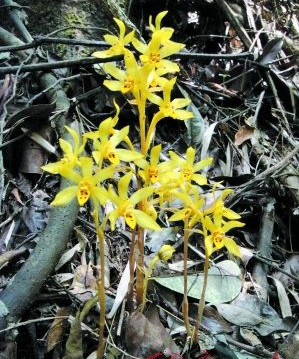
Growth patterns
Its growing location differs every year, as if it had legs and appeared and disappeared mysteriously
The discovery of the Danxia orchid originated from a deep-mountain backpacking trip by Renhua's veteran backpacker Zhu Jiaqiang. On May 1, 2010, Zhu Jiaqiang and several friends went deep into the hinterland of Danxia Mountain to "scout the route." Every place they reached was a remote deep mountain rarely visited by people. Suddenly, he discovered something unusual in a small valley. It was a small clearing in a bamboo grove, covered with dead leaves and withered vines. Within an area of more than ten square meters, there was not a single plant, yet in the carpet of dead leaves, about 6 pretty orchids were miraculously growing.
As a local veteran backpacker, Zhu Jiaqiang had walked through many no-man's-land areas and remote old-growth forests of Danxia Mountain, but "had never seen an orchid that grew so strangely." This plant had only fresh flowers and no green leaves. The flower color was especially vivid, entirely golden yellow. The fully blooming delicate flowers formed a sharp contrast with the withered branches and fallen leaves all over the ground, immediately attracting Zhu Jiaqiang.
After taking photos with his mobile phone, he left the deep mountain full of doubts. After returning home, Zhu Jiaqiang posted the photos he had taken online, but after seeing them, all the orchid enthusiasts and researchers were unable to state the exact identity of these strange orchids.
In April 2011, Zhu Jiaqiang, driven by strong curiosity, came again to the mountainous area where he had discovered the strange orchids the previous year. This time, however, he found that in last year's orchid growing site there was not a single orchid this year. Old Zhu unwillingly searched the surroundings and finally, to his delight, found more than 20 strange orchids in another valley about 1 km away. Researchers later found that the growing locations of the strange orchids differ every year. As if they had grown legs, they "mysteriously" popped up in different areas.
Zhu Jiaqiang also carefully picked one strange orchid and planted it in a flowerpot at home. But in his daily observations, he discovered an even stranger phenomenon. Apart from the short flowering period of a little over ten days when the flower stem and flowers could be observed above the soil, at all other times nothing could be seen except the soil in the flowerpot.
Survival rules
Without leaves it cannot photosynthesize; it draws nutrients with the help of fungi
A research team led by Professor Liu Zhongjian of the Shenzhen Orchid Conservation and Research Center and Researcher Xing Fuwu of the South China Botanical Garden, Chinese Academy of Sciences, conducted systematic research on the strange orchid discovered by Zhu Jiaqiang. According to the introduction, the number of wild Danxia orchids currently found is very small. Since its discovery, the total number has been fewer than 100 plants, and this year only 21 plants were found. The Danxia orchid prefers to grow in humid, shady, sparsely visited places in the mountains, and artificial transplanting makes it very difficult to survive. At present, it has been found globally only in Renhua, where it is unique and extremely precious. Liu Zhongjian said that the Danxia orchid is a species with a very narrow distribution. According to the relevant standards of the International Union for Conservation of Nature, it is a critically endangered species.
Because the Danxia orchid is usually very difficult to find, and only during the flowering period does its mysterious figure faintly appear, the Danxia orchid also has the nickname "ghost orchid." This strange orchid has no leaves and cannot obtain the large amount of nutrients needed for growth through photosynthesis. It can only maintain growth by stealing nutrients through fungi in the surrounding environment.
The researchers wittily compared it by saying: "The Danxia orchid is like the leader of a beggar gang, completely relying on countless fungi around it as its 'disciples' to 'beg for alms,' stealing nutrients from the environment for it to maintain survival. It and the fungi have a mutually beneficial and interdependent relationship." Because its growth depends extremely heavily on the fungi in the unique Danxia landform, it is very difficult to keep alive after humans transplant it elsewhere.