Introduction and Appreciation of the Chunlan Variety Zishou Jinzhang
Among Chunlan (Cymbidium goeringii) there are also records of Jinlan. In "A Brief History of Orchids and Huilan," the Chunlan plum-petal variety "Zishou Jinzhang" is described: "The three petals have large heads and fine tapering, tight edges, separated sections with semi-hard hooded holding petals, a small round lip, level shoulders, and a long stem. What is remarkable is that it is golden yellow like rapeseed flowers, while the stem is red like vermilion lacquer. Truly a rare variety, also called Jinlan. Recently only the Jiufeng Pavilion has it." No illustration. "A Brief History of Orchids and Huilan"...
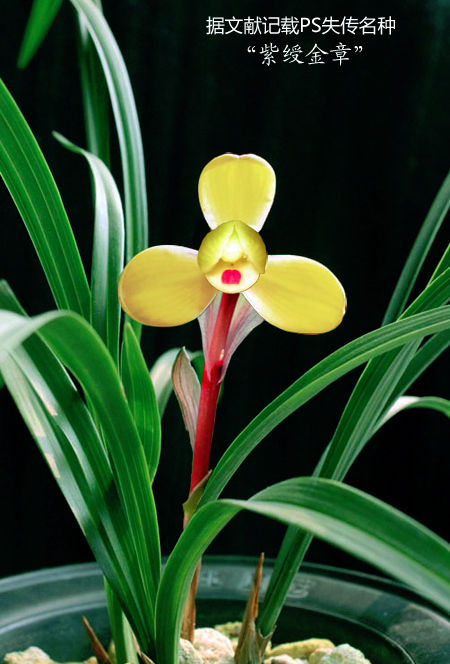
1, In 1923, "Zishou Jinzhang" was recorded in "A Brief History of Orchids and Huilan": The three petals have large heads, fine tapering with tight edges and separated sections, semi-hard holding petals,
a small round lip, level shoulders, a long stem; what is remarkable is that it is golden yellow like rapeseed flowers, while the stem is red like vermilion lacquer. Truly a rare variety, also called Jinlan. Recently
only the Jiufeng Pavilion has it.
2, In 1937, the Japanese-published "Orchid Spectrum" by Ohara Eijiro (courtesy name Ryusui), page 68, states: "Zishou Jinzhang," also called
"Jinlan." The flower form has three petals with large heads, tapering roots with tight edges, semi-hard holding petals, a small round lip, level shoulders, and a long stem; the flower color is golden yellow,
like rapeseed flowers; the flower stem is vermilion. Truly a distinct variety.
Current situation: several years ago it came to the Keikado, but the flower has not yet been seen. Because it is a fine-leaf type, there is concern that it may be a different variety.
3, In 1956, "Orchids" by Yao Yuyu (original character cannot be typed) and Zhu Youren, in the table of major orchid variety morphological descriptions and their
growth habit records: "Zishou Jinzhang" leaf buds emerge on May 23, bud sheaths are rose red, leaf posture is fully drooping, leaves are lusterless,
leaf width 2.5 cm (unclear what unit of measurement was used at the time), leaf length 26.4 cm, leaf tips are sharp, leaf veins are shallow,
leaf texture is thin, and the base sheaths are low.
4, In 1999, "Three Hundred Questions on Chinese Orchid Art," page 208, states: This variety is recorded in "A Brief History of Orchids and Huilan." The outer three petals have large round heads,
fine tapering roots, tight edges, level shoulders, semi-hard hooded holding petals, and a small round lip. The flower stem is tall, with a stem color red like vermilion lacquer. The outer three petals and holding petals are both
golden yellow like rapeseed flowers. This variety is truly a rare treasure of extraordinary color. According to the record in the Japanese book "Chinese Chunlan," Mr. Matsumura has this variety.
5, In 2000, "Chunlan Spectrum," page 100, records: Petal type: plum petal. History: selected in the 1910s. Characteristics: the outer
three petals have round heads with fine tapering and tight edges, semi-hard holding petals, a small ruyi lip, level shoulders, and golden yellow color. The scape is tall, and the sheath is like vermilion lacquer. The flower form is well-proportioned,
and the color is brilliant.
6, In the second half of 2002, I learned from a famous orchid grower that "Zishou Jinzhang" had returned to China (he only told me this when I asked about the whereabouts of "Zishou Jin
zhang"). "Zishou Jinzhang" was brought back from Japan in 2000 by a well-known orchid grower through special connections, a few seedlings. Because this variety is not very numerous in Japan, it was always blocked from export.