Elder Feng Rumei, Titan of the Orchid World, Passes Away: The Orchid Community Mourns the Loss of a Master
Mr. Feng Rumei, a famous Chinese orchid cultivator, a Chinese orchid culture expert, and a senior veteran, suffered a sudden cerebral hemorrhage on October 9, 2013. Despite medical treatment, he passed away peacefully at 19:00 on October 15 at the age of 92. The Life of Elder Feng Rumei: Mr. Feng Rumei was born in Huzhou, Zhejiang, in 1922. His granduncle Feng Xizhai...
The Life of Elder Feng Rumei
Mr. Feng Rumei was born in Huzhou, Zhejiang, in 1922. His granduncle, Mr. Feng Xizhai, was a famous orchid cultivator in Huzhou during the early Republic of China period. Mr. Feng came from a family of orchid and cymbidium growers, and was immersed in and influenced by orchids from childhood. When he grew up, he went to Shanghai to study, but later returned home and left school due to lung disease. During his convalescence, he began growing orchids.
He associated with orchid enthusiasts from Shaoxing such as Zhu Zhangfu, Zhu Youren, Liu Shaoquan, and Liu Shaode, and also sought instruction from famous orchid growers such as Jiang Dongfu of Wuxi, Yao Xuanyu of Suzhou, Yang Huaibai, Yao Ximin, He Nailong, Wang Qingpei, Xu Dugong, and Liu Hanlin of Shanghai, and Tao Juru and Zhang Wenchong of Jiaxing.
He has been cultivating orchids for more than 60 years now. Though advanced in years, he remains hale and clear-minded. In cultivating orchids and cymbidiums, he advocates the ancient methods: he prefers humus soil for growing them and likes to plant Selaginella uncinata on the surface of the pot, believing that without this one cannot fully appreciate the elegant beauty of a whole pot of orchids and cymbidiums. Even though he knew perfectly well that using expanded clay pellets, orchid stone, and Xiantu soil gives excellent results, he was unwilling to change because he was not accustomed to it. Throughout his life he valued orchids and slighted cymbidiums, which was simply his nature. In appreciation and evaluation, he was always deliberately exacting, insisting on the traditional orthodox form and strictly demanding excellence in flower color, flower quality, and flower persistence, so very few met his approval, and what he kept was even fewer.
In the early 1960s, he wrote three volumes of orchid manuscripts, which remained sealed for decades. Urged by orchid friends in Huzhou to publish them, and with their vigorous assistance in typing, proofreading, and typesetting, "Nai'an Ju Orchid Cultivation Notes" finally came out in early 2003. Mr. Feng was modest, considering it mere traces in the snow and mud, perhaps worth keeping as a memento.
In old age, Mr. Feng had a peaceful mindset, was content and happy, and found peace in seeking nothing. Hence he once named two flowers "Contentment" and "Seeking Nothing." After turning 80, he also changed the name of his orchid room to "Nai'an Ju," hoping only for peace and happiness.
Appendix: An article by Yifan Lansheng published in the Zhejiang Orchid Association's [Guolan] magazine
Visiting the Great Orchid Grower Feng Rumei 2009-02
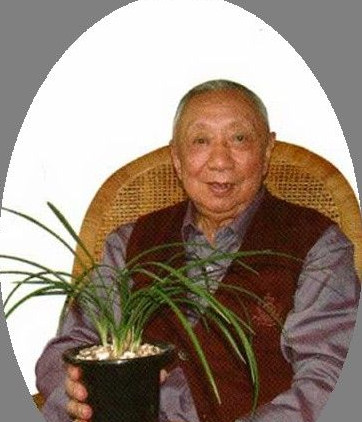
People say that strolling through a garden reveals a new scene with every step; I say that visiting a person brings a new astonishment with every step.
The autumn day was pleasant. I went straight from Hangzhou to Huzhou to visit the orchid cultivation senior Feng Rumei. In today's China, among those still active in the orchid world, how many can compare with him in either orchid artistry or seniority?
Old Feng was a most engaging talker, truly astonishing at every step, and so this became a record of three astonishments.
First astonishment: 70 years of growing orchids, devoted heart unchanged to the end. Old Feng was born in 1922. At 17, he returned to his hometown of Huzhou to recuperate from lung disease and began to take pleasure in growing flowers. Old Feng recounted: in childhood, influenced by his late uncle Mr. Xizhai and his maternal grandfather Mr. Zhou Shaofu, he loved growing flowers and plants, handling antiques, and keeping insects, fish, birds, and animals. Later, he went to Shanghai's Yiyuan to pay respects to the great Wuxi collector Mr. Jiang Dongfu, and visited the Xiangcao Ju at Yanqiao, Xishuiguan, Wuxi. He admired the orchids and cymbidiums, and was also shown the entire antique collection. After seeing it, he was dumbstruck and marveled at it as the height of excellence. He immediately declared that having seen such perfection today, he would no longer collect antiques and would henceforth take pleasure only in orchid cultivation. Thereafter, Old Feng often kept orchids and cymbidiums as companions and gradually collected some famous varieties.
At that time it was precisely during the War of Resistance, and the orchids of Jiangsu and Zhejiang suffered a great calamity. When the Japanese soldiers came, Zheng Tongmei, for safety's sake, took refuge in Shanghai, and all his orchids and cymbidiums were buried pot and all in the courtyard in the countryside. In 1940 Zheng Tongmei died. Following the instructions in Mr. Jiang Dongfu's letter, I spared no expense to seek out the orchids and cymbidiums Zheng Tongmei had left behind, searching for the famous cymbidium Dakui Su. I therefore went with others to Zheng Tongmei's former residence in Shuanglin, and after many searches, found nothing in the end. The famous cymbidium of a generation, Dakui Su, was lost to the world forever. Speaking of this, Old Feng appeared very sorrowful.
With reform and opening up and the advent of a prosperous era, Old Feng also rallied his forces anew. Old Feng said: in this round of orchid growing, I strove for famous varieties, so the cultivars are better than those planted before. In the autumn of 1984, Old Feng planned and established the Huzhou Phoenix Orchid Garden, which became the first private collectively invested professional orchid unit in Jiangsu and Zhejiang. In 1995 the Huzhou Orchid Association was established, and Old Feng served as its president. The current association president, Chen Guanshan, said: Old Feng made great contributions to vigorously promoting orchid activities and to revitalizing the Huzhou orchid industry.
By rough count, Old Feng has been growing orchids for a full 70 years. Although it was interrupted several times by calamity, his love for orchids remained consistent, never pausing for a moment.
Second astonishment: people grow orchids to stay forever young; orchids keep people long-lived. Old Feng recounted: I am old indeed, but fortunately my eyes are bright, my body is healthy, tea tastes sweet, and food smells fragrant. Seeing him, these words were no exaggeration. Old Feng grows orchids and takes pleasure in them, calling it "playing with orchids." He has a famous saying: people grow orchids, and orchids nourish people. This saying highly summarizes Old Feng's mindset and philosophy in growing orchids and fully embodies his idea that orchid growing and health preservation are consistent with each other. Old Feng is 87 this year, speaks with abundant vigor, and walks with a free and easy stride, which cannot but serve as proof. He was frail in childhood and suffered from lung disease, yet now he is healthy and long-lived, which cannot but owe something to orchid growing.
Speaking of the relationship between growing orchids and preserving health, Old Feng said: growing orchids can cultivate one's character, and this is true. The orchid's character is noble and pure, enjoying its own fragrance in solitude, and it can delight the eye and gladden the heart and elevate one's character. But more specifically, growing orchids can nourish the mind, and the key lies in the two words "calm the mind." This is the insight from Old Feng's lifetime of growing orchids. Only when a person is calm and peaceful can he grow orchids well; otherwise he cannot. This is because orchids grow slowly and often do not bloom for several years, yet one must still tend them carefully. This is a test of a person's patience and a cultivation of patience. When orchids are grown well, patience is cultivated as well. Through successive political movements, Old Feng endured shocks and still survived, and he felt that growing orchids gave him a heart of forbearance, enabling him to think things through, look at things broadly, and be tolerant.
Old Feng grew orchids in his residence, which he named Nai'an Ju, meaning tranquility and ease. No matter how cold the wind and rain outside, once he entered the orchid room and was with the orchids, he felt tranquil and at ease. Old Feng said he liked to name orchids. Whenever he cultivated a good flower, he could not contain his joy and had to give it a good name. When orchid friends cultivated good flowers, he was also happy to give them a fragrant name. Among the Chunlan orchids he cultivated and named, the most influential include "Contentment," "Seeking Nothing," and "Biyue." He also named flowers for orchid friends such as "Guanzhi" and "Qifeng," each one a free expression of "calming the mind." The orchids and cymbidiums grown in Nai'an Ju were also mainly plain-hearted varieties. Old Feng lived in seclusion in the city with a plain and simple heart, selecting varieties to grow, calmly growing orchids, and growing orchids to calm the mind, plain and peaceful, one might say he attained the true essence of orchid growing.
Growing orchids naturally requires hands-on work: watering, moving pots. But though the hands move, the mind is still. The body moves while the mind is calm, a combination of movement and stillness. Sitting at the desk with orchids as companions, letting one's gaze caress the orchids, body and mind immersed in their delicate fragrance, one enters into a kind of exchange and dialogue with the orchids. Growing orchids in this way brings both orchid growing and longevity, and undoubtedly leads to a long life.
Third astonishment: refined in skill yet not bound by antiquity, with thoughts ever new. Old Feng was born into a wealthy family and recited poetry and classical prose from childhood, giving him a deep foundation in traditional Chinese learning. Entering his humble room, though there were modern appliances, the table and cabinets were still old-fashioned, and especially the thread-bound books piled on the table brought a rush of ancient style.
For decades, while growing orchids, Old Feng carefully studied ancient orchid texts. This not only improved his skills in growing and identifying orchids but also deeply immersed him in orchid culture. He said: there are not many books specifically recording orchids and cymbidiums; those transmitted to the present from the Song, Ming, and Qing dynasties to modern times number about 40 kinds, some of which are still handwritten copies. Old Feng carefully read all the books and in the early 1960s made summaries of their contents. Besides his own study and research, he also intended to enable fellow orchid enthusiasts to hold this one volume and thereby know the general outline. The excerpted contents were divided into aspects such as morphology, evaluation, identification, cultivation, and others, emphasizing Jiangsu and Zhejiang orchids and cymbidiums while being brief on Jianlan. Fortunately the original manuscript was preserved, and in 2003 the orchid book "Nai'an Ju Orchid Cultivation Notes" was published. Old Feng's orchid-growing skills came from two sources: transmission from ancient texts and his own practice. He learned from antiquity without being bound by it, being practical and bringing in new ideas. Speaking of scientific and technological orchid growing, although Old Feng adhered to traditional methods, he did not reject or criticize it, believing it was the general trend and the inevitable future.
Although Old Feng was advanced in years, he could often be seen at orchid exhibitions in various places. He liked to make orchid friends, often went out to visit orchid gardens, and was often visited by orchid friends. When speaking of new varieties and people in the orchid world, he was well informed and quick-minded, astonishing people endlessly. He prided himself on being old but not muddled: a person grows old, but is not muddled. Now, his grandson Feng Tian'e has established the orchid garden Xiangcao Ju, and Old Feng, delighted that there is a successor in orchid growing, works hard to support him.
Speaking of the current sluggish orchid market, Old Feng had his own views: first, the sluggish orchid market is a return to normal; some varieties may not have fallen far enough and still have room to decline, returning to the state of 2003 and 2004. Second, this can encourage orchids to be grown in large pots so that good flowers can bloom. Dividing them too frequently, with just a few plants per pot and seeking quick success and instant benefit, cannot produce strong, good flowers. Third, at a few hundred yuan per plant and not even a thousand yuan for a pot, everyone can afford them and enjoy them, and only then can orchids enter thousands of households. Whether marketized or industrialized, orchids are by nature meant for people to enjoy. Growing orchids and enjoying orchids, that is life, that is culture, that is industry.
The three astonishments are in fact three respects: admiration for the orchid-growing realm and life of the senior Feng Rumei.