A Detailed Guide to the Propagation Methods and Care Techniques of the Giant Spider Lily
The giant spider lily has a sturdy, handsome plant form and elegant, pure-scented flowers, making it a large potted flower for decorating halls and meeting venues. Also known as Shiba Xueshi, Wenzhu Lan and White-flowered Spider Lily, it is a perennial evergreen herbaceous plant of the Amaryllidaceae family and the genus Crinum. It has a tunicated bulb, long and cylindrical. The leaves are basal and sword-shaped, mostly densely arranged in a rosette at the top of the bulb, with wavy edges. The plant height is about 1 m. The scape emerges from the leaf cluster, bearing an umbel subtended by two large spathes, with more than 20 flowers; the perianth tube is slender and upright, and fragrant. The flowering period is mostly in summer, and under conditions of sufficient water and fertilizer and moderate temperature and humidity, it can bloom continuously all year round. Article from: http://www.yuhuagu.com/
The genus contains about 100 species. Among the commonly cultivated ornamentals are: the red-flowered giant spider lily, with the inner surface of the flower tube white or light red and the outside purplish red, native to Sumatra. The pink-flowered giant spider lily, with strap-shaped, leathery, bright green leaves and pinkish white flowers, native to South Africa. The creamy-yellow giant spider lily, with a scape about 70 cm tall and usually 4 flowers, native to North America. The southwestern giant spider lily, with salverform white flowers tinged with red, native to Yunnan, Guangxi and Guizhou in China, as well as Vietnam to India and Malaysia, growing on sandy riverbeds. The giant spider lily is native to tropical Asia, and grows wild on Hainan Island, China.
The giant spider lily likes warm weather and fresh, humid air, and avoids scorching sun in high temperatures, while requiring sufficient light at medium and low temperatures. The suitable growth temperature is 18°C to 22°C, and the winter room temperature must not be lower than 5°C. For potting, a sandy culture soil with high humus content, loose fertility and strong permeability is suitable. Plants of the genus Crinum are mostly distributed in tropical and subtropical coastal areas, so they are relatively tolerant of saline-alkaline soil.
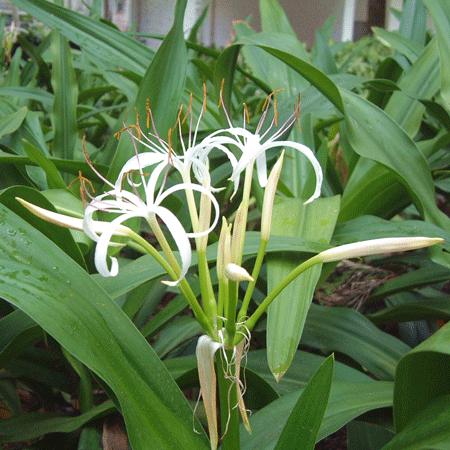
The giant spider lily is usually propagated by sowing and division. Sowing should preferably be done immediately after harvest, using sandy culture soil as the substrate, maintaining 20°C to 25°C; germination takes about 2 weeks, and it takes 3 to 4 years of care to bloom. Because seeds are not easy to mature under greenhouse potted conditions, and some species do not set seed, such as the red-flowered giant spider lily, division is usually the main method. In early spring or late autumn, along with repotting and changing the soil, separate the offsets produced around the mother plant, taking care not to damage the roots, and plant them separately. Most offsets have no roots, so they need to be handled with plain sand or vermiculite in the same way as ordinary softwood cuttings; in a warm, lightly shaded and humid environment, they root in about 1 month or more. After the cuttings take root and survive, first plant them in a small pot with ordinary culture soil. Plant the seedlings not too shallowly, just deep enough that the bulb is not visible, and in subsequent years use fertilized culture soil, placing some crushed hoof pieces or bone meal and other slow-release fertilizer at the bottom, and move them into larger pots for care. The giant spider lily has a strong root system and grows rapidly, and during the growing period it requires sufficient water and fertilizer; keep the potting soil and surrounding environment warm and moist at all times, guard against waterlogging, and apply liquid fertilizer once every two weeks.