Cultivation and Care Methods for String of Pearls (Senecio rowleyanus)
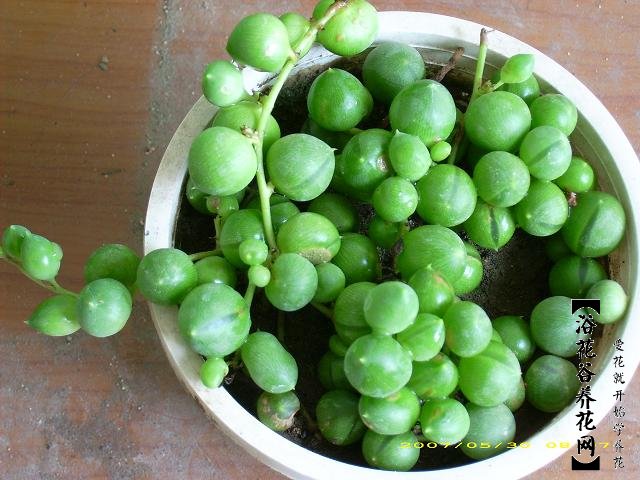
String of Pearls is a perennial trailing flowering plant. It is also commonly called watermelon rind, watermelon string of pearls, and so on. String of Pearls has oval spherical succulent leaves, pale green, alternately arranged; the flowers are pale yellow-white or pale purple, small and lovely. It is generally grown in pots to admire the hanging bead-like stems, which after three to four years can reach more than one meter in length, remaining lushly green all year round, and is deeply loved by home gardeners.
Cultivation key points: Its habits are quite tough, and in cultivation it will grow well as long as you pay attention to the following points:
1. Because the leaves are succulent and juicy, it is drought-tolerant. When watering during cultivation, it is better to keep it dry than wet; this is one of the keys to success. When the weather is dry, you can mist the leaves and stems more often to make up for the lack of water and keep the beads green and plump. It prefers partial shade; scorching sun may burn the beads, while too little light will make growth weak.
2. The plant's root system is very shallow, so it can be planted in a shallow pot. Generally, use a piece of tile to cover the bottom hole, and spread a layer of coal cinders or coarse sand to increase aeration and drainage; for the soil, it is best to use leaf mold mixed with a certain amount of sand, with a soil-to-sand ratio of about 1:3.
3. It likes warmth and humidity, is relatively cold-tolerant and heat-tolerant, and the most suitable temperature is around 20°C~28°C. Growth is slow at both high and low temperatures; especially in a high-temperature environment above 30°C it almost goes dormant, so watering and fertilizing should be reduced, otherwise the roots are prone to rot--this is also one of the keys to successful cultivation.
4. In spring and autumn, when growth is vigorous, fertilizer should be applied "diluted and often"; frequently spraying the leaf surface with 1-3‰ nitrogen fertilizer and potassium dihydrogen phosphate helps make the beads greener and plumper and improves their ornamental value.
5. There are few pests and diseases. Aphids in spring are one of them; remove them promptly or spray 1500-fold omethoate to kill them. Mites in summer and autumn are another; use 1000-fold dicofol to kill them. Pay attention to ventilation and increase leaf surface humidity, which can reduce mite infestation.
6. It can be propagated by cuttings. The stems and vines easily produce aerial roots; in spring and autumn, cut off a few segments and bury half of them in sand or loose soil, keeping them moist but not waterlogged, and they will soon take root for planting.
Article source: http://www.yuhuagu.com/