A detailed guide to the cultivation methods of Cymbidium sinense, teaching you to grow Cymbidium sinense with ease
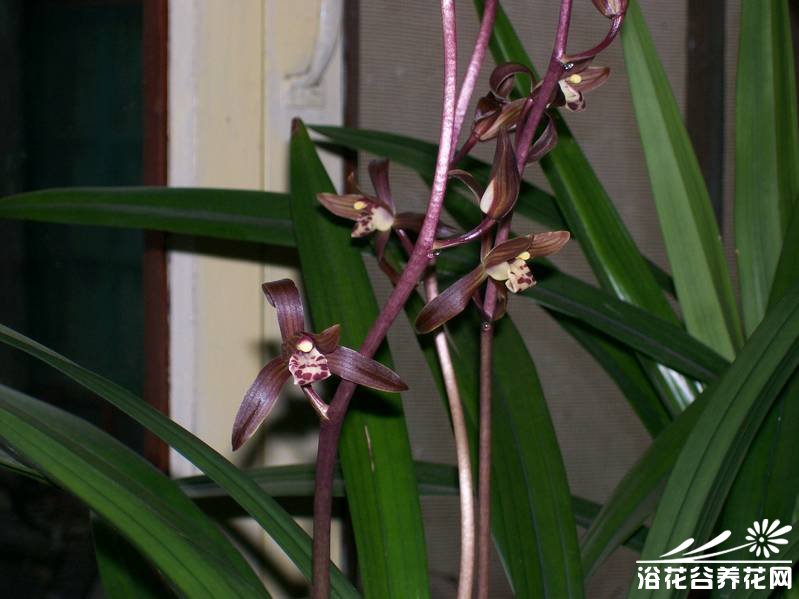
Cymbidium sinense is also known as Baosui Orchid, Baisui Orchid, and Fengsui Orchid. The leaves of Cymbidium sinense are broad, generally 2—4.2 cm wide and about 25—80 cm long. 2—5 leaves grow on the pseudobulb. The pseudobulb is relatively large, with a diameter of 1.5-2.5 cm. The leaves are glossy, with a cross-section in a shallow “y” shape or a flat leaf surface, and the leaf margins usually have no serrations. The flower stalk is upright, generally all taller than the leaf canopy. It is a raceme, bearing 5-20 or more flowers, with individual flowers about 2.5—5 cm across when fully open. The sepals and petals are usually narrowly lanceolate, and the lip is pendulous and revolute. The flower color is mostly light purplish brown, marked with dark purplish brown stripes. The flowering period runs from late autumn to February of the following year, with a sweet fragrance.
Cymbidium sinense grows in areas south of 26°N in China, including Fujian, Guangdong, Guangxi, Taiwan, China, Jiangxi, Yunnan, Hainan, Sichuan, and southern Guizhou, among other places. Cymbidium sinense produced in different regions has its own characteristics; based on these characteristics it can be divided into Taiwan, China Baosui Orchid, Daming series Cymbidium sinense, Guangdong Cymbidium sinense, Yunnan Cymbidium sinense, Jiangxi Cymbidium sinense, and so on.
Several points to note in the cultivation methods of Cymbidium sinense:
1. Preparation of growing medium and selection of orchid pots:
Orchids originated in sparse forest valleys and grow in slightly acidic soil rich in humus. When growing orchids at home, one must follow this growing environment and use a growing medium that is loose and breathable, drains well and retains fertilizer, with a pH of 5.5—6.5. There are many materials that can be used as growing medium, such as leaf mold from the forest, coarse sand from rivers, household coal cinders, as well as easily collected sawdust, charcoal powder, plastic foam, rotted bark, broken brick pieces, rice husks, sphagnum moss, spent edible mushroom substrate, commercially available send soil, perlite, and so on. But each material has both advantages and drawbacks. For example, leaf mold collected from the mountains contains more humus, is loose and breathable, retains water and fertilizer, and is slightly acidic, which is very beneficial to orchid growth. However, its particles are fine, its water permeability is poor, and it easily compacts and lacks oxygen, causing root rot. Coarse sand and coal cinders have good aggregate structure and strong breathability and water permeability, but poor water and fertilizer retention, and they dry out and lose water easily. That is to say, at present there is no single material that can be used directly as a growing medium for cultivation; two or more materials must be mixed and prepared before use.
Therefore, before use, you must first understand the characteristics of each material, use its strengths, and make up for its shortcomings, so as to prepare a relatively ideal orchid growing medium. After the materials are selected, they must also be treated by sun-drying or steaming, boiling, frying, and chemical treatment to remove insects, sterilize, and prevent contamination. The disinfected materials should then be sieved separately, mostly divided into three particle sizes: coarse, medium, and fine. Finally, they are mixed in a certain ratio to become the planting medium. When planting, place the coarse material at the bottom of the pot, the medium material in the middle, and the fine material in the upper part. The container for planting orchids should generally be tall and cylindrical, with pot feet, and good permeability. The size of the container should be such that the orchid roots can spread out completely inside the pot.
Commonly used orchid pots include clay pots, ceramic pots, glazed pots, and plastic pots, which are suitable for the ground, balconies, rooftops, and indoors. Their performance varies, and each has advantages and disadvantages. Home orchid growing is mainly ornamental, so it is best to use purple clay pots or plastic pots. Special purple clay pots for orchids are mostly tall-footed and trumpet-shaped, with many holes at the bottom edge, draining water and allowing air flow, with distinctive shapes, colors that harmonize with the orchid plants, and engraved or painted orchid patterns and orchid-reciting verses, making them highly ornamental. Plastic pots are deep, have many holes, are lightweight, neat, inexpensive, easy to move, and reduce the load on floors. If plastic pots are used, it is advisable to use an electric drill or heat a metal wire to add more holes in the middle and lower parts of the pot wall to improve ventilation. Orchid growers must choose according to the growing site, economic conditions, and personal preference.
2. Regulation of light, temperature, and humidity:
Orchids prefer a semi-shaded environment and are averse to dryness. In winter the sunlight is weak in quality, and in spring the sunlight is soft, which is suitable for orchid growth, so full sunlight can be accepted. From early summer to mid-autumn, the sunshine duration is long and the light quality is strong, which is unfavorable for orchid growth, so shading is needed. Large-scale orchid growing sites set on the ground or rooftops and equipped with special orchid sheds can be regulated in a timely and appropriate manner according to the light requirements of orchids in different seasons, different varieties, and different growth stages. However, household orchid sites are rarely on the ground or indoors; the vast majority are on balconies, which brings much inconvenience to light regulation. In this regard, measures should be taken according to local conditions to overcome it.
For those growing a small number, it is advisable to place them in tree shade or under the eaves, or in places where sunlight can be seen in the morning and evening but not after 9 a.m., or where there is skylight but no direct sunlight. For those growing on buildings, if there are east and west balconies, place the orchids on the east balcony; if there are south and north balconies, place the orchids on the north balcony or windowsill; if there is no north-facing balcony, they can be placed outdoors or on an indoor windowsill. For those growing a larger number, set up a shade shed in the courtyard or install a shade net on the balcony; the shading degree for general varieties should be no less than 70%, and for Cymbidium sinense and variegated orchids it should reach 80%—90%. According to reference materials, the suitable temperature for orchid rooting, sprouting, and normal growth is 20℃—28℃. Below 20℃ growth is slow, above 25℃ growth becomes rapid, and at 30℃ they are forced into a dormant state. With a daytime temperature of 10℃—16℃ and a nighttime temperature of 5℃—10℃, this is the winter dormancy period. The limit of low temperature they can tolerate: Cymbidium goeringii minus 3℃, Cymbidium faberi minus 4℃, Cymbidium ensifolium minus 2℃, Cymbidium sinense minus 2℃. Home orchids are mostly overwintered indoors, and no heating measures are needed in winter and spring to safely pass through the severe cold period. If overwintering in a wind-sheltered spot in a courtyard or on a balcony, a temporary greenhouse can be built with plastic film.