How to repot a cymbidium orchid? Sharing my care experience
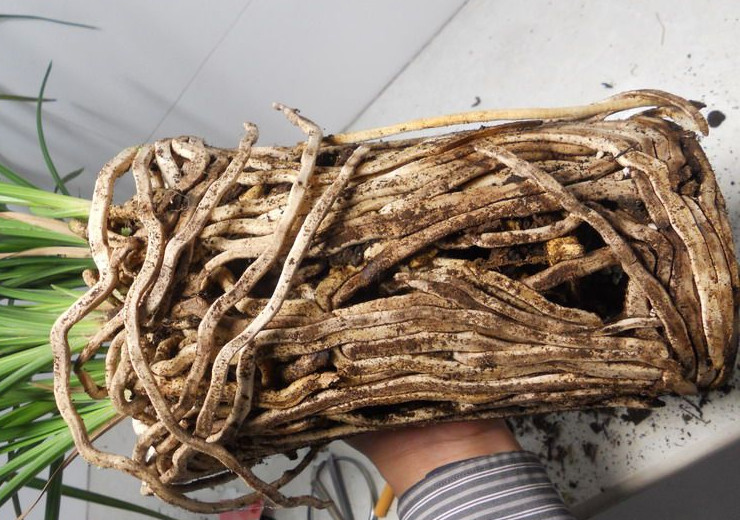
Rongfeng is lazy, and a green-flowered cymbidium has gone more than 2 years without repotting. When dividing the plants, I found a large shoot piercing into the pseudobulb base; in over ten years of growing orchids, this is the first time I've encountered it, so I'm posting it for everyone to enjoy. Repotting, dividing and potting up took more than 1 hour. Mix: 40% refined Rong bark, 40% Ishi-ishi (Kanuma-type stone), 20% Sendon (Japanese akadama-type clay). In May 2011, 2 plants with shoots were potted up, in a plastic pot on the 1st-floor balcony...
Author: Rongfeng (Luoyang, Henan)
I'm lazy, and a green-flowered cymbidium has gone more than 2 years without repotting. Posting it for everyone to enjoy. Repotting, dividing and potting up took more than 1 hour.
Mix:40% refined Rong bark, 40% Ishi-ishi, 20% Sendon. In May 2011, 2 plants with shoots were potted up, grown in a plastic pot on the 1st-floor balcony.
Repotting results:Lost 3 autumn shoots, squeezed flat by the roots and probably unable to grow. 13 plants in total, 4 groups of front-growth mother-and-son plants, the back-growth plants divided singly, aiming for a harvest of 50 growths in 2 years.
Summary:
1. Depending on growth conditions, repotting a cymbidium orchid is most suitable at about 1.5 to 2 years; beyond 2 years, you will very likely lose a generation of shoots. Under normal growth, 2-3 front-growth plants can basically reach about 7 or 8 plants in 2 years, and some varieties will produce even more. At this point the lateral roots grow sideways, and underwater shoots easily form; if the root system is too dense it may cause rotten shoots or stunted shoots (spring shoots tend to rot, autumn shoots tend to stall).
2. Timely repotting is a good way to multiply plants. If back-growth plants of about 3 years are divided off in time, the survival rate of the divisions is very high, they easily produce double growths, and the plants will not be too weak. Old plants over 4 years old have a low success rate when coaxed for old-pseudobulb propagation, and the shoots they produce are like toothpicks; keeping them even longer wastes them, which is somewhat regrettable.
3. For plants about to be repotted, skip one watering interval. First, it is easier to knock them out of the pot; second, the roots are more flexible when dividing, avoiding unnecessary root breakage and damage to the crystal tips. If there is a lot of moisture in the pot when dividing and the roots are plump, it is very hard to separate the plants even after cutting along the rhizome. Pulling hard, breaking a few roots is a small matter, but frequently breaking new plants and new shoots is a real loss.
4. Dividing large pots and densely rooted plants requires plenty of patience. First find the rhizome, then straighten the orchid roots plant by plant; when you encounter a crossing root, cut it immediately, and it will be much easier to divide. If the plants grow "in a row", dividing the back-growth plants first makes it easier to separate them.