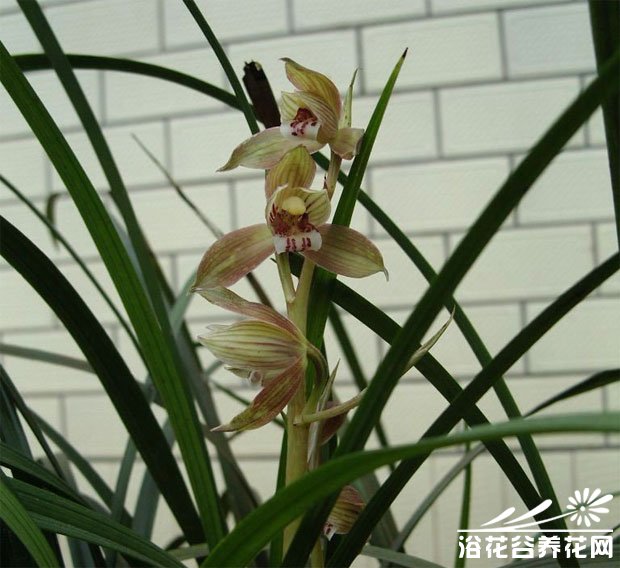
Detailed Guide to Cultivating Four-Season Orchid (also known as Jian Orchid, Stone Orchid)
The four-season orchid is relatively easy to cultivate and manage, but it is not yet widely grown, so it should be vigorously developed. Jian orchid (four-season orchid) is a good variety for home cultivation. Jian orchid is best repotted in spring, though it can also be done in autumn.
Jian orchid originates from the warm regions of southern China, so it requires slightly stronger light than summer cymbidium and has slightly weaker cold resistance. In winter it should be protected to prevent frost damage at low temperatures. Jian orchid is prone to yellow rust disease; special attention should be paid to using thiophanate-methyl for control in summer and autumn. If a small amount of rust spots is found, they should be cut off immediately.
During the flower bud emergence and blooming periods of Jian orchid, attention should also be paid to controlling snails and slugs. For potted Jian orchid, keep the soil moist but do not overwater. Never allow water to accumulate at the roots. In summer, spray water on the leaves frequently. During the growing season, fertilize once every half month; the fertilizer solution must never contaminate the leaves. During the high-temperature and strong-light period of midsummer, set up shade facilities and strictly prevent heavy rain from washing over them. In winter, keep them indoors to avoid frost damage to the leaves.
Division propagation is commonly used. It can be done in spring or autumn. Cut apart dense clusters of pseudobulbs with a knife and plant them separately, with at least 3 pseudobulbs per cluster. After appropriately trimming the roots, pot them up. Generally, divide once every 2—3 years.
Anthracnose, black spot disease and scale insects are common problems. For diseases, spray with 10% carbendazim wettable powder at 500 times dilution; for insect pests, spray with 40% omethoate emulsifiable concentrate at 1,500 times dilution.