A Detailed Guide to the Cultivation and Management of Cymbidium goeringii 'Doubanlan' (with photos)
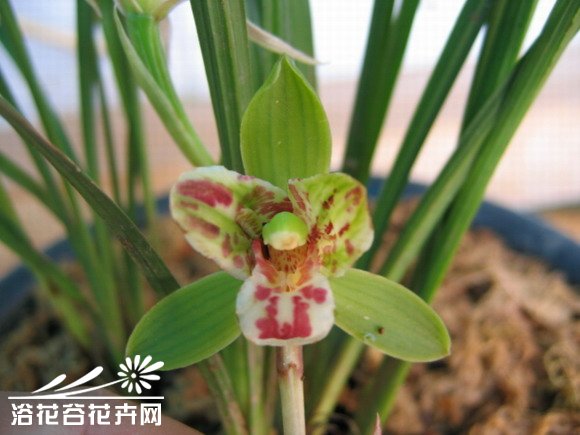
Doubanlan, also known as line-art Spring Orchid, is a member of the large Chinese orchid family, with a long cultivation history in Yunnan Province, a great variety of types, wide distribution and abundant resources. Through many years of selective breeding, cultivation, development and utilization by orchid enthusiasts, some excellent varieties have appeared among Doubanlan, attracting attention in orchid circles and increasingly favored by orchid lovers at home and abroad. Among them, 'Cuiyu Mei', developed by Mr. Zhang Qilin, standing director and deputy secretary-general of the Dali Prefecture Orchid Association, combines crystal flowers, plum petals, flying shoulders, hard stamen columns, crystal-clear color and strong fleshy texture in one, and is one of the finest varieties of Doubanlan.
I. Hardware and software of cultivation and management
(I) Hardware conditions for cultivation and management
1. Good lighting (the best orientation for the orchid shed is east and south);
2. Good ventilation conditions: ventilation environment outdoors, indoors and for the orchid pots; (electric fans or exhaust fans may be used);
3. Good indoor humidity environment: sprinkling water on the floor, water curtains, etc.
(II) Software
1. Healthy, disease-free good seedlings;
2. A certain amount of knowledge of orchid appreciation;
3. A certain amount of knowledge of orchid cultivation and management.
II. Pots for cultivation
1. Plastic pots are preferred: they must have standardized air permeability and be convenient for standardized management;
2. Clay pots, tile pots, etc. are not the first choice.
III. Growing medium
1. Use chestnut leaves, tree fern fiber, raw granular red soil, sheep manure, fired soil, tree bark, Zhijinshi (orchid stone), etc. In principle, the leaves used must be thoroughly decomposed, and those that can grow mushrooms are even better; sheep manure must also be thoroughly decomposed, while the others need not be too particular about (for the cultivation of 'Jiuzhou Hongmei', leaves make up 70-85%, and 10-25% raw granular red soil, or a little tree fern fiber, Zhijinshi, sheep manure, tree bark, etc. may be added);
2. The selected and blended growing medium must in principle be airy, breathable, well-draining and moderate in fertility.
IV. Cultivation and management
1. Water management. Water management is the most important part of orchid cultivation; the quality of management determines the growth rate, seedling production and health of the orchids.
The basic principle for watering time and temperature is: neither a light pot nor a heavy pot is the best time to water. There are no high requirements for water quality (ordinary tap water is fine). When watering, try to make the pot temperature, water temperature and orchid room temperature basically consistent; you may water by showering or by watering around the pot edge. After watering, you must open the window or use an electric fan to blow dry the moisture in the leaves or in the hearts of the buds, or place them in a cool, ventilated place to dry, and then place them on the pot rack for routine management;
2. Ventilation. Ventilation of the orchid room is an important factor. Ventilation between the orchid room and the outdoors, ventilation of the orchid pots in the orchid room, and the circulation of air and airflow in the orchid room are all inextricably related to orchid growth. The best ventilation is a gentle breeze that makes the orchid leaves sway slightly;
3. Orchid room temperature and humidity. Temperature and humidity are contradictory and yet coordinated: when temperature is high, humidity is low; when temperature is low, humidity is high. Sprinkling water on the floor or using water curtains can better reconcile the contradiction between temperature and humidity. When the orchid room temperature is 25-28°C and the relative humidity is 50-70%, this is the best growing environment for orchids;
4. Light management. Curtains may be used inside the orchid room, and shade nets, etc. may be used outside the orchid room for light management. The shading rate may be about 60-85%. Orchid leaves and pots may receive appropriate direct light, but the time should not be too long; sunlight in the first one or two hours after sunrise in the morning is especially good. Too much or too little sunlight is not conducive to orchid growth and can easily cause scorching of orchid leaves or stagnation of orchid root vitality, resulting in stunted seedlings and stunted roots;
5. The sphagnum moss on the orchid pots must be kept moist, creating a good moist growing environment for the tender roots of new small seedlings, so that conditions such as burnt tips of leaf sheaths or stunted seedlings are less likely to occur.
V. Situations such as burnt tips, collapsed seedlings and stunted seedlings during cultivation and management
1. Burnt tips. Most are caused by improper timing of watering (too dry or too wet) and too great a temperature difference among water temperature, pot temperature and orchid room temperature, showing as pale white or light brown leaf tips; fertilizer burn can also cause burnt tips, showing as black leaf tips;
2. Collapsed seedlings. Poor control of watering temperature, with water accumulating in the heart of the seedling during watering, causes dehydration and collapse of the seedling under rising temperatures or direct sunlight; other factors such as old seedlings and diseased seedlings can also cause collapsed seedlings;
3. Stunted seedlings. Because the watering temperature is too high or too low, or because the orchid pot is exposed to strong sunlight, etc., causing the pot temperature to be too high, orchid root growth stagnates, especially when often placed under high temperatures; conversely, placement under low temperatures can also cause orchid root growth to stagnate, resulting in stunted seedlings.
The above situations generally occur because certain links in the management process are not in place, or because problems have arisen with the orchid roots. To grow orchids well, you must first grow the orchid roots well; only then can you cultivate orchids well. Cultivating orchids is a systematic project, and every link is important. The quality of management determines the quality of cultivation.
VI. The grower's good mindset
1. You must have a relatively deep understanding of the traits of the orchid varieties you grow, and must distinguish the unique habits and growth patterns of each orchid variety. You cannot apply the same cultivation and management without distinguishing varieties and without considering the different characteristics of different varieties, and even less can you try to pull up seedlings to help them grow or seek quick success;
2. You must have a correct positioning and realistic goals for the expectations of the orchids you cultivate;
3. You must stick to your own actual situation and, based on your own cultivation environment and management habits, explore a set of cultivation experience that suits your actual conditions. You cannot keep changing your mind; if you change your own cultivation and management methods as soon as you hear others say something is good, in the end you will not know what to follow and will be unable to cultivate.
4. The growth habits of Doubanlan do not demand much from cultivation and management; being a little dry has little effect. Generally, the seedling production rate is not as good as that of Cymbidium tortisepalum, but with proper cultivation, some varieties such as 'Jiuzhou Hongmei' can also reach a seedling production rate of 1:1, or 1:2, with considerable benefits.