What kind of orchid root counts as a dragon root?
The “dragon root” and “dragon root seedlings” in orchids can be true or false. The so-called true “dragon root seedlings” are actually formed by seed germination, also called “seedling plants.” As everyone knows, orchid seeds are very small, very numerous, and very light. After the orchid seed capsule matures and splits open, the seeds scatter in the native place where she originally grew and was raised. When the wind blows, these light seeds, some of them drift with the wind, leaving home, flying far away, and scattering in foreign lands. If the place where they land is a mountain slope rock wall, mountain forest land, or mountain stream canyon suitable for orchid growth, some of the scattered seeds will take root, sprout, and grow leaves there, settle down, and multiply and survive. In nature, after orchid seeds germinate, they first form a “dragon root” in the soil. This kind of “dragon root” is not an orchid root, but an orchid rhizome. When the “dragon root” grows to the soil surface, its tip swells to form a small pseudobulb, roots downward, grows leaves upward, and grows into a seedling. This kind of orchid seedling with a “dragon root” is called a “seedling plant,” commonly known as a “dragon root seedling,” also called a “dragon root seed-grown seedling.” Generally speaking, only native plants have dragon roots, while secondary shoots do not have dragon roots.
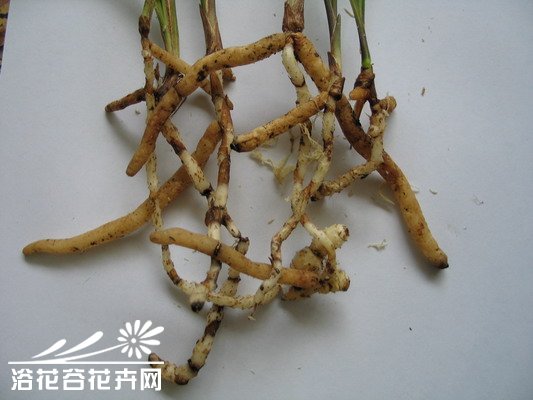
The dragon root is relatively small and dense, with short and tender internodes, and has many nodes and internodes. Each node position has a dormant bud, and each dormant bud may sprout a new seedling plant. Generally speaking, the lifespan of a dragon root is about 2 years. After the small seedling grows strong and the pseudobulb forms, its dragon egg falls off on its own, and the dragon root and dragon egg do not reappear. After the dragon root of the native plant rots, a papilla-like object will remain for a long time, and the traces of the dragon root are faintly recognizable.
True dragon roots and dragon root seedlings also have two situations: first, dragon root seedlings germinated from a single seed. In nature, this type of dragon root seedling is mostly a weak young plant of a single individual, each plant has only one dragon root, directly below the bud, in a vertical or nearly vertical state. In the wild mountains, most young single orchid seedlings belong to this type of dragon root seedling. Sometimes one trip up the mountain can collect dozens of such dragon root seedlings. This type of dragon root seedling is weak and small, and management is very laborious; it is not easy to see flowers in 5-8 years. Second, ginger-like dragon roots. Ginger-like dragon roots, also called block-like dragon roots by some people, are shaped like ginger and also like coral, and the orchid plant grows from the tuber. The production of ginger-like dragon roots may be because after the orchid seed capsule falls to the ground, tens of thousands of seed grains densely germinate at the same time, intertwining with each other into a mass resembling a tuber. The dragon root seedlings sprouted from this kind of ginger-like dragon root sometimes grow together as several seedlings or even dozens of seedlings.
Some people have proposed that dragon root seedlings easily produce mutated new varieties, with a probability of about 1.4%, and when evaluating dragon roots, they say that longer dragon roots are superior and shorter ones inferior, short internodes are good and long internodes are inferior. The more bizarre the shape of the dragon root, the better. Whether these views can hold remains to be further verified.
Regarding the formation of false dragon root seedlings. Under normal circumstances, orchid pseudobulbs grow clustered together, and the place where they connect has a very short section of underground stem. During growth in nature, due to some reason, such as being buried too deep or pressed by a large rock, when growth is inhibited and the survival of the orchid clump is endangered, this underground stem will sprout a relatively long bamboo-jointed root (false dragon root), extending all the way to a suitable place before forming a new bud, rooting and growing leaves, and forming a new pseudobulb. This bamboo-jointed underground stem is also commonly called a “dragon root” by some people, and the growing plant is also called a “dragon root seedling.” What the Taiwanese orchid circles call a dragon root that is “hard to find even after digging three chi into the ground” may refer to this kind of dragon root sprouted after the orchid plant is deeply buried in the soil. Some people say that for home-cultivated orchid plants, due to improper planting, the pseudobulbs are buried too deep in the potting soil, and a similar situation can also occur. They also propose that this kind of “dragon root seedling” mutates relatively often, and this view also remains to be confirmed by orchid friends.
In recent years, influenced by the saying that dragon root seedlings easily produce mutated new varieties, many people, driven by profit or eager for fine varieties, blindly buy or recklessly dig dragon root seed-grown seedlings in the mountains, causing devastating damage to orchid resources. Admittedly, among the famous varieties of Taiwan, China's Cymbidium sinense, Hanguang, Wandai Fu, and others were all cultivated from dragon root seedlings. The double-petaled strange flower of Cymbidium sinense has characteristics such as strange roots, strange bracts, strange leaves, dragon roots, and three-sided thorns. This is an indisputable fact. In fact, dragon root seedlings may produce leaf variegation and bloom strange flowers, but this is only a possibility. Because famous varieties are originally rare and hard-to-get things. It is exactly that “strange flowers have characteristics, but those with characteristics do not necessarily bloom strange flowers.” “Dragon root” is only one of the characteristics of fine orchids, but it is absolutely not the case that every dragon root seedling with a dragon root will frequently produce fine varieties.