Dendrobium Orchid Cultivation Methods and Care Tips
Potted dendrobium orchids require a lightweight, well-draining, airy substrate such as peat moss, fern roots, bark chunks and charcoal. At the same time, place extra tiles or crushed brick fragments at the bottom of the pot to promote root development. The growing location must have ample light, which is more favorable for dendrobium growth and flowering. During the spring and summer growing season, water thoroughly to speed up pseudobulb growth. After September, gradually reduce watering so the pseudobulbs ripen gradually, which can promote flowering.
During the growing season, fertilize once every ten days; reduce fertilizing in autumn, and stop fertilizing completely once the pseudobulbs reach maturity and during the winter dormancy period. Dendrobium orchids grown for more than 2 to 3 years become crowded, with roots filling the pot and the potting material already rotted, so they should be repotted in time. Whether evergreen or deciduous dendrobium orchids, repot after flowering. When repotting, avoid injuring the roots too much, otherwise the leaves will turn yellow and drop in low temperatures.
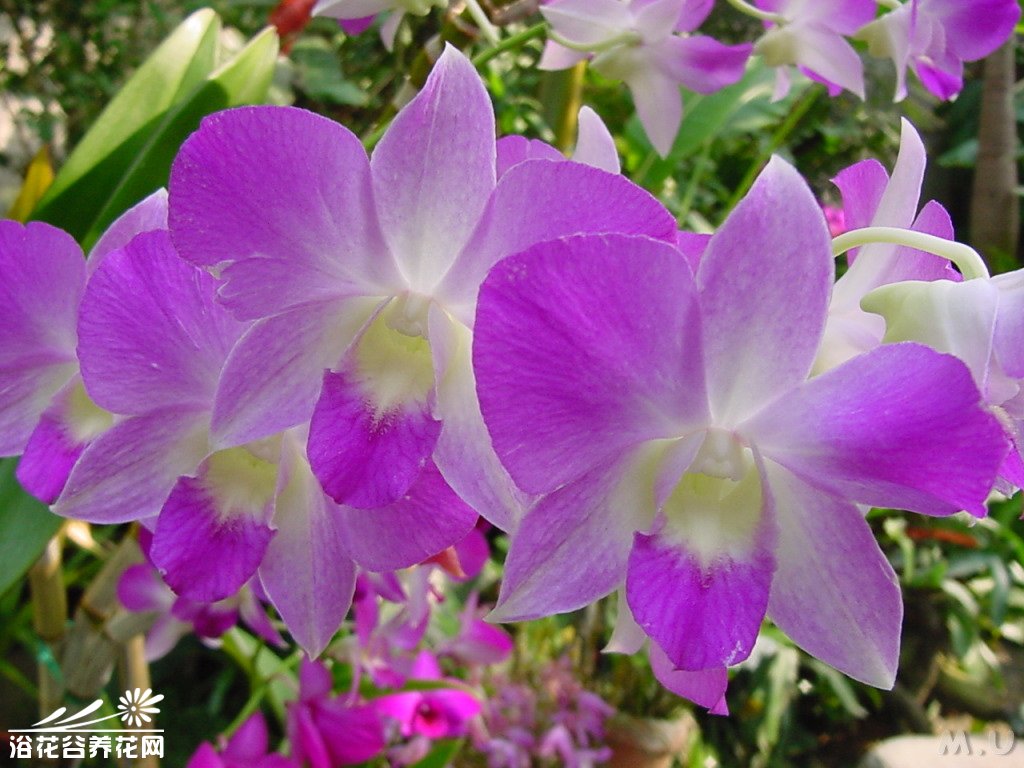
Propagation Methods
Division, cuttings and tissue culture propagation are commonly used.
① Division propagation
Carry out in spring together with repotting. Take the densely growing mother plant out of the pot, minimizing damage to roots and leaves, gently pull the orchid seedlings apart, and choose 3 to 4 plants to plant in a 15 cm pot, which favors shaping and flowering.
② Cutting propagation
Select pseudobulbs that have not flowered and are plump, cut them off at the base, then cut into sections of 2 to 3 nodes each, insert directly into peat moss or wrap the base of the cuttings with sphagnum moss, keep moist, with room temperature at 18 to 22°C; roots can form 30 to 40 days after insertion. Once the roots are 3 to 5 cm long, pot them up.
③ Tissue culture propagation
Shoot tips and leaf tips are often used as explants, and on MS medium supplemented with 2,4-D 0.15 to 0.5 mg/L and 6-benzylaminopurine 0.5 mg/L, the differentiation rate can reach about 1:10. The differentiated shoots are transferred to a medium containing activated
charcoal. In MS medium with coconut milk (supplemented with 2,4-D and 6-benzylaminopurine at 0.1 mg/L each), they can grow normally and form rootless seedlings; transferring the seedlings to MS medium containing indolebutyric acid 0.2 to 0.4 mg/L can induce rooting and form complete small plantlets with roots, stems and leaves.
Pest and Disease Control
Black spot disease and viral disease are common, and can be sprayed with a 1000-fold dilution of 10% antibacterial agent 401 acetic acid solution. Among insect pests, scale insects are harmful, and can be killed by spraying with a 2000-fold dilution of 40% omethoate emulsifiable concentrate.
Control methods:
1. Clean the orchid garden: the few diseased leaves appearing in the orchid garden should be cut off, and fallen leaves from the winter disease period should be collected and burned.
2. Greenhouse environment management: during the summer high-temperature period, the temperature inside the greenhouse often reaches as high as 40°C, so ventilation and cooling should be provided to avoid poor orchid growth; during the winter low-temperature period, watering should be done at noon on clear sunny days, and part of the plastic sheeting should be opened to increase ventilation and lower the relative humidity inside the greenhouse.