How to grow a ponytail palm? Detailed care instructions
The ponytail palm (Beaucarnea recurvata), also called the elephant-foot tree, belongs to the Agavaceae family, genus Beaucarnea. The ponytail palm loves sunlight and can take direct sun all year round; even in the hottest midsummer, continuous exposure under the blazing sun will not scorch its leaves. However, it is not cold-hardy, so in northern regions it must be brought indoors before Frost's Descent, placed in a warm, sunny spot. A room temperature of around 10°C is ideal; if it drops below 5°C, cold-protection and warming measures must be taken to prevent cold damage. Because the ponytail palm is relatively drought-tolerant, it should not be watered too much, otherwise the roots rot easily. In spring and autumn, water when the soil is dry and let it dry out between waterings; in summer keep it moist; in winter water again when the soil is dry. During the growing season, when grown outdoors, apply a dilute liquid fertilizer once every half month; when grown indoors, granular fertilizer is preferable.
For potting a ponytail palm, you can use a mix of 2 parts leaf mold, 1 part garden soil, 1 part river sand and a small amount of plant ash as the growing medium. From March to October, during the growing season, strengthen fertilizer and water management to promote swelling of the stem. Since the swollen stem can store a certain amount of water and the plant is quite drought-tolerant, water only enough to keep the potting soil moist, following the principle of preferring dry over wet, and avoid waterlogging in the pot, otherwise the fleshy roots and stem rot easily. Especially after late autumn, when temperatures drop, reduce watering to increase the plant's cold resistance. During the growing season, apply liquid fertilizer or compound fertilizer twice a month, and be sure to increase phosphorus and potassium fertilizers when feeding. Regularly prune old leaves to encourage the plant to grow taller. It likes high temperatures and tolerates drought, with an optimal growing temperature of 20-28°C.
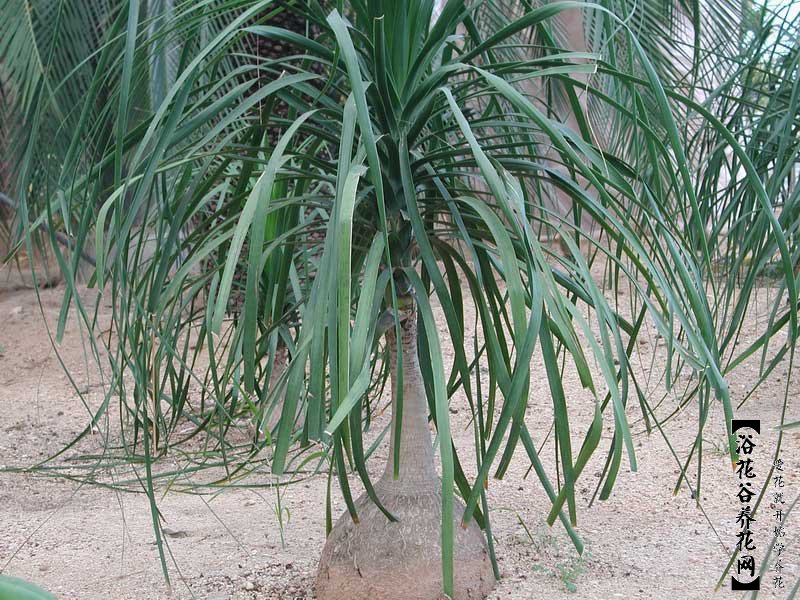
Overwintering measures for the ponytail palm: In northern regions, to ensure the plant overwinters safely, the following measures should be taken: strengthen water and fertilizer management to promote robust growth and further improve its cold resistance; indoors, place it in a sunny spot where it can get plenty of light during the day; to prevent cold air from entering the room, maintain the temperature above 3°C. If the temperature is too low, timely measures should be taken; in northern regions, to help the plant overwinter, watering should be controlled, and the potting soil should be dry rather than wet; after the weather warms up around Qingming Festival, gradually move it back outdoors.
The ponytail palm is generally propagated by sowing and cuttings. Sowing is best done indoors in pots. Potted plants in the north seldom bloom and set seed, so you can only use the suckers sprouting from the base for cuttings in spring; after breaking off the young shoots, let them dry for 1-2 days, then insert them into river sand or plain soil, cover with plastic film to retain moisture and warmth, and they root very easily at 20-25°C. From April to November, during the ponytail palm's growing season, avoid moving the pot or changing its orientation; make sure it keeps a fixed spot. At this time, give plenty of water and nutrients to encourage the stem to swell. According to how wet or dry the potting soil is and how deep the leaf color is, water and fertilize appropriately and in a timely manner, so that the soil neither becomes waterlogged nor dries out; from January to March, strictly control water, watering only once a month with water at room temperature until it drains through. When fertilizing, do not use raw manure or concentrated fertilizer. Article source: http://www.yuhuagu.com