|
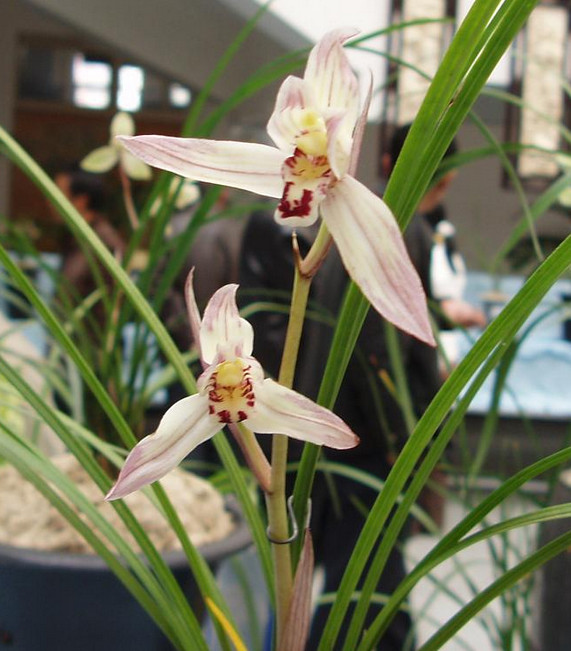
Bilong Qidie: also known as the Cymbidium tortisepalum butterfly flower, it belongs to the Cymbidium tortisepalum varieties. It is named because its petals form a butterfly shape and it was planted in Bilong Orchid Garden. It was originally named Rainbow Cymbidium tortisepalum. It originates from a secluded valley on Luoping Mountain within Eryuan on the southern edge of the Hengduan Mountains. In 1996, it was discovered by Li Yinglong, owner of Bilong Orchid Garden and a famous orchid connoisseur and cultivator, and has been domesticated into a variety with stable characteristics. Leaves 7-8, semi-pendulous, light green and glossy. The flower scape is slender, with 1-3 flowers, flower diameter 3.5 cm, petals silvery white with a red blush. The sepals are thick, white with a slight green tint, the central veins of the petals are thick purple-red, the petal surface is wavy, the petal tips are slightly twisted, and a small yellow fleshy round block protrudes on the inner lower side, forming an inverted triangular arrangement with the column. The petals (the column-guarding petals) are butterfly-transformed, white with red blush spots, very peculiar. The side lobes of the lip have purple-red transverse stripes, and the middle lobe is white with thick U-shaped purple-red spots. The whole flower is white, ingeniously combined with red and yellow, bright and eye-catching, with stable characteristics and pure fragrance, making it a treasure among Cymbidium tortisepalum. It blooms around the Spring Festival, with a flowering period of nearly 2 months. It won the gold award at the 6th China Orchid Expo, and was registered as a famous Chinese orchid on March 30, 1996, with registration number 39.
|