Introduction to the Cypripedium-like Cymbidium 'Guanhui' Variety and Analysis of Its Characteristics
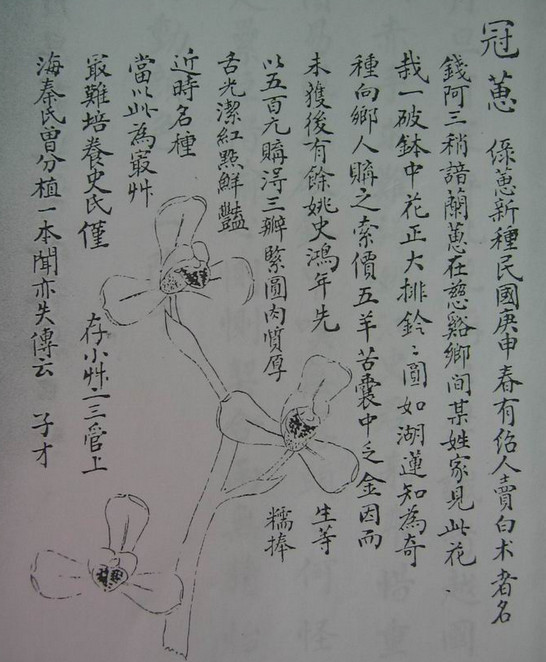
The green cymbidium "Guanhui" has been lost. "A Brief History of Orchids and Cymbidiums": "Produced in Yuyao in the ninth year of the Republic of China. Five petals in separate segments, shoulders level, color emerald, lip also well-formed. Cultivated by Liu Zhenqing." "The ninth year of the Republic of China" is 1920 AD. "Cultivated by Liu Zhenqing." According to "Nai'an Ju Bi Tan," it is recorded as "Cultivated by Liu Zhenqing of Yuyao." It seems Liu Zhenqing must have been from Yuyao. "Nai...
The green cymbidium "Guanhui" has been lost.
"A Brief History of Orchids and Cymbidiums": "Produced in Yuyao in the ninth year of the Republic of China. Five petals in separate segments, shoulders level, color emerald, lip also well-formed. Cultivated by Liu Zhenqing."
"The ninth year of the Republic of China" is 1920 AD. "Cultivated by Liu Zhenqing." According to "Nai'an Ju Bi Tan," it is recorded as "Cultivated by Liu Zhenqing of Yuyao." It seems Liu Zhenqing must have been from Yuyao. When "Nai'an Ju Bi Tan" recorded "Guanhui," it also said: "This variety's flower form is extremely fine, truly the crown among cymbidiums. Unfortunately, very few are circulating nowadays, and some say it is already extinct, which I deeply regret." In recent years, orchid publications have rarely recorded "Guanhui," nor has it appeared; Japan also does not have this variety. It seems the prospects are grim, though of course one should not speak in absolutes. "Sequel to the Concordant Record of Orchids and Cymbidiums" records this variety in considerable detail:
"Guanhui. A new variety of green cymbidium. In the spring of the gengshen year of the Republic of China (1920), a Shaoxing man named Qian Asan who sold white atractylodes and knew a little about orchids and cymbidiums saw this flower in a certain family's home in the countryside of Cixi, planted in a broken bowl. The flower was in full bud, the buds round like lake lotus, and he knew it was a rare variety. He sought to buy it from the country people, who asked five sheep as the price, but his purse was empty, so he did not obtain it. Later, Mr. Shi Hongnian of Yuyao and others purchased it for five hundred yuan. The three outer petals are tight and round, the substance thick and glutinous, the clasping petals and lip smooth and clean, the red dots vivid. Among recent famous varieties, this should be considered the finest. The plant is extremely difficult to cultivate; Mr. Shi kept only two or three small shoots. The Qin family of Shanghai once divided and planted one plant, and it is said to have also been lost." "Anonymous Orchid and Cymbidium Catalog" records it in much the same way as "Sequel to the Concordant Record of Orchids and Cymbidiums."
The "gengshen year of the Republic of China" mentioned in the text is 1920, consistent with what "A Brief History of Orchids and Cymbidiums" records. "The seller of white atractylodes named Qian Asan" - "Qian Asan" can no longer be traced; "white atractylodes" (Atractylodes macrocephala), also known as gongzhu, fengzhu, or yuzhu, is a plant of the Asteraceae family whose root can be used as medicine. It is currently rare in the wild and mostly cultivated. "Cixi" borders Yuyao and is the birthplace of Chinese celadon; it is said to be the departure point from which Xu Fu sailed east to Japan in search of the elixir of immortality. "Lake lotus" refers to lotus that grows naturally by the shores of large lakes such as Dongting Lake and Poyang Lake; there are also regional names, for example the well-known Ting lotus of Hunan, Jian lotus of Fujian, and Hu lotus of Jiangsu. Here it refers generally to lotus seeds. The small flower buds are round and full like large lotus seeds.
The phrase "asked five sheep as the price" in "Sequel to the Concordant Record of Orchids and Cymbidiums" is truly puzzling. From the context of the sentence, it should refer to currency, but in 1920 there was no such currency as "five sheep." The "five sheep" currency appeared in 1936, when Chen Jitang, the ruler of Guangdong, arbitrarily minted and issued a "one cent" copper coin locally. Because the coin used a five-sheep design, it was called the "five-sheep copper coin." Another possibility is that "sheep" (yang) was interchangeable with "ocean" (yang), meaning silver dollars, i.e., the silver dollar of the time; five large coins would be five silver dollars, which is far too great a difference from the later purchase by Shi Hongnian and others for five hundred silver dollars. Yet another explanation is barter - exchanging five sheep for this clump of grass. How many silver dollars five sheep would have been worth at that time is not worth investigating, but this possibility of barter still exists.
In 1994, the fifth issue of "Chinese Orchids" published Mr. Wang Xianfa's article "Yuyao Will Revive the Glory of the 'Home of Famous Orchids'," which said: "It is said that the discoverer of Guanhui was surnamed Zhong. Because he found Guanhui, he obtained 200 silver dollars, and with this he married, built a house, and opened a shop. His son Zhong Yueming is still alive and speaks of this matter with great relish." As stated above, this is recorded here for future reference.
"Shi Hongnian of Yuyao" and "the Qin family of Shanghai" also cannot be traced. "The Qin family of Shanghai" most likely refers to Qin Cainan of Shanghai at that time, who was also a lover of orchids. In the renxu year of the Republic of China (1922), the "Huanqiu Hedin" that Yu Kongzhao purchased for eight hundred yuan - the following year (guihai), he transferred the only remaining three shoots to Qin Cainan for six hundred and fifty yuan. "Tianxing Mei," after being recorded in Xu Jilou's "Concordant Record of Orchids and Cymbidiums," had vanished for more than fifty years, until Qin Cainan obtained it from some unknown place. Whether it was the original variety is unknown. The "Tianxing Mei" circulating today comes from this source.
"Sequel to the Concordant Record of Orchids and Cymbidiums" says of "Guanhui": "The plant is extremely difficult to cultivate; Mr. Shi kept only two or three small shoots. The Qin family of Shanghai once divided and planted one plant, and it is said to have also been lost." "The plant is extremely difficult to cultivate" may also be one of the reasons this variety could not survive.
Speaking of Yuyao, one cannot fail to mention the earlier great orchid cultivator Mr. Wang Shuping. "Fifty Years of Orchid Cultivation Experience" contains a biography of him; limited by space, a portion is excerpted here:
"Wang Shuping (1886-1965), courtesy name Xiaoyou, childhood name Yangqing, known in the world by his courtesy name. Born in the twelfth year of the Guangxu reign of the Qing dynasty in Yaohu Yuan, Kaiyuan Township (now part of Mazhu Town). (Note: His father Wang Zhiqian was also a lover of orchids.)
The Wang family was a prominent local clan. Their ancestors had opened the Wang Sansheng medicinal materials shop in Hankou, and after making their fortune, acquired extensive farmland in their hometown, becoming the great wealthy family of western Yuyao. He had four brothers and was the third. As a youth he attended a private school in his hometown, and at age 19 dropped out due to lung disease. He loved planting flowers and tending plants, especially orchids. During his recuperation he grew several pots of famous orchids for leisure. He loved the orchid's fragrance filling the room, and even more its elegant, refined, and unrestrained demeanor, so that from liking he came to deeply love them, and ultimately became a famous orchid cultivator. Around age 30, he was already somewhat famous in western Yuyao. Many orchid lovers from the surrounding villages often visited Yaohu Yuan to seek orchids from him, either offering goods in exchange or seeking to purchase at high prices. Yuyao was a hometown of orchids, and his home in western Yuyao was in a remote location, which he found quite inconvenient, so in 1927 he moved his entire family to settle at Zhishen Lane in the county town."
"Mountain folk came to the county town to sell wild orchids in the first ten days of the first lunar month. He had a discerning eye and was willing to pay high prices to purchase those with potential for cultivation, which he then carefully cultivated. He set up six large greenhouses and sixty to seventy flower stands, which together could hold more than six hundred pots."
"He devoted his life's energy to orchids, and in return, famous varieties kept emerging. Notable ones include Jin'ao Su, Taiyuan Mei, and Guanyao Mei. When Guanyao Mei was successfully cultivated, he was overjoyed; not only did the whole family celebrate, but he also sent word to relatives and friends, and hired a photographer to take pictures, which he distributed to orchid friends as reference material. Over several decades, the orchids he cultivated were all purchased on-site by orchid merchants from Shaoxing, Hangzhou, Shanghai, and other places, and transported and sold throughout the country, even to Japan and Southeast Asia. Thus his fame grew daily, and many skilled orchid cultivators and famous connoisseurs came to visit him. Some even praised him as one of China's three great orchid generals. The contemporary famous orchid cultivator of Beijing and Shanghai, Mr. Zhu Youren of Shaoxing, was the most devoted admirer among his guests."
"At the same time, he systematically organized and summarized the large amount of material and rich experience accumulated over his lifetime, writing books to establish his legacy. He wrote one volume of 'Fifty Years of Orchid Cultivation Experience' and asked the famous scholar Mr. Du Tianmi to review it. In 1964, in order to ensure successors and revive the orchid industry, he packed the material accumulated over the years, including specimens, photographs, and pictures, into eight hanging scrolls, and donated them all free of charge to two orchid lovers surnamed Liu and Huang of Shanghai. In the same year, he also mimeographed his orchid cultivation experience into a booklet, distributed it to friends, and, supported by his grandson Wang Jiaying, climbed Longquan Mountain and solemnly presented it to the Lizhou Library. Today, Yuyao orchids are still famous throughout the world, and the foremost credit must go to Wang Shuping of Yaohu Yuan, Mazhu."
According to "Fifty Years of Orchid Cultivation Experience," Wang Shuping during his lifetime cultivated 116 varieties of spring orchids and 43 varieties of cymbidiums, totaling 159 varieties. Through the efforts of Mr. Yu Bojun of Yuyao, and with the help of Mr. Zhu Hehua, Yu Zongying, Xiong Xiaoping, Ling Weichun of Ningbo, and Zhao Aijun of Huzhou, "Fifty Years of Orchid Cultivation Experience" was finally reprinted. This precious orchid cultural heritage has thus been preserved and passed down. It is said that a "Wang Shuping Orchid and Cymbidium Catalog" has been handed down, but unfortunately it cannot be seen, which is truly a lifelong regret.
The "Zhejiang Province Spring Orchid Sample Garden" has a variety called "Xin Guanhui": "In 2001, Li Hanrun discovered it at Taohua Ling in Yuyao. The three outer petals are rooted and rounded, with constricted base and broadened tips, five petals in separate segments, tightly covering with flying shoulders, soft mussel-shell clasping petals, large Liu Hai tongue, emerald color and glutinous substance, extremely fine charm. It is an outstanding green cymbidium plum-petal treasure among recent new varieties." This is recorded here.
According to Patiguli of Yuyao in "Ningbo Orchid and Cymbidium Culture," Mr. Zhang Benchu of Yuyao discovered a plum-petal cymbidium similar to "Guanhui" at an old orchid-digging man's place. Having discovered such a rare new green cymbidium plum-petal variety, Mr. Zhang Benchu was wild with joy and bought it back to cultivate carefully. It is said that a merchant from out of town wanted to pay a large sum to buy it, but Mr. Zhang Benchu, who loved orchids to distraction, absolutely refused to part with it. He said: "Having orchids at home is like having friends, and having friends is like having clouds. In leisure time from work, savoring tea, meeting friends, and admiring orchids - life is better than that of immortals!" I once had the good fortune to interact with Mr. Zhang several times. Mr. Zhang was warm, forthright, and upright. He once gave a pot of his selected spring orchid "Benchu Mei" (this variety is introduced in "Three Hundred Questions on Chinese Orchid Art") (this variety was not circulated externally, and only two pots existed) to a Taiwan orchid friend. The Taiwan orchid friend declined repeatedly, and Mr. Zhang, in his impatience, was about to throw it out the window. Seeing this, the Taiwan orchid friend tremblingly accepted it. Although it did not come to throwing it away, Mr. Zhang's character can be glimpsed from this.
Whether Mr. Zhang Benchu's plum-petal cymbidium similar to "Guanhui" and the "Xin Guanhui" variety of the "Zhejiang Province Spring Orchid Sample Garden" come from the same species - this is possible. Then Li Hanrun would be this "old orchid-digging man." Although "Ningbo Orchid and Cymbidium Culture" records them separately, it does not describe them in detail.
In "Sequel to the Concordant Record of Orchids and Cymbidiums," after "Guanhui" there is an appended poem: "Monthly judgments have a settled verdict; this flower is called the leader. The connoisseur is a man of Yue; with bare hands it is hard to obtain. Mr. Shi of Yaojiang came, sparing no high price to exchange. Though placed in a broken bowl, one sighs there is no day of emergence. No wonder the minister of Chu's fortifications borrowed it as a metaphor with a sorrowful heart. In perfect accord, both without suspicion, cheerful and joyful, their countenances stirred."