How to grow Phalaenopsis orchids? Save this complete cultivation guide
Spring care: spring is the flowering season for Phalaenopsis, because to make Phalaenopsis bloom in winter, the temperature must be kept above 15°C; otherwise, it can only bloom in spring. When blooming, the flowers open in order from bottom to top, but if there is continuous low temperature, often only a few flowers will open before it stops. In this season, the new leaves and new roots of the orchid plant have not yet grown, and its form is the same as in winter.
The growing location can be either in a greenhouse or outdoors. If grown outdoors, it is best to hang it under the eaves where rain cannot reach it, and ventilation must be good; in particular, high-humidity wind is very helpful for its growth. Phalaenopsis does not like strong sunlight, so when grown in a greenhouse, a layer of shade netting should be set up from early spring for shade, with a shading rate of about 50-60%. However, if plastic sheeting is attached to the inner side of the greenhouse glass, it is not too late to set up the shade netting in mid-spring. If grown indoors, it should be placed by the windowsill and receive sunlight through the curtains.
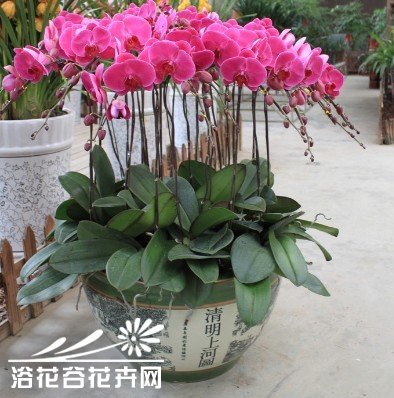
Watering: spring is the period of most vigorous root growth for the orchid, so when the surface of growing media such as sphagnum moss and bark appears dry, water promptly. The roots of Phalaenopsis, unlike those of other herbaceous flowers, do not like being soaked in water for a long time. You must wait until the surface of the growing medium is completely dry before watering again, or switch to misting the leaves to water; this will not harm the orchid roots and will also help raise humidity and support vigorous growth. During the plum rain season, because the night temperature is slightly lower than usual, if water accumulates in the leaf crown at this time, it is prone to rot, so when watering at night, do not let water accumulate in the leaf crown.
Fertilizer: generally in spring, only 1000-times diluted liquid fertilizer is applied, but no fertilizer is applied during the flowering period. After the flowering period, when new roots grow from the base of the plant, begin applying liquid fertilizer again, once a week. Only after new leaves grow in late spring should solid organic fertilizer the size of a fingertip, made from a mixture of oil cake and bone meal, be used, placing two pieces in a 4-5 inch pot. If solid organic fertilizer is applied too early, it is instead prone to damaging the roots.
Pest and disease control: in this season, prevent soft rot, and regularly spray Dasen water-dispersible powder and Benlate water-dispersible powder. Especially during the disease outbreak period in the plum rain season, take extra care to prevent problems. At the same time, be careful not to let the root tips be eaten by **.
Repotting: Phalaenopsis is a monopodial orchid and will rarely produce offshoots, so there is no need to divide it; only repotting is needed. Orchid plants whose lower leaves have fallen, plants with declining growth, or plants whose growing medium has become old all need repotting. Usually repot once every 2-3 years. The most suitable time is late spring to early summer, when flowering has ended and new roots begin to grow. When repotting, first remove the old growing medium, but do not damage the roots. Old stems and old roots should also be trimmed and removed. To make drainage good, place styrofoam balls in one third of the bottom of the pot to facilitate drainage. Then wrap the styrofoam pieces with sphagnum moss and place them under the orchid roots, spread the roots evenly and plant them into the pot, and cover with moderately soft sphagnum moss. Half a month after repotting, place it in a semi-shaded spot with high humidity, do not water too much, and misting the leaves is better; at this time, still do not fertilize, and only after new roots grow should it be managed like ordinary orchid plants.
Tree fern board planting method: for Phalaenopsis with slender flower stems and drooping leaves, if planted on a tree fern board, it will not only have an elegant posture, but will also avoid water accumulation in the center of new leaves. The planting time on tree fern boards is the same as repotting, with late spring to early summer, when new roots grow most vigorously, being suitable. The key to planting on a tree fern board is to cover the tidied orchid roots with a thin layer of sphagnum moss, then nail them onto the tree fern board. After planting, the management is the same as after repotting: frequently mist the leaves to encourage new roots to grow. After it becomes established, water frequently and avoid excessive drying.