Orchid Rare Varieties Overview: Introduction to the Main Varieties of Cymbidium faberi
After long-term cultivation and selective breeding by working people, China's orchids have a great many varieties. Many precious orchids are named according to the special forms of their petal types, such as “×× Plum”, “×× Lotus”, “×× Narcissus”, “×× Plain”, “×× Odd Petal”, and so on. Some are described according to their colors, such as “Green Cloud”, “Jade Canopy”, “Green Essence”, “Purple Ribbon and Golden Seal”, “Jade First Rank”, “Red Bee Skill”, “Immortal Green”, “Large Green Lotus”, “Green Chief”, “Jade Toad”, “Purple Winter Orchid”, “White New Year's Greeting”, and so on. Some are named according to the cultivator's name, anecdotes in the selection and breeding process, or place names, such as “Song Plum”, “Duan Plum”, “Tang Plum”, “Zhang Lotus Plain”, “Xie Lotus Plain”, “Cheng Plum”, “Cui Plum”, “Yang's Lotus Plain”, “Yang's Plain Butterfly”, “Great First Rank”, “Small Strike”, “Changshu Plain”, “Suzhou Spring First Rank”, “Yuyao First Plum”, “Shanghai Plum”, “Songjiang Large Lotus”, “Wenzhou Plain”, “Juzhou Plain”, “Jin'ao Plain”, “Longyan Plain”, “Guanyin Plain”, “Yong'an Plain”, “Yongfu Plain”, “Jian Orchid”, and so on. Some are also named according to their forms, such as “Gathering Circle”, “Parrot Plum”, “Seagull”, “Cloud Cluster”, “Bee Skill”, “Jade Butterfly”, “Moth Bee Plum”, “Duan Plum”, “Top Grade”, “Fish Roe Orchid”, and so on. Still others are named according to the number and appearance of the flowers borne on the scape, such as “Thirteen Generals”, “Eighteen Great Phoenixes”, “Dai Plum”, “Cymbidium Lotus”, “Harmony Butterfly”, “Four Happinesses Butterfly”, and so on. In order to let readers understand in detail the history, characteristics, and petal-type systems of China's main famous orchid varieties, they are introduced in detail below:
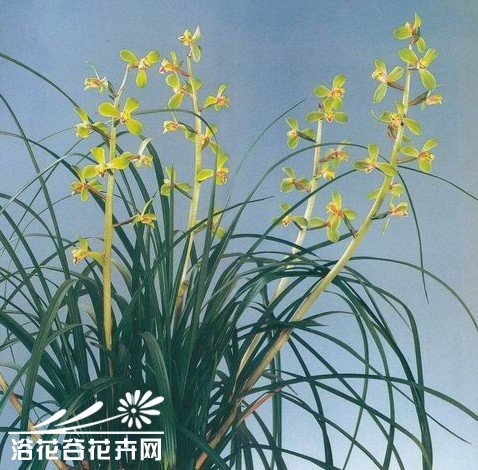
Cymbidium faberi group
1. Shanghai Plum. Petal type: Green-shell type plum petal. History: selected by Li Liangbin in the early Jiaqing period of the Qing Dynasty. Characteristics: three petals with long feet and round heads, half-closed hard column, pierced-cheek small Ruyi tongue, flower color emerald green, one-character shoulder. After full bloom, the lateral petals occasionally turn backward. Leaves semi-drooping. Scape slender. Bracts green. Listed as one of the Old Eight Varieties.
2. Immortal Green. Petal type: green-shell plum petal, also known as Yixing Plum; because the flower shape closely resembles Old Shanghai Plum, it is also called Later Shanghai Plum. History: selected in the early Republic of China by an orchid grower in Yixing. Characteristics: three petals with round heads, narrow and long, separated chambers, goat-horn hood column, tongue long and not curled. In the old society, orchid peddlers often passed this variety off as Old Shanghai Plum for sale. Bracts green. Often produces plum-form narcissus petals.
3. Old Bee Skill. Petal type: red-shell type green-flower plum petal. History: selected during the Kangxi period of the Qing Dynasty by a resident of Zhujiajiao in Qingpu County, Shanghai. At that time a man surnamed Jin from Dongting Mountain in Suzhou opened a pawnshop there. When asked to sell it, he refused, and instructed a thief to steal it out; this even led to litigation. It is said that both sides bribed officials and appealed level by level without either winning or losing, until the case was appealed all the way to the Kangxi Emperor, arousing his curiosity. He ordered the flower sent to the capital, and afterward, while viewing it, a bee happened to fly down onto the flower, so it was immediately named Bee Skill.
Characteristics: three petals with literary wrinkles, fine roots, flared corners, tight edges, cat-ear column, square-notched tongue. Flower color slightly yellow. Bracts light green. It is a precious variety among the old famous varieties.
4. Old Top Grade. Petal type: green-shell type green-flower plum petal. History: selected in the Xinchou year of the Guangxu period of the Qing Dynasty by Feng Changjin of Gongcheng Garden in Hangzhou. Characteristics: three petals with round heads, long feet and fine roots, separated chambers, hard hood column (sometimes occasionally split-head closed-back form), dragon-swallowing large tongue, level shoulders. Bracts green. Listed among the New Eight Varieties of Cymbidium faberi.
5. Jiangnan New Top Grade. Petal type: red-shell type plum petal. History: in 1951 brought by the Zhejiang orchid peddler A Lu to the home of Yang Ganqing in Wuxi. At that time Yang asked Mr. Rong Wenqing to examine the flower buds and confirm that a fine flower variety would certainly emerge later, after which Yang Ganqing bought it.
Characteristics: flower shape similar to Old Top Grade. Three petals with round heads and fine roots, separated chambers with semi-hard hood slightly closed, dragon-swallowing large tongue, level shoulders, slender scape, excellent charm and color, listed as one of the New Eight Varieties of Cymbidium faberi.
6. Duan Plum. Petal type: red-turning-green-shell type plum petal. History: selected in 1913 by Lu Changshou of Hangzhou; because the flower appearance is upright and proper, it was named Duan Plum. Characteristics: three petals with round heads, tight edges and green color, level shoulders, separated chambers or split-head closed-back, silkworm-moth hood column, large tongue. Flowers rather densely arranged. Listed as one of the New Eight Varieties and a famous variety among Cymbidium faberi.
7. Cui Plum. Petal type: red-turning-green-shell type plum petal. History: selected before the War of Resistance Against Japanese Aggression by Cui Yiting of Hangzhou. Characteristics: three petals with round and large heads, finely tapered roots, thick and glutinous petal flesh, semi-hard column, separated chambers or split-head closed-back, dragon-swallowing tongue. Green color, level shoulders. Listed as one of the New Eight Varieties and also a famous variety among Cymbidium faberi.
8. Immortal Butterfly. Petal type: red-shell green-flower plum petal. History: selected in the Gengzi year of the Guangxu period of the Qing Dynasty by the Shaoxing orchid peddler Xu Amu, identified and named by Shao Zhiyan of Hangzhou. Characteristics: three petals with long feet and round heads, tight edges, thick flesh, soft silkworm-moth hood column, large Ruyi tongue. Each flower stalk slightly red. When the flowers first open they slightly bow their heads, and after one week they stand upright.
9. Jade Calyx. Petal type: green-shell plum petal. History: selected in 1909 by Rong Wenqing of Wuxi. Characteristics: three petals short and round, tight edges, hard hood column, separated chambers, small Ruyi tongue, level shoulders. Sometimes when the flowers open poorly, a bone needle must be used to lift open the hooked three petals; otherwise the three petals are wrinkled, with hard tendons in the center of the petal width. Listed as one of the New Eight Varieties of Cymbidium faberi.
10. Qinghua Plum. Petal type: green-shell type plum petal. History: selected in 1911 by the Zhejiang Shaoxing orchid peddler Che Qing, sold to Mr. Wu Enyuan, and bloomed again after six years of cultivation. At that time the Manchu Qing dynasty was being overthrown, and for the sake of celebration, considering that Che Qing had discovered this flower at the Huaxing Hotel, the person and the place were linked, so it was named Qinghua. Characteristics: three petals with short feet and round heads, tight edges, thick petals, separated-chamber silkworm-moth column, large Ruyi tongue, one-character shoulder. Listed as one of the New Eight Varieties of Cymbidium faberi.
11. Hanbi Plum. Petal type: red-turning-green-shell type plum petal. History: selected in 1918 by the Zhejiang Shaoxing orchid peddler Liu Delin. Characteristics:
Three petals short and broad, tight edges, thick petals, separated chambers with semi-hard column (base slightly closed at the back), dragon-swallowing tongue, scape slender and tall. Flower color like jasper. Not widely circulated; because the flower appearance is upright and beautiful, it is regarded as one of the outstanding varieties among Cymbidium faberi.
12. Rong Plum. Petal type: red-shell type plum petal. History: selected in the first year of Xuantong of the Qing Dynasty by Rong Wenqing of Wuxi. Characteristics: three petals with long feet and round heads, separated-chamber semi-hard hood column (sometimes the base of the column petals has a closed-back form), round tongue, five petals thick in texture and glutinous, green color. One of the New Eight Varieties.
13. Cheng Plum. Petal type: red-shell type plum petal. History: selected during the Qianlong period of the Qing Dynasty by a person surnamed Cheng from Changshu, Jiangsu. Characteristics: three petals with tight edges and short and round form, split-head closed-back or separated-chamber column, dragon tongue, scape thick and tall, leaves broad and bow-shaped. It is the foremost of the Old Eight red Cymbidium faberi varieties. 14. Guanding. Petal type: red-shell type plum petal. History: selected during the Qianlong period of the Qing Dynasty by the owner of the Wanhe Hotel in Huguan, Jiangsu. Therefore it is also called Wanhe. Characteristics: five petals short and round, bean-shell, separated chambers, large round tongue, level shoulders. Leaves broad. One of the Old Eight red Cymbidium faberi varieties.
15. Yuan Character. Petal type: red-shell type green-flower plum petal. History: selected during the Daoguang period of the Qing Dynasty by an orchid grower in Huguan. Characteristics: three petals with round heads and long feet, tight edges, green color, separated-chamber semi-hard column, level shoulders, gui-holding tongue, scape thick and tall, one of the Old Eight red Cymbidium faberi varieties.
16. Old Dye Character. Petal type: red-shell type plum petal. History: selected during the Daoguang period of the Qing Dynasty by a person surnamed Ruan from Jiashan, Zhejiang. Also called Ruan Character. Characteristics: three petals short, narrow and deep, level shoulders, separated-chamber large Guanyin hood column, large round tongue; sometimes the flowers open poorly; the tip of the lip is pinched narrow and not stretched, upturned or skewed, so it is commonly called Scale-hook-head Old Dye Character. Scape slender. One of the Old Eight Varieties among Cymbidium faberi.
17. Later Jade Toad. Petal type: green-shell type plum petal. History: there was formerly a Jade Toad, selected during the Qianlong period of the Qing Dynasty by a person surnamed You from Yixing, Jiangsu, and its line later became extinct. In the seventh year of Xianfeng, Zhang Shenglin of Fuyang selected a similar flower form and, to commemorate the old variety, named it Jade Toad again, so the orchid world commonly called it Later Jade Toad to distinguish it.
Characteristics: outer three petals short and round, roots extremely finely tapered, the front part of the petals shaped like a spoon with a chime-opening mouth, petal flesh thick, semi-hard split-head closed-back column, small Ruyi tongue, level shoulders, flower color pretty green like jade, flower stem slender, round and straight. Not easy to flower, slow to propagate. One of the famous fine varieties among Cymbidium faberi. Leaves thick and broad, bow-shaped.
18. Duan Hui. Petal type: red-shell type green-flower plum petal. History: selected by Zhu Changsheng of Hangzhou, Zhejiang. Characteristics: three petals with round heads, tight edges, long feet and fine roots, level shoulders, semi-hard column, large Ruyi tongue, scape slender.
19. Jiepei. Petal type: red-shell type green-flower plum petal. History: selected in the early Republic of China by a person surnamed Zhang from Shanghai. Characteristics: three petals emerald green, tight edges, short feet and round heads, white jade column, large Ruyi tongue, scape slender. When the buds first release their petals the flower shape is slightly small, and afterward it opens wider and wider, with a vigorous flower posture. Leaves narrow and slender, bow-shaped, propagates quickly, vigorous flowering.
20. Green as the Sea. Petal type: red-turning-green plum petal. History: selected in 1933 by the author Shen Yuanru. Characteristics: flower shape resembles Shanghai Plum, flower color emerald green, scape slender, vigorous flowering, easy to propagate. Leaves narrow and slender, semi-drooping.
21. Tianxi Plum. Petal type: red-shell type plum petal. History: unknown. Characteristics: three petals with round heads, tight edges, fine roots, level shoulders, semi-hard hood column, small Ruyi tongue, only four or five flowers on the scape inflorescence.
22. Qi's First Plum. Petal type: red-turning-green plum petal. History: selected in 1930 by Qi Zhigang. Characteristics: flower shape similar to Old Top Grade.
23. Summer Gathering Circle. Petal type: red-shell type plum petal (actually plum-form narcissus petal). History: selected before the War of Resistance Against Japanese Aggression. Characteristics:
Flower shape similar to the Gathering Circle of Cymbidium goeringii. 24. Yu Plum. Petal type: red-shell type plum petal. History: selected before the War of Resistance Against Japanese Aggression by Mr. Yu Zhixiang of Shanghai. Characteristics: three petals round and short, fine roots, soft silkworm-moth column, small Ruyi tongue. Scape moderate, upright and vigorous, matching the inflorescence form.