How to switch potting medium when sprouting buds? Guoxiangju explains in detail
On the evening of June 16, 2006, I found two buds had sprouted from the three old pseudobulbs I had been sprouting. One of the buds had a blackened sheath, so I quickly isolated it to find the cause. Opening the sphagnum moss on the surface to inspect, I saw the bud base was blackened, while the new roots were still snow white. Depressed, I pondered the reason long and hard. After a day of thinking, I decisively decided to replace the medium with fresh material for the several pots where I had been sprouting buds in sphagnum moss.
So I opened the sphagnum moss around the old pseudobulb of the Cymbidium kanran soft-pouch, peach-cheek plain flower. The new bud and new root emerging at the pot surface were already nearly two centimeters long, and on the opposite side of the new root a second root tip had emerged. Taking out all the sphagnum moss, I found that one initially solid old root was now hollow; what was reassuring was that the old pseudobulb was perfectly intact as before. On the Chunlan (Cymbidium goeringii) new variety plum-petal, three old residual leaves were shrinking back. Opening the sphagnum moss, I saw the new bud was as big as a soybean, but no new roots had come. Just like the Cymbidium kanran before, the original carbonized root had gone hollow, so I could only keep the central column for positioning purposes.
The two buds produced by the three old pseudobulbs were turned out for inspection. Both buds had new roots about three centimeters long, and the bud bases were also brownish. What stunned me even more was that all three old pseudobulbs had rotted, and though still firm they had lost their vitality, so I had no choice but to discard them. The same situation appeared in three pots: the sphagnum moss had turned brown with a slight rotten smell, and the old roots were hollow and rotten.
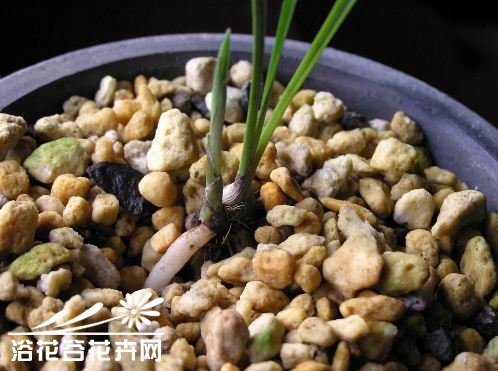
I. Switching and selecting the potting medium Discard the old sphagnum moss and switch to vermiculite (Zhijinshi) for planting.
Medium ratio: 90% small-grade vermiculite (Zhijinshi), 5% tree-fern fiber, 5% foam plastic granules. Use the original small plastic pot for planting, with medium-grade foam plastic chunks as drainage at the bottom of the pot. Spread out the central column on the old pseudobulb and carefully fill in the prepared medium, holding the pseudobulb with the thumb and index finger in a fist shape while the other three fingers are loosely spread to protect the tender buds and new roots from being knocked. When nearing the new roots, use small tweezers to pick up the vermiculite and gently place it so it makes close contact with the roots. Then continue using small tweezers to pick up the vermiculite and gently place it around the bud base, and then finish the pot surface. Since the medium is already moist, there is no need to water to settle the roots. Operation-process photos are included with the article.
II. Method for replacing in the original pot A friend of mine used two old pseudobulbs of Cymbidium kanran plain flower with roots to sprout. That year a strong plant was produced and it bloomed in winter, with large flowers and abundant fragrance. Many orchid enthusiasts clicked their tongues in wonder: an expert indeed! Because the old pseudobulb of the Cymbidium kanran soft-pouch, peach-cheek plain flower is so rare, I discussed with my friend to seek the best method. He set out his own experience in sprouting old pseudobulbs.
The medium ratio is: a mix of vermiculite (Zhijinshi) and volcanic stone making up 95%, with 5% sphagnum moss wrapping the pseudobulb, and the surrounding space filled completely with the hard medium of the mix. Pot used: plastic pots have good moisture retention and are clean, making them best for sprouting old pseudobulbs. Technical treatment: plain cultivation. After the sphagnum moss has successfully sprouted new buds and roots have grown about 2 centimeters, slowly pull out the sphagnum moss. Do not pull it all out at once; proceed step by step, and promptly replenish the vacated areas with fresh medium. In this way, without repotting, you can safely replace the old sphagnum moss and let the new roots grow healthily in fresh medium. At this point, management enters normal procedures.
III. Comparison of sphagnum moss and vermiculite (Zhijinshi) for sprouting old pseudobulbs Sprouting old pseudobulbs in sphagnum moss: strong moisture retention, fast sprouting, and fast rooting are its advantages. The drawback is that the water content is hard to control; the lower layer holds too much water and easily causes the old pseudobulb and roots to rot. In use, take its advantages and avoid its drawbacks, keep the period of use within a month, and replace it promptly once new buds and new roots have grown.
Sprouting old pseudobulbs in vermiculite (Zhijinshi): vermiculite is clean and hygienic, has good moisture retention, and easily produces roots and buds together. Its sprouting speed is slower than sphagnum moss. After the buds emerge and grow roots, there is no need to change the medium, and you can directly shift gradually into normal management. For example: the buds sprouted from the old pseudobulb of the newly collected plum-petal variety are already over ten centimeters, with good roots and three leaves on the bud, now recovering vigor. Summary: Examples prove that after sphagnum moss has been used in cultivation for more than a month, the inner layer becomes waterlogged and slowly rots, easily breeding fungi, and easily accelerating the hollowing and rotting of old roots; if left too long it will harm the old pseudobulb and buds. The surface layer, which easily dries out, does not rot easily, so it is more suitable for covering the pot surface to retain moisture in balcony and outdoor granular cultivation.
Recommendation: For very old pseudobulbs, use sphagnum moss for plain sprouting, and promptly change the medium once buds and roots emerge. For slightly younger old pseudobulbs that have roots, you can directly use vermiculite (Zhijinshi) or other hard media for plain sprouting, and after buds and roots emerge you can gradually shift into normal management.