How to Propagate and Care for Phalaenopsis Orchids? A Full Analysis of Practical Tips
The Phalaenopsis orchid is an epiphytic orchid native to the tropics and has long been known by the beautiful title “Queen of Orchids.” It bears a raceme with many flowers, the flowers resemble butterflies in shape, the flower colors are gorgeous and rich in variety, and the flowering period is very long. It is one of the most widely and commonly cultivated species in the Orchidaceae family, deeply loved by people around the world. As a very important indoor flower, it can often be seen in homes and offices, and in some regions it is also often used as a bride's bouquet.
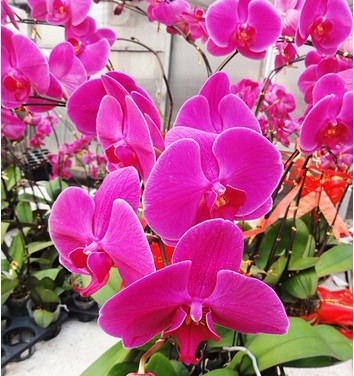
Propagation methods for Phalaenopsis orchids:
Phalaenopsis orchids are generally propagated by tissue culture and division, but when no tiller buds are produced and propagation is impossible under home conditions, many flower lovers truly feel regret. Here we recommend a technique for propagating Phalaenopsis orchids using their flower stalks.
After flowering, cut off the spent flowers on the flower stalk together with the stalk, taking care to keep the un-sprouted node buds (about 3 to 4 nodes); carefully remove the bracts on the buds of the top 1 to 2 nodes to expose the node buds, being careful not to damage the buds; take a small amount of budding agent (plant hormone) and apply it evenly to the node buds; place the treated orchid in a suitable spot, keeping the temperature at 25 to 30°C and the humidity above 75%. After 2 to 3 months, 1 to 2 new flower seedlings will grow; when the new seedlings have grown to a certain size, wrap a small amount of sphagnum moss around their base with plastic film, and when the small seedlings have grown 2-3 thick roots, they can be cut off and planted separately.
When caring for Phalaenopsis orchids at home, pay attention to the following points:
(1) Temperature: The Phalaenopsis orchid originates from tropical regions and likes a high-temperature, high-humidity environment. During the growing period, the minimum temperature should be kept above 15°C, and the optimum growth temperature is 20 to 30%. When it exceeds 35°C in summer or falls below 10°C in winter, its growth will be inhibited. The peak flowering period is around the Spring Festival; a moderate drop in temperature can extend the viewing time, but it must not go below 13°C.
(2) Water: In its place of origin, the Phalaenopsis orchid mostly grows on tree trunks, with its roots exposed to the air, and it can absorb moisture from the humid air; the air humidity should be kept at 70%. When cultivated artificially, the roots are buried in the growing medium. If watered too much, the medium's aeration will worsen, the fleshy roots will rot, the leaves will turn yellow and fall off, and in severe cases it will lead to death. The principle of watering: water when dry and let it dry between waterings, and water thoroughly when watering. When the indoor air is dry, you can use a sprayer or watering can to mist the leaf surfaces, but note that during the flowering period you must not spray water mist onto the flowers, so as to avoid dropping flowers and buds.
(3) Light: The Phalaenopsis orchid needs little light, about 1/3 to 1/2 of the light for ordinary orchids, and must absolutely not be exposed to direct strong light. If it is grown on an indoor windowsill, use window screening to shade part of the sunlight: 80% shading in summer, 60% shading in autumn, and 40% shading in winter. Before and after the flowering period, appropriate light can promote the Phalaenopsis orchid to bloom and make the flowers more brilliant and long-lasting.
(4) Nutrition: For cultivating Phalaenopsis orchids, sphagnum moss and moss are generally chosen as the growing medium. The principle of fertilizing should be to apply less fertilizer and apply dilute fertilizer. During the normal growing period, apply a 2000-fold solution of orchid-specific fertilizer for root fertilization, once every 2 to 3 weeks depending on the growth situation. Before flowering, you can choose a compound flower fertilizer mainly based on water-soluble high-phosphorus and high-potassium fertilizer at a 1000 to 2000-fold solution, sprayed once about every 10 days. Stop fertilizing during the flowering period and in seasons with lower temperatures.
(5) Repotting: It takes about 2 years from seedling to flowering. For mature Phalaenopsis orchids, it is advisable to repot and replace the growing medium after flowering each spring, otherwise dirt and green moss easily accumulate, and the growing medium also easily rots and breeds pests and diseases. For potted Phalaenopsis orchids, it is advisable to use porous, breathable unglazed clay pots. When planting, the growing medium placed at the bottom of the pot should account for at least 1/2 of the pot's capacity, and part of the roots should be left exposed on the pot surface; never bury them completely and deeply, otherwise it will hinder breathing and growth.