How to Increase the Germination Rate of Orchids? Practical Methods Shared
Most orchid growers hope their orchids will produce plenty of new shoots, which brings up the question of how to increase the orchid sprouting rate. Drawing on my own experience growing orchids, I believe effort needs to be put into the following aspects.
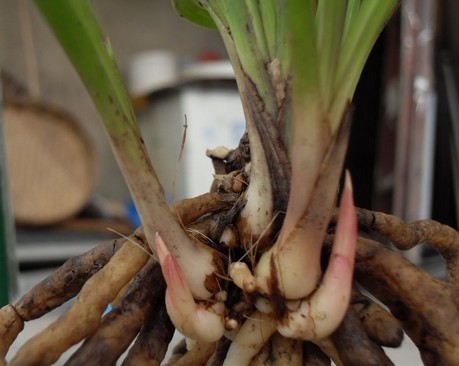
First, ensure good roots and strong shoots
New orchid shoots grow from the pseudobulbs, and the pseudobulbs are the mother body from which orchids grow roots, sprout, grow leaves, form buds and bloom. Although in theory each mature plant can produce about 6 orchid shoots, under normal circumstances each plant produces only one shoot; only vigorous plants with abundant roots and leaves can produce double shoots, or even more, while the remaining bud points stay dormant. It can be seen that raising one's orchid-growing skill so that the orchids have abundant roots and leaves is the basic prerequisite for increasing the orchid sprouting rate.
Second, divide the plants reasonably
In China, Chinese orchids are mostly propagated by division, a form of asexual propagation. When there are too many orchid plants in a pot, the nutrient supply cannot keep up, which inevitably leads to fewer and weaker shoots. Therefore, the ancients, when growing orchids, had a saying: "when extremely weak, combine; when extremely vigorous, divide." When there are too many orchid plants in a pot, they must be divided reasonably at the right time; this is the most important and most basic method for increasing the orchid sprouting rate.
Third, replant old plants separately to encourage sprouting
Generally speaking, old plants with good roots can manufacture nutrients and deliver them to the next generation, promoting the growth and development of new shoots; while old plants with no roots or poor roots can hardly manufacture nutrients on their own, and the nutrients they themselves need are provided by the new plants. Such old plants are instead harmful to the growth and sprouting of the new plants, and must be separated and replanted on their own, generally with about 3 shoots being appropriate.
Fourth, twist and bruise the pseudobulbs
The specific method is: in late autumn or mid-spring, when dividing plants and repotting, take out the orchid plants, hold the middle-upper parts of two pseudobulbs with both hands and twist them in opposite directions by 90 degrees to 180 degrees, so that the connecting stem is in a half-separated state, but do not twist it completely off. Apply thiophanate-methyl to the bruised spot promptly to prevent bacterial infection, then plant the orchid back into the pot. In this way, the half-separated pseudobulbs of the grandfather, father and child generations can each send out new shoots. However, this method is only suitable for Cymbidium goeringii (Spring Orchid), Cymbidium sinense (Chinese Cymbidium) and Cymbidium ensifolium (Fragrant Orchid), which have relatively large pseudobulbs; it is not suitable for Cymbidium faberi (Faber's Cymbidium) and Cymbidium tortisepalum (Spring Sword), which have relatively small pseudobulbs and short connecting stems forming clumps.
Fifth, propagate from single plants
This should be done in late autumn and early winter or in late spring and early summer, and can be carried out by cutting the connecting stem without repotting. The steps are: remove the growing medium above the pseudobulbs to expose the connecting stem between two pseudobulbs, cut the connecting stem with sterilized scissors or a scalpel, apply thiophanate-methyl to the wound promptly for disinfection, let it dry in the air for two to three hours, then fill in sterilized growing medium.
Sixth, use plant growth regulators
The use of orchid sprouting agents can multiply the sprouting rate of new shoots and old plants, making it possible to produce two to three generations, or even four generations, of shoots in a year. But the shoots forced out can only grow into mature plants in especially superior modern greenhouses with the help of various nutrient solutions; in natural or semi-natural environments, only strong large shoots can grow normally. At the same time, because the new plants forced out by hormones are already overdrawn, after being introduced and cultivated in a natural environment they often cannot sprout normally the following year, and generally need a year of rest and recuperation before they can sprout normally.
Seventh, thin the buds appropriately
Orchid growers should, according to the vigor or weakness of the potted orchids and following the principle of removing the weak and keeping the strong, promptly thin the flower buds that emerge after the Start of Winter and those produced by back pseudobulbs. Generally, a full pot of vigorous Cymbidium goeringii (Spring Orchid) can keep two or three flower buds, and Cymbidium faberi (Faber's Cymbidium) can keep just one flower bud. This concentrates the nutrients and helps increase the sprouting rate of the orchids.
Eighth, let the orchids get appropriate rain in spring
Spring rain plays an irreplaceable role in plant growth. Practice has shown that, as long as the air pollution where you live is not heavy, letting orchids get rained on after half an hour of rain in spring, when pollutants in the air are greatly reduced, is very beneficial to the growth of orchid shoots.
Ninth, appropriately shorten the orchid dormancy period
Orchids go through two dormancy periods in a year, in summer and winter, and orchid growers can achieve the goal of more sprouts by appropriately shortening the orchid dormancy period. The specific methods are: starting from the Start of Spring, raise the temperature of the orchid room to above 15°C and keep it there for about one month, so that the orchids enter the growth period early from dormancy and are prompted to sprout early; second, when the temperature of the orchid room in midsummer is above 30°C, find ways to lower the temperature of the micro-environment to around 25°C, shortening the summer dormancy time of the orchids and extending the growth time.