What are the pros and cons of soft potting media for orchids
Orchid roots are very tender, watery, and snap easily. The kind of root with a very long crystal tip is called a water root. This kind of root is relatively long with a fairly uniform surface. It is not tough; during transport or repotting it is easily damaged, and if you change the potting medium and do it poorly, the roots will hollow out. If the orchid you buy has beautiful roots with long, very tender crystal tips, then once it arrives home those crystal tips are bound to be damaged. The more tender and plump they are, the more damage they suffer, and the slower the plant adjusts to its pot. Are such roots bad? Wrong, they are very good. An orchid with this kind of root grows fast, develops quickly, has a high sprouting rate, and sprouts early (because soft potting media holds warmth better). But if you are introducing a new plant, it adjusts to the pot more slowly, and you cannot casually switch potting media. If you grow orchids just for your own enjoyment and want to grow them in large pots, using soft potting media is better. Especially for growing Cymbidium tortisepalum (Lianban orchid), it is the only choice.
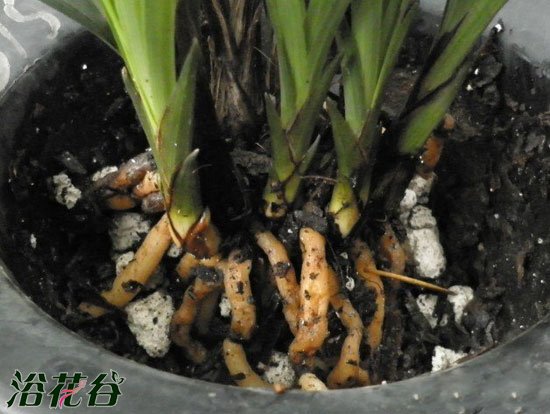
How do you grow tough roots with soft potting media?
1. Soft potting media must be mixed with hard potting media such as inorganic orchid stone (soft media rots easily and turns acidic; mixing in hard media has a balancing effect).
2. Control water. If soft potting media is too wet, it easily produces water roots and easily rots roots. If too dry, some parts cannot absorb water thoroughly and roots easily hollow out. Mixing in a certain amount of hard potting media is precisely to make water control convenient in early autumn, to make water absorption even, and to make roots tough, robust, and easy to divide and propagate!
3. When using soft potting media, it is best not to fertilize again; if applied poorly, it very easily causes black roots and hard roots!
I still prefer hard potting media; it is convenient to manage. Whether there is a bit more or a bit less water, it does not matter! In the past I grew quite a few pots of grass with soft potting media; they sprouted early and grew fast, but once management could not keep up, problems easily arose. Now I have gradually replaced them all, or mixed in a large amount of hard potting media. Only a few pots of Cymbidium tortisepalum (Lianban orchid) are still using soft potting media! My soft potting medium is finely washed peat, plus some used fine-grained hard material; it grows fairly well, but repotting needs to be more frequent! Finely washed peat is a good thing. I have never seen finely washed peat for sale online! Do not use that kind of peat block.
Knowing a certain amount of theory about growing orchids is a good thing and very necessary, but theory is not for copying directly; it is for flexible application in combination with your own actual conditions! Explore slowly, summarize, and there will always be one that suits you..
Practice brings true knowledge. Other people's experience can only be borrowed and referenced. I suggest still using hard potting media; it is convenient and not prone to problems!
But if you also want more sprouts, earlier sprouts, and fast growth, you can slowly add an appropriate amount of soft potting media. Finely washed peat is the only choice. Nothing else can compare with its warmth and moisture retention!