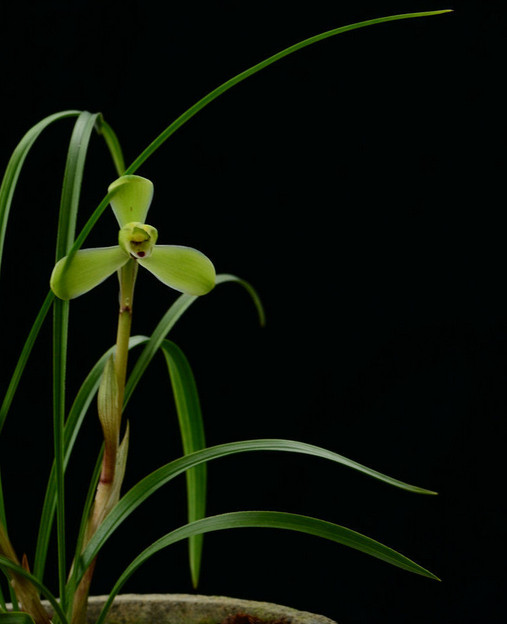
Introduction to the Chunlan 'Dingyuan Mei' Variety and Key Appreciation Points
Floral art: Plum petal. History: On February 19, 2006, during the 16th (Guiyang) Orchid Expo, Mr. Wan Yunkun obtained it by peeling open a flower bud at a stall in the square flower market as a gamble. Mr. Liu Yongfu, a native of Yezhong Township, Shuicheng County, Liupanshui City, Guizhou Province, dug it up within the territory of Wanshan County, Tongren City, Guizhou Province (in the mountain range near Guangxi, Hunan, and Chongqing)...
Floral art: Plum petal
History: On February 19, 2006, during the 16th (Guiyang) Orchid Expo, Mr. Wan Yunkun obtained it by peeling open a flower bud at a stall in the square flower market as a gamble. Mr. Liu Yongfu, a native of Yezhong Township, Shuicheng County, Liupanshui City, Guizhou Province, dug it up within the territory of Wanshan County, Tongren City, Guizhou Province (in the mountain range near Guangxi, Hunan, and Chongqing).
Characteristics: The plant type is compact, with leaves held obliquely and accompanied by semi-pendent leaves. There are 5-8 leaves, the longest leaf is 28-35 cm, the widest is 0.9 cm, the color is yellow-green, the leaf texture is thick and firm yet glutinous, with luster, forming a deep "V" shape, the marginal teeth are fine (slightly coarser than Jiangsu-Zhejiang grass), the leaf tip is sharp and has an awn-like pointed tip; the plum petal form when open, the five petals are separated at the base, the flower color is emerald green, the three outer petals bloom in an embracing posture, with tight edges and a hooded form. The middle of the petal is broad, the petal tip is round, and the base tapers finely. The petal is 3 cm long and 1.5 cm wide. The flower diameter is 5 cm, with level shoulders and a slight flight. The back of the petals has a peeled-orange-like raised groove running to the petal tip that curves back into a hood, also like the back of a lotus petal; the soft silkworm-moth or semi-hard silkworm-moth central petal is round, neat, smooth, and embraces the column, lasting more than a month without folding. The Liu Hai tongue droops slightly, and the heart-shaped red patch on the tongue surface is bright and eye-catching (white tongue occurs very rarely).
Flower scape: upright and slanting outward or erect, the stalk is mercury red, fading gradually upward, and the small flower stalk at the turning point is pure tender green. It is 0.3 cm thick and 20-22 cm tall. The flowers above the leaves present a spectacular display.
Flower bud: mercury-red sheath or green sheath with purple vein patterns, the veins are coarse, sparse, and extend to the top, the sand halo is good, and the pointed tip shows a white head. Shelling off is excellent. The base of the bud sheath shows a mercury-red sand halo that gradually turns purple upward; due to the swelling of the petals, the upper part of the bud sheath bulges, so the purple veins are sparse and the sheath color is pale green. The small close-fitting bract is shaped like a miniature olive, with dense purple veins at the base, and the green color becomes progressively richer upward. The small bract with strongly masculinized central petals has heavy green color, while the soft-petal type has lighter green color. The five bud sheaths are thin yet hard in texture and fairly well formed.
Since "Dingyuan Mei" formed its bond on February 19, 2006, it has been at Guoxiang Ju for eight years in a flash. From the initially unremarkable 5 shoots of residual-root grass, it has been cultivated to more than 40 pseudobulbs today, which has truly not been easy. What is comforting is that the flower quality becomes more and more charming.
Looking back then, that refined and utterly unremarkable flower bud had been picked up and looked at and then put down again by countless people in the surging crowd. Who would be willing to take away these few shoots of residual-root grass whose flower bud had been peeled open to reveal smooth-mouthed central petals? Everything is related to fate. When I encountered it, I remembered that the night before I had dreamed of finding several shoots of plum-petal orchid, and I immediately could not move my feet. Friends around me all advised me, saying what was there to like about this grass, it had no form, and the flower bud was not outstanding either. So, after circling many times, by the afternoon these few shoots of grass were still there with no one asking about them. Carrying a special affection for these few shoots of grass, feeling that she lay on the ground pitifully unnoticed, I could not help squatting down and holding them in my hand to look carefully. My friend could not argue me down and had no choice but to let me appreciate them without further dissuasion. In the end, the deal was made at 200 yuan, the price of a smooth-mouthed narcissus plant.
While appreciating the flower bud, I also asked where this grass had been dug. Since all the raw grass at that stall was the fruit of the digger's own labor, he told the details of its mountain origin without any ambiguity. Of course, at the time of the deal, it was unavoidable to also look at the other party's ID card.
In 2006, against the crazy backdrop of the orchid market, many mountain people in Guizhou, like mountain farmers in Jiangsu and Zhejiang, first dug out all the nearby resources, then teamed up to seek orchids in deeper and more distant places. Some of them, under the oral instruction of orchid enthusiasts, gradually mastered a little knowledge of the "petal-type theory," but many were not proficient and could not accurately grasp the precise requirements for plum and narcissus types, let alone the specific appreciation of flower buds, which was even harder. They only knew that a thick block in the central petal meant a good flower. At first, when they brought them to orchid shows, they all thought their own were excellent treasures and waited to sell at a high price. By the time the day was almost over and no one asked about them, their confidence was completely gone.
A heaven-sent good bond, it was destined that she and I would be bound for life. This was my second opportunity since spring 2005, when I gambled at a flower market and obtained the green cymbidium top-grade outer butterfly "Guoxiang Yan Die." The difference was that this time there was a dream as a sign, and in a market of millions of plants I took a fancy to only her, who was unremarkable in appearance.
At first, this grass was named after the "Yun" in the middle of my name and called Yun Mei. Later, when I saw in an orchid magazine that Yun Mei had already been used, I adopted the second naming plan, interpreting my meeting, following, and accompanying bond with this grass as destined by fate, and called it Dingyuan.
"Dingyuan Mei," upon blooming again for the third consecutive time, successfully completed "China Orchid Variety Registration" in April 2010.
China Orchid Variety Registration Certificate
Number: (Lan) No. 0339
Name: Dingyuan Mei (Chunlan)
Latin name: Cymbidium goeringii CV."Ding yuan Mei"