How to Water Orchids Correctly? A Detailed Guide to the Method
How to water orchids is a headache for beginners just starting to grow them. First of all, water is an important component of the protoplasm of orchid plants. The water content of orchid protoplasm is generally above 80%; if the water content decreases, life activities are affected. If the protoplasm loses too much water, it will be damaged, leading to the death of the plant.
Secondly, water is a raw material in the metabolic process of orchid plants. Both assimilation and dissimilation within orchid plants require the participation of water molecules, such as photosynthesis, respiration, and hydrolysis reactions.
Thirdly, water is the medium of the metabolic process of orchid plants. Nutrient elements in the growing medium can only be absorbed by orchid roots after dissolving in water, and various metabolic products must also be transported with water to all parts of the orchid plant.
Fourth, water enables orchid plants to maintain their inherent form. Only when the cells of orchid plants contain a large amount of water can the cells expand and the plant stand upright, facilitating light reception and gas exchange. Once an orchid plant loses water, it will wilt.
Fifth, water can regulate the body temperature of orchid plants. Water has a high heat of vaporization and specific heat, as well as relatively high thermal conductivity, which helps orchid plants maintain body temperature and dissipate heat. One of the important functions of watering orchids is to regulate the body temperature of the orchid plant.
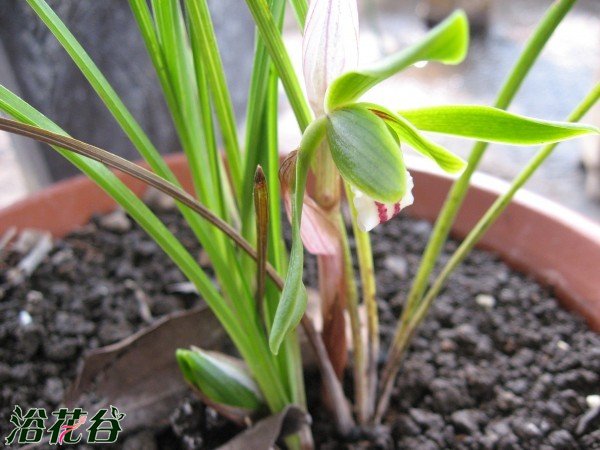
First, it should be based on the growth season of the orchid. Orchids should be watered more during the growth period or bud gestation period, less or not at all during the dormant period, more during the sprouting period, less after sprouting, more when flower buds appear, less during the flowering period to prolong the flowering period, and watering should be stopped for several days after the flowers fade to let them rest before watering again
Secondly, it should be based on the growth condition of the orchid. Water more for orchids with strong growth, less for those with poor growth, do not water diseased plants, water sparingly or not at all for orchids that need rescue, water more when there are many plants in the pot, and less when there are few.
Thirdly, it should be based on the moisture retention of the growing medium. A medium with fine particles and strong water retention (such as mountain soil and sawdust, etc.) consumes water slowly, so the frequency of watering should be reduced; on the contrary, a medium with coarser particles and weak water retention (such as Xiantu) requires more frequent watering.
Fourth, it depends on the texture and size of the pot. Clay pots with strong air permeability should be watered more, while purple clay pots and plastic pots with poor air permeability should be watered less. Small pots dry easily, while large pots dry slowly, so the frequency of watering also differs.
When to Water Orchids
There is also a certain scientific basis for the timing of watering orchid plants. Generally speaking, watering in the morning is preferable.
Generally speaking, when orchids are outdoors in late spring and summer and autumn, it is best to water in the morning: first, after a night of cooling, the temperature of the growing medium in the pot is lower in the morning, and watering at this time will not harm the seedlings
Second, watering thoroughly in the morning allows the medium to become moist by evening, with no standing water in the pot at night and air circulating in the pot, which is beneficial to the respiratory cycle of orchid roots and to orchid growth.
Third, if watered in the evening, water evaporates slowly at night and easily causes standing water, while during the day when transpiration is fast the pot has already become moist, creating the situation of “standing water in the pot when it should be dry, and lack of water in the pot when it should be moist”;
Fourth, in the evening the orchid pot temperature is still high, and suddenly watering with cold water causes a sudden temperature drop, which can affect root water absorption and disturb the physiological balance; fifth, at night the temperature is low and the cellular activity of orchid plants is weak, so excessive water can cause bacteria to multiply and can also breed snails and slugs. When orchids are indoors in winter and early spring, the watering time should be appropriately delayed, and it is best to water around nine o'clock in the morning after the temperature rises, or at noon.
Regarding the timing of watering, the principle to grasp overall is: water orchids in the morning, water a little earlier when the temperature is high, and water a little later when the temperature is low.
The Amount of Water for Orchids
“Water thoroughly when you water” is a standard for measuring how much to water orchids. What is “watering thoroughly”? The standard for “watering thoroughly” is not only that water flows out from the drainage hole at the bottom of the pot, but also that all the growing medium in the pot is soaked through. Often, after one watering, although water flows out from the bottom hole, it still does not reach the standard of “thorough.” To soak all the growing medium in the pot, you can water in several rounds or use the immersion method. For dry granular growing media, thorough watering is impossible without immersion, but the immersion method should not be used continuously; there must be a certain interval to give the orchids time to breathe. In addition, in winter and early spring, the amount of water used should not be too large, and moistening is preferable.
In short, the watering methods of others who have succeeded in growing orchids are not necessarily suitable for your orchid garden. When flower buds are forming, keep it on the dry side; when grass shoots are sprouting, keep it on the moist side; when petal-type flowers are in full bloom, keep it slightly moist; when unusual-type flowers are blooming, it can be moist.