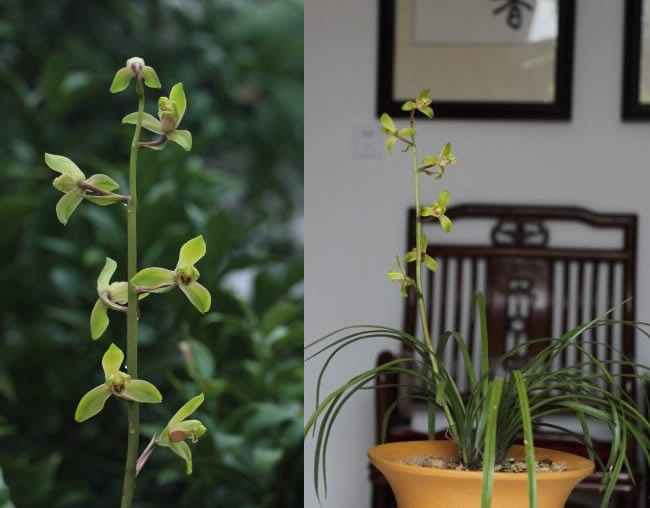
Introduction to the Characteristics of the Qingping Fengqiao Huilan (Cymbidium faberi) Variety
A full 10 years, from the discovery of Huangshan No.1 Hui, its emergence, its decline, to today's hard-won rejuvenation - now I know what vicissitudes really mean. Last year I wrote an article about it, and this year I'll add a few more words. I like reading all kinds of books, miscellaneous rather than specialized, reading just for the sake of chatting. Over a decade ago I once read about the appreciation of orchid petal types...
A full 10 years, from the discovery of Huangshan No.1 Hui, its emergence, its decline, to today's hard-won rejuvenation - now I know what vicissitudes really mean. Last year I once wrote an article about it, and this year I'll add a few more words.
I like reading all kinds of books, miscellaneous rather than specialized, reading just for the sake of chatting. Over a decade ago I once read about the appreciation of orchid petal-type flowers, and learned that the originator of orchid petal types - Bao Yiyun - was actually right beside me, at Yansi in ancient Huizhou, my own hometown, by the banks of the Fengle River. Yansi, a key town of ancient Huizhou, is now the seat of the Huizhou District government.
Appreciating orchids really can only be considered a side pursuit. When "Yanzhen Zhicao" introduced Bao Yiyun, there was nothing about his orchid research; it only said that his poetry was especially good, and that Qian Zhongshu greatly admired it.
Yet among the orchids of Huizhou, the precious varieties mentioned in works on orchids have almost never appeared. The only one is 'Huizhou Mo', which in the end proved not to be an orchid originating from Huizhou, because Huizhou has four distinct seasons and does not produce Jianlan (Cymbidium ensifolium) or Molan (Cymbidium sinense).
Checking back, my first introduction of Huangshan No.1 Hui on the China Orchid Network was on March 31, 2004, almost the same time as this year. Across these vast 10 years, having weathered wind and rain, it has finally rejuvenated and produced normal flower form. Thanks to heaven and to my own sincerity, and thanks to those who have followed this flower.
Of course, the one most deserving of thanks is Mr. Bao, parted from us for 300 years. I once very much wanted to name this flower after Mr. Bao, but in the end it was hard to convey his meaning, so I had to choose a very plain name: Huangshan No.1 Hui and Qingping Fengqiao. Because it was after all born in Mr. Bao Yiyun's hometown, it can be counted as a response from heaven, and as a kind of remembrance of Mr. Bao from 300 years ago.
Because in Bao Yiyun's hometown, a petal-type flower of Huilan (Cymbidium faberi) has finally appeared.
This flower is a red-turning-green floating-door lotus-type narcissus, opening at first like Zhengxiao He, and after three days gradually floating up like Old Fengqiao. The front half of the petals is as green as jade, the back half like yellow jade, with colors as glistening as rouge. The plant type has arched leaves exactly in place, standing well above the pot, with a green tongue marked with radiating red patches. The central column is excellent, and within the sepals a few scattered dots like millet grains can be seen.