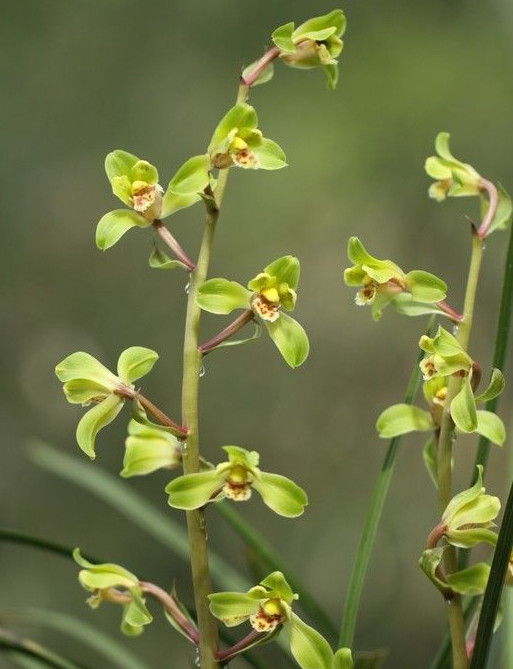
Introduction to the Cymbidium faberi 'Huizhou Mei' Variety and Key Appreciation Points
In March 2002, it was collected in Xiuning County, Huangshan City, Anhui, and first rebloomed in 2005. Because it was the first Cymbidium faberi plum-petal variety selected and bred within Huangshan City (formerly Huizhou Prefecture), it was named: Huizhou Mei. Huizhou Mei is a red-to-green Cymbidium faberi; the foliage is hard and V-shaped, with leaves about 0.8 cm wide and 45 cm long. The flowers are dignified and elegant, emerald green with a glutinous texture; the outer petals are short and broad...
In March 2002, it was collected in Xiuning County, Huangshan City, Anhui, and first rebloomed in 2005. Because it was the first Cymbidium faberi plum-petal variety selected and bred within Huangshan City (formerly Huizhou Prefecture), it was named: Huizhou Mei. Huizhou Mei is a red-to-green Cymbidium faberi; the foliage is hard and V-shaped, with leaves about 0.8 cm wide and 45 cm long. The flowers are dignified and elegant, emerald green with a glutinous texture; the outer petals are short and broad; the petaloids form a pouch with a distinct white tip; the lip is a zhihui-type tongue evenly marked with red spots; the fragrance is distant and lasting.
Origin of Huizhou Mei: An Early Manuscript by the Flower Owner
In 2002, the flower owner learned from his friend Mr. Qian that a local flower farmer had dug up a Cymbidium faberi plum-petal plant, and Mr. Qian asked whether he wanted to go and take a look. Because he had heard too many such remarks and been disappointed too many times, and because he was busy with work, he did not take it to heart and soon forgot about it. Fifteen days later, the flower owner and Mr. Qian went to a bonsai garden in Wan'an Town. While chatting, the Cymbidium faberi came up again. The flower owner thought it was not far away and decided to go take a look. They immediately drove with Mr. Qian to the flower farmer's home. After a bumpy ride, the villagers pointed out the flower farmer's house in the distance. After greeting each other, the flower farmer led me to the fence of his vegetable garden and said: quite a few Cymbidium faberi and Cymbidium goeringii are planted here, take a look yourself. After a sweep, no "rare flowers and exotic plants" were found. The flower farmer then took out a bottle from inside the house and handed me a flower scape broken off from the mother plant. The scape was about one chi long, with nine emerald green flower buds arranged in order, each shaped like a peanut. Although not yet open, they were just like the buds of traditional old and new Cymbidium faberi varieties. Once I had calmed down, I asked about the origin of this flower. He said: this past year my health has not been good, so I did not go up the mountain to dig orchids; these 2 plants were seen by chance while I was up the mountain keeping bees. This flower grew under a tree stump, with 4 plants and 1 flower. At the time, I saw that the buds were different from other orchids, so I dug up the 2 plants with flowers. After hearing this, I proposed going to see the place, with the intention of also getting the other 2 plants. After repeated negotiation and requests, he finally agreed to accompany me up the mountain.
After walking all the way without any discoveries, I asked: are there orchids here? He said: in earlier years they were everywhere, but in recent years the locals have dug them all up. Hearing this, I could not help but feel somewhat worried. We kept climbing to halfway up the mountain and saw scattered orchids. Then the flower farmer pointed with his hand under a large tree stump and said: that is the place. Looking in the direction he pointed, there were indeed 2 Cymbidium faberi plants. The flower farmer pulled the orchids out in a few movements. On closer inspection, not a hair was damaged. After cleaning them, we wrapped them in mountain moss and went down the mountain. Back at the flower farmer's home, a detailed comparison with the plants in the vegetable garden showed they were completely identical. After several rounds of negotiation, all 4 plants were acquired together.