What should I do if my Cymbidium only grows leaves and does not produce flower buds?
Cymbidiums are usually bought when they are in full bloom, and getting them to bloom again the following year is relatively difficult. Zhang Shaoyi's Cymbidium in Wuhu, Anhui, only grows leaves and does not produce flower buds, so what should be done? See the advice given by experienced flower growers below.
Answer1:Cymbidium is a plant that must go through a low-temperature stage before it can bloom. Let us start from the beginning. As early as the previous bloom, green shoots emerge from the base of the pseudobulb, and these shoots must be protected. When the flowers are fully open, it is best to cut off the flower stems and put them in a vase for viewing, so as to preserve more nutrients for the shoots. If you do not cut them off, then at least cut off the flower stalks early when the flowers are about to fade. If there is more than one shoot, keep only the large one and remove the rest, and remove all shoots that emerge afterward as well. By summer this shoot will have grown into a robust pseudobulb. Around July, flower buds will emerge from the base of this pseudobulb, but at high temperatures they do not grow larger and are easily overlooked. Along with the flower buds, leaf buds also appear, and all leaf buds must be removed; this point is especially important. The difference between flower buds and leaf buds is that flower buds are round and leaf buds are flat. If you are not sure, wait until they are slightly larger and can be clearly distinguished before removing them.
If the flower buds produced in summer do not go through low temperatures, they will not elongate, grow larger, or bloom, and may even wither on the surface of the soil. Therefore, in autumn (mid-to-early October in Beijing) it must be subjected to about 20-30 days of low-temperature stimulation at around 10°C (varying by cultivar), so leave it outdoors and bring it indoors only when the temperature drops below 7-8°C. By then most of the north is already heated, so try your best to create low-temperature conditions. It can be placed on a north-facing balcony, with the window open, allowing it to receive only a little sunlight in the morning. At the same time, keep it moist; you can wrap at least two or three sides with a wet cloth and simply keep it constantly moist. After going through low temperatures, the flower buds will gradually elongate and then open. (Lu Sicong, Yu Xizhao, Beijing)
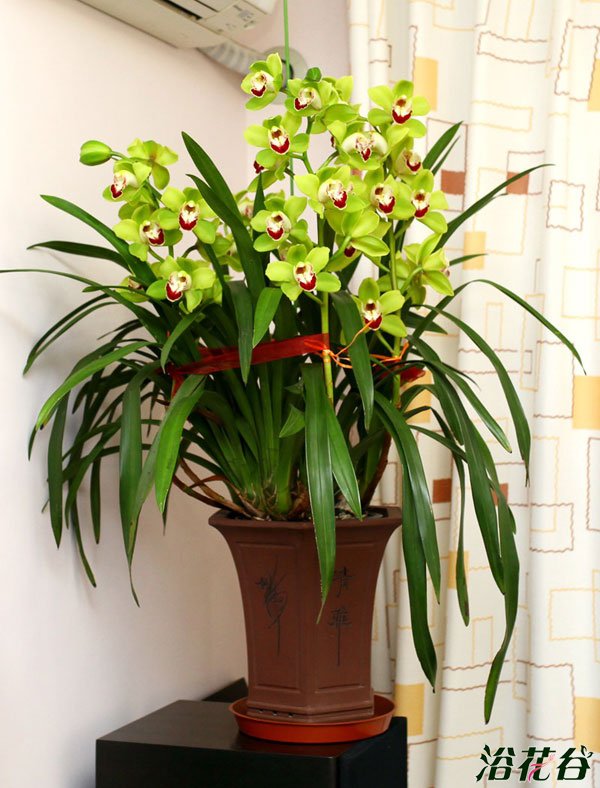
Answer2First, you need to understand the flowering process of Cymbidium. Cymbidium requires an environment with a large temperature difference for more than one month in order to carry out flower bud differentiation. Growing operations generally move it to high mountains in July for flower bud differentiation. If you can do that, then there is hope it will bloom. There is also the drying method. Plants all have this characteristic: when dried to a certain degree, they think a crisis is coming, so they quickly start their reproduction program, because seeds can be preserved for a long time, and therefore they bloom. You can try this method. However, this method causes a certain amount of harm to the plant. There is also chemical treatment, which is more specialized, so I will not elaborate on it. (Li Haifeng, Anshan, Liaoning)
Answer3The reason Cymbidium only grows leaves and does not produce flower buds is probably excessive nitrogen fertilizer and overly vigorous vegetative growth. This indicates that the plant lacks the two elements phosphorus and potassium. Phosphorus is an important substance for promoting flower bud differentiation, and potassium is an important substance for promoting flower stem differentiation and growth. Therefore, when fertilizing Cymbidium during the spring growth period, nitrogen fertilizer should be the main component, supplemented by phosphorus and potassium fertilizers, generally mainly cake fertilizer water, applied 1-2 times; while in autumn, phosphorus and potassium fertilizers should be the main component, supplemented by nitrogen fertilizer, also generally using cake fertilizer water, with an appropriate amount of bone meal or diammonium phosphate compound fertilizer, applied 1-2 times. (Xu Jinguo, Rudong, Jiangsu)