How to Grow Cymbidium Orchids? Cultivation Methods and Precautions
Many flower enthusiasts are not particularly familiar with Cymbidium orchids. They buy them simply because they look beautiful, then look for information and search for how to grow Cymbidium orchids. In fact, Cymbidium orchids are easy to grow from the time you bring them home until the flowers fade. The difficulty lies in getting them to rebloom, that is, getting them to flower again in the second year.
I. How to Grow Cymbidium Orchids
Cymbidium orchids are relatively tolerant of low temperatures. Temperatures between 10 and 30 degrees are basically no problem. Above 30 degrees, it is best to use ventilation, humidity and shading to reduce damage. In summer, autumn and the rainy season, daytime temperatures should not exceed 30 degrees. Once the temperature exceeds 30 degrees, increase air circulation, lower the leaf surface temperature, and there must also be a noticeable day-night temperature difference to stimulate flower bud differentiation. At night, do not let it exceed 14 degrees, otherwise the flower buds cannot differentiate, and even if they do differentiate, they will wither prematurely. In spring, ensure air circulation during the day. Placing it in a cooler environment can extend the flowering period, because outdoor temperatures at night are usually below 10 degrees, so do not place it outdoors.
After the surface of the potting soil dries, water thoroughly, giving it a good soak at one time. Usually sprinkle water around the orchid pot to increase air humidity. Unless the environment is especially dry, do not spray water on the leaves, otherwise brown spots will appear on the leaves. During the flowering period and when new shoots have not yet grown, reduce watering and just keep the potting soil slightly moist. After new shoots grow, the water requirement increases. Temperature also affects watering accordingly. When the temperature is low, reduce the amount of watering; when the temperature is high, increase it accordingly. During the flowering period, there is also no need to fertilize. During the shoot stage, apply solid fertilizer and liquid fertilizer alternately, but the concentration should be low. Standard liquid fertilizer is generally diluted 1000 times, once every two weeks. A small amount of solid fertilizer is enough. Do not apply in winter.
Good ventilation is necessary to ensure the normal growth of Cymbidium orchids. For indoor cultivation, open windows as much as possible to ensure air circulation. In high temperatures or enclosed environments, use an electric fan as much as possible to increase air circulation.
Cymbidium orchids like light. From the end of October through the entire winter, they can receive direct sunlight. In spring, shade 30%, and in summer, also shade 30% to 40%. If grown on a balcony, the balcony should also avoid excessively high temperatures and overly intense sunlight in autumn and winter. Insufficient light is detrimental to growth.
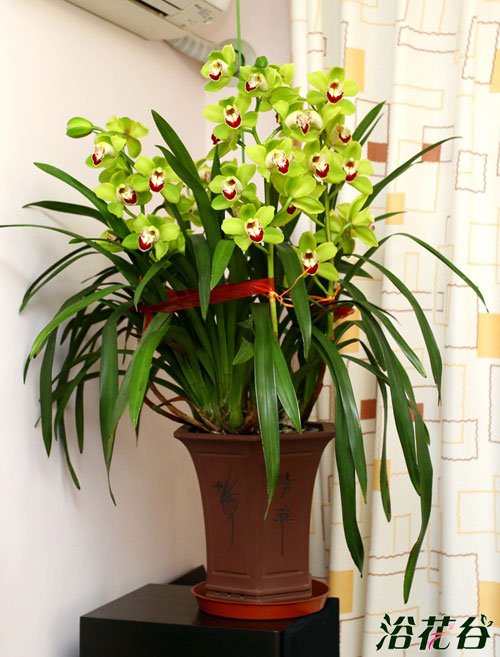
II. Suggestions for Getting Cymbidium Orchids to Rebloom
1. If bought as a New Year festive flower, it usually comes with a pot, so there is no need to repot. After checking with many experts at reblooming, they also do not repot. The orchid roots in the pot grow densely and do not need to be tidied. The experts say that Cymbidium orchids only bloom when grown in small pots.
2. If it is a bare-root seedling without a pot, it can be cultivated with medium-sized granular bark and humus soil, common potting media for Chinese orchids. The pot should not be too large, and the planting method is similar to that for Chinese orchids. If there are too many seedlings in one pot, they can be divided. Generally, 3 to 4 seedlings per pot. Too many seedlings also make reblooming difficult.
3. For balcony cultivation, in spring it needs to be grown in a sunny place without shading. In summer, shading is needed. The key is good ventilation, more compound fertilizer (the amount should be slightly more than what Chinese orchids need, that is, light fertilizer applied frequently; for example, for the same fertilizer, if Chinese orchids need to be diluted 1000 times before use, then Cymbidium orchids can be diluted 800 times), and frequent watering (it cannot dry out completely; drying out completely is very harmful to orchids; when moisture content is 30%, it can be watered). If conditions permit, it can be placed outdoors. In general, it is extensive management.
4. Cymbidium orchids need a vernalization process. In late autumn, keep them at night temperatures below 14 degrees for about 55 days, then they can be moved indoors. In summer, when temperatures are above 30 degrees, spray water and ventilate to cool them down.
5. Diseases of Cymbidium orchids can be treated the same way as those of Chinese orchids.
Summary: The main points are strong light, more fertilizer, and increasing the temperature difference in autumn to force flowering. If these conditions are met, they can rebloom.