What are the cultivation methods and precautions for Phalaenopsis?
Flower enthusiasts like Phalaenopsis, but also feel that Phalaenopsis is difficult to care for, and they do not know much about the cultivation methods for Phalaenopsis, so some flower enthusiasts even choose to discard it after the flowers fade. In fact, Phalaenopsis is very easy to grow, even much easier to grow than the potted jasmine and Aglaia odorata commonly seen in our northern regions.
Regarding the cultivation methods for Phalaenopsis, you may want to pay attention to the following points, and then your Phalaenopsis will surely bloom beautifully every spring.
1. Flower pot: If you are observant enough, you will notice that the Phalaenopsis sold on the market are all planted in white transparent plastic pots. It should be noted that this is not because merchants are unwilling to use good pots to reduce costs, but because the roots of Phalaenopsis need to carry out photosynthesis, so the roots of the well-growing Phalaenopsis you see are green, which is the result of photosynthesis. If you care for them at home, you can choose a colorless transparent plastic container, as long as the size is suitable.
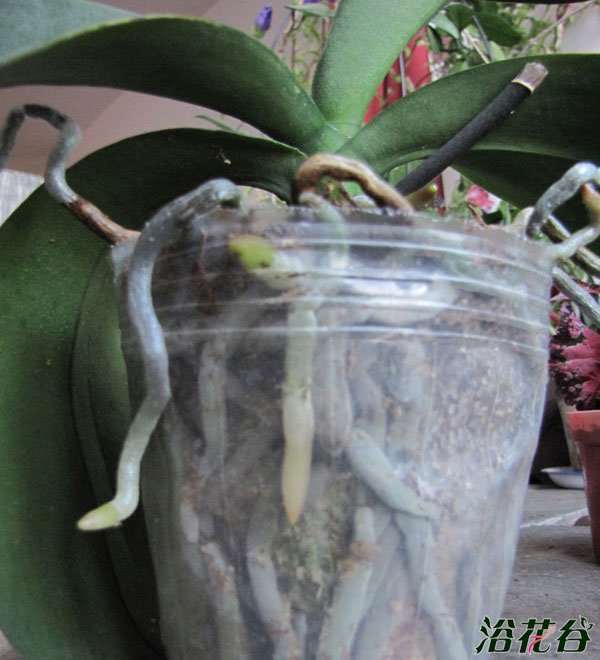
2. Flower soil: Generally, sphagnum moss is used to grow Phalaenopsis. The quality of the sphagnum moss is also very important. Do not choose one that is too fragmented and powdery, because sphagnum moss has very strong water retention, and too fragmented sphagnum moss will cause too much moisture at the roots and lead to rot. Because sphagnum moss has good water absorption, when growing Phalaenopsis you can spread some ceramsite or orchid-growing substrate at the bottom of the pot, and then use sphagnum moss for care.
3. Treatment after blooming: Most people receive Phalaenopsis as a gift from friends during the Spring Festival or buy Phalaenopsis themselves. With normal watering, allowing the soil to dry and become wet alternately, they can generally bloom until March or April; if it is a Phalaenopsis you grow yourself, it is still blooming brightly by mid-May now.
After the Phalaenopsis you bought back finishes blooming, there are two ways to handle it: one is to choose to cut off the flower stalk, which can effectively reduce the loss of nutrients and preserve nutrients for flowering around the Spring Festival; the other is to choose to keep the flower stalk and provide normal care. Generally by mid-May, a new branch will grow on this flower stalk and continue to bloom;
In the north, blooming twice a year is very normal. After this blooming ends, cut off the flower stalk and provide normal care. Around the Spring Festival, a flower stalk will grow from the base of the leaves, form buds, and bloom.
For plants that bloom twice, because nutrient consumption is relatively large, fertilizer needs to be applied reasonably and appropriately to ensure abundant blooming the following year. I am rather lazy about growing flowers. Generally, after the first flowering period, I choose to cut off the flower stalk. At this time it is already May or June, and having enjoyed the flowers for half a year is already very satisfying, so I cut off the flower stalk to maintain the plant.
4. Phalaenopsis does not have strict light requirements. Although many can grow normally with just diffused light, if your home flower-growing environment is good, you can choose to place them under large plants, which both maintains good humidity and avoids direct sun exposure, achieving two benefits at once.
5. It is already very difficult to buy small Phalaenopsis seedlings from the market now, so going to look for Phalaenopsis that have already bloomed is a good method. How to find robust Phalaenopsis: every year after the Spring Festival, some merchants will successively take unsold Phalaenopsis off the shelves and pile them by the wall, priced at 2.5-3 yuan/pot. This is exactly a good time to look for them. As long as you are patient and observe carefully, you can buy very good Phalaenopsis. The method is simple: first look at the roots: the roots should be somewhat green, with shiny, moist, and robust root tips; then feel the leaves: the leaves should be thick, somewhat firm, and glossy; if the flower stalk is still there, see whether it is dried up. It is best if it is not dried up, which indicates good growth.