How to water orchids in summer? Master the correct watering method
I. Learning from the successful growing experience of senior members on Zhongjiao.net
1. Laobai: Orchid growers all know that when humidity is high, the shoot production rate is high, and new plants also grow fast. On a balcony without a humidifier, how do you raise humidity? Watering more can raise humidity.
2. Zhu Dayong: The humidity of the macro environment is very low, and things like adding water trays have little effect. Keep the roots healthy, and even if the humidity is very low, it does not matter.
3. Guanqi: When growing orchids in granular potting media, prefer moist over dry. Especially in high-temperature seasons, I have observed rotted roots in transparent pots; when the bottom of the pot is wet every day, the orchid roots grow well. When the pot surface is dry, you can water.
4. Wei Chang: If you want good roots, you cannot have too little light. Light is the driving force for root development. The stronger the light, the more water evaporates from the leaf surface, and the more nutrients are consumed, prompting root development so as to increase water and fertilizer uptake. This is just like people: with a large amount of exercise, they also eat and drink more. As long as nutrition keeps up, and they eat well, drink well, and sleep well, it is hard for them not to be robust. Once you understand this principle, it is not hard to arrive at the management method best suited to your own environment. If your fertilizer is on the rich side, then increase light as appropriate; if the potting medium is on the fine side and has strong water retention, then also increase light as appropriate; conversely, if the potting medium is on the coarse side and relatively lean, then reduce light appropriately, and it is fine to supply a little less water; if the potting medium is coarse and the environmental light is also strong, then increase both the amount of fertilizer and the amount of watering, so as to avoid the orchid plants consuming too much and developing thin, yellowing leaves….
Based on the valuable orchid-growing experience of the seniors above, the conclusion is as follows: when growing orchids on an urban balcony, because the climate is dry, you need to water more in summer to increase environmental humidity and replenish the water the orchids lose; only then can the orchids grow normally and produce more shoots. But the prerequisite for watering more is having healthy roots. If the roots have rotted and cannot absorb water, then watering the orchids more is useless. Therefore, you must look at the orchid type, the intensity of light, and the planting material to decide how to fully supply the orchids with water and fertilizer; only then can the orchids grow vigorously.
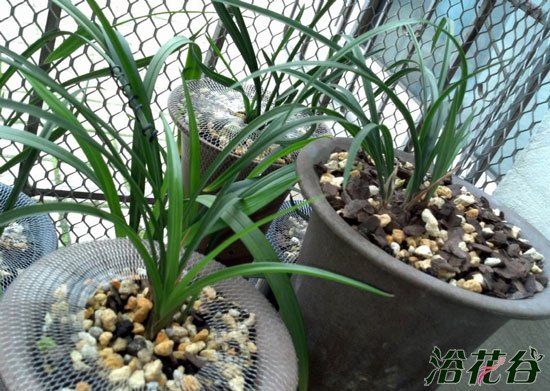
II. In summer on a dry balcony, if you grow orchids with organic materials, you must sterilize regularly in summer to prevent root rot, and the method of watering to keep them moist at noon is not very suitable; otherwise, the chance of root rot greatly increases. If you do not sterilize regularly with pesticides, it is best not to use organic fertilizer when fertilizing, because organic fertilizer relies on bacteria to decompose, and in a high-temperature, humid environment it can easily cause the occurrence of the two rots. Using Haokangduo, 20-30 granules per pot, does not harm roots or leaves. As for the dilution ratios for other orchid chemical fertilizers, it depends on the dryness and humidity of the environment, the temperature level, and the orchid type. As long as there is no fertilizer burn and the orchids grow well, that is the correct fertilizing method. Of course, you also need to observe with your eyes. For example, after new shoots emerge from the medium but have not yet opened their leaves, observe the upper edge of the leaf sheath after fertilizing. If there is blackening, that indicates the fertilizer is too strong, because this place easily accumulates water and fertilizer. After the water on a dry balcony evaporates, it leaves the fertilizer here, and when the concentration becomes high, the edge of the leaf sheath will blacken from fertilizer burn. In addition, if the roots and root tips are brown or blackened, it is mostly because the material is too rich or the fertilizer used is too strong.
III. Whether to water at noon is not the key point. The key point is whether the orchids in summer on a dry balcony lack water. If the orchids grow normally and do not fail to grow larger, then of course there is no need to water at noon. Senior Zhu Chunyuan grows orchids in large pots, watering once every two days in summer, and can grow two generations of shoots a year with good growth, so naturally there is no need to water at noon. Therefore, if in summer the new shoots of the orchids stop growing and the orchid leaves become twisted and deformed, these are signs that the orchids lack water, and at this time you should water at noon. If after watering at noon most orchid new shoots still do not grow, that can only prove one thing: your environment is not suitable for orchid growth. You can only build a greenhouse and continue growing orchids, or give up growing orchids, because watering at noon is already the last resort for growing orchids on a dry balcony. If you have tried this last resort and the orchids still cannot grow normally, then there is no other method.
IV. What I grow is Cymbidium sinense (baosui orchid), whose leaves are broad and roots relatively small. It likes a shady, moist environment and is relatively intolerant of drought. Therefore, watering at noon replenishes the lost water, so the growth condition is naturally better. But some orchids have fine leaves and many roots and are drought-tolerant, such as Cymbidium faberi and Cymbidium ensifolium; as long as they grow normally, there is naturally no need to water at noon.
V. Senior Zhu said not to take the same prescription for every illness, which means you should treat the illness according to its cause. Once the illness is cured, do not keep taking medicine. Watering at noon is only to solve the problem of growth stagnation caused by water loss from orchids in a dry environment in summer. After autumn begins, temperatures drop, the orchids' demand for water decreases, and of course there is no need to water at noon; you should slowly reduce the water supply.
VI. When growing orchids on a dry balcony in summer, fully supplying water is the key to orchid growth. If you do not use pesticides to sterilize, then you should use inorganic materials for planting and use chemical fertilizers. If you use organic materials for planting and use organic fertilizers, then you must sterilize regularly in summer. Of course, the temperature level of the environment also has a great influence, so there is no fixed method for growing orchids. Everyone must choose the growing method suited to their environment. If the orchids can grow normally and bloom, with few diseases, that is the correct orchid-growing method.
VII. In a humid environment, orchids lose less water, so you should water on the dry side. In a dry environment at high temperatures, orchids lose a lot of water, so you should water on the moist side; only then can the orchids grow normally. In a high-temperature, dry environment, if you also grow them dry, then of course the orchids will fail to grow larger due to lack of water.
VIII. A humid environment is also not suitable for watering at noon. Water accumulated in the shoot core is not easy to dry, and under high-temperature conditions it can cause shoot rot, so it is more suitable to water at night when it is cooler. In a dry environment, the water accumulated in the shoot core dries 10 minutes after watering, so when watering at noon you must also consider environmental factors and must not rigidly insist on exactly when to water.