What to Do When Orchid Roots Rot? Teach You the Correct Way to Handle It
Orchid root rot means there is a problem with your orchid care. If even one factor - environment, planting method, watering, fertilizing, spraying - fails to meet the orchid's needs, and the tips of new shoot leaves begin to wither or black spots appear on the leaves, it means the orchid has started to become diseased and its roots are rotting. If you do not find the cause and improve it, the orchid will rot and die.
I. Poor Environment:
1. Insufficient sunlight: The number of sunlight hours needed varies by orchid species, but basically at least 4 hours or more is required. If sunlight is insufficient and the light is dim, photosynthesis will be poor, the potting medium will not dry easily, and if you water too frequently, the roots will easily rot. (You need to change the orchid-growing environment or use plant grow lights to supplement light.)
2. Muggy heat: If the environment is not ventilated, muggy heat will build up. In summer the temperature will keep rising, and the effect is like slowly cooking the orchid in a pot. The orchid will suffer heat damage and its roots will rot. (The black shade net around the orchid house must not be fully enclosed; leave some gaps so the hot air can rise and escape, or install an exhaust fan to expel the hot air.)
3. No ventilation or too much ventilation: (1) Lack of ventilation not only creates muggy heat, but also makes it hard for the medium to dry after watering at night. If the medium is too fine, water retention can also easily cause root rot, and the roots will appear black, indicating it is too wet. (Use pots with holes, and do not use medium that is too fine.) (2) If the wind is too strong, and you are using pots with holes, the wind will quickly dry out the moisture in the pot. If you do not replenish water frequently, the orchid's roots will dry out, turning white and hollow, and the orchid will also die. (Use pots without holes, and use a medium with stronger water retention.)
4. Insufficient humidity: The hardest thing to overcome when growing orchids on a balcony is insufficient humidity. Orchid roots need stable temperature and humidity. If it is too hot or too cold, or too dry or too wet, orchid roots will easily rot. So improve the environment and maintain the temperature and humidity suitable for orchids. If the orchid grows normally, with pure white roots and normal root tips, then the environment is suitable for orchid growth. If the orchid keeps suffering root rot and grows poorly, most of the time it is caused by the environment being too dry, especially insufficient humidity in summer. So simply increasing the humidity needed by the roots can restore normal orchid growth.
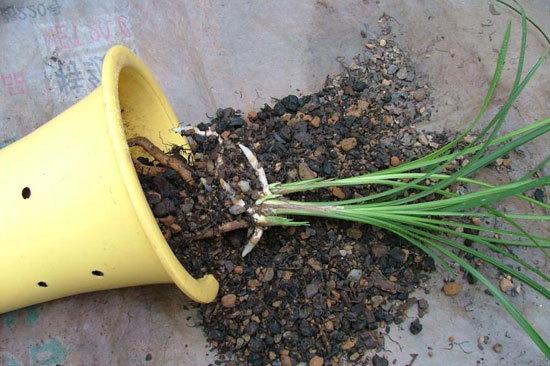
II. The Planting Method Does Not Suit the Environment
Different environments require different materials for planting. You need to consider all kinds of environmental factors, such as temperature, humidity, sunlight, ventilation, whether it will get rained on, whether there is a humidifier, etc. If even one link is not considered carefully, the orchid will be unable to adapt to the environment and will die. For example: I grow orchids on a second-floor rooftop, and the orchids get rained on. I used pots with holes and planted with Ishi-ishi (Kiryu stone) in the traditional large, medium, small arrangement (from bottom to top). As a result, the orchids either suffered root rot or died. Later I discovered the problem occurred during the plum rain season: after a month of rain, because the upper part of the pot was small-particle Ishi-ishi, water pooled there and rotted the pseudobulbs and orchid roots. And the pots with holes, in the high summer heat and wind, quickly dried out the moisture in the pot. So the orchids either suffered root rot from being too wet or died from being too dry. Only after I changed the planting method and used pots without holes did the orchids return to normal growth.
III. Wrong Watering Time and Method
Watering time and method vary with the moisture or dryness of the environment, with the pots and materials and planting method, and with the temperature changes of the four seasons, producing different watering methods. The goal is to keep the medium in the pot from becoming too dry or too wet, which would cause root rot. For example: I grow orchids with large-particle Ishi-ishi. When I watered on summer nights, I found the orchids stopped growing, and the new shoots were like bamboo shoots whose leaves could not emerge. This was a sign of lack of water. Large-particle Ishi-ishi drains well, so the pot has better airflow and is less prone to root rot, but it has poor water retention. After I switched to watering in the early morning, the orchids returned to normal growth. On the other hand, if finer medium is used in the pot and you water in the early morning, because water retention is strong, once the sun comes out, the poor ventilation in the pot combined with high temperature and high humidity will also lead to root rot and affect orchid growth. So in summer it is best to water at night; by the next day the excess water will have dripped away, and the pot will not be too wet. Therefore, when watering, you must keep observing the orchid's growth. If growth is poor, change the watering time and method. If the problem still cannot be solved, find out where the problem lies, so you can treat the cause; in addition, when the temperature is too low (below 10°C) or too high (above 30°C), do not water, otherwise the orchid will suffer cold damage or heat damage and its roots will rot.
IV. Improper Fertilizing
Orchids have aerial roots and cannot absorb high-concentration fertilizer. Once the orchid roots are damaged, they will naturally rot, so apply light fertilizer more often; also, using fermented organic fertilizer and solid slow-release chemical fertilizer (best placed at the edge of the pot) too close to the roots can also cause root rot.
V. The Orchid Plant Is Sick
Orchids affected by pests, bacteria, or viral infection will also become sick, suffer root rot, and die. If disease symptoms are found, spray accordingly to prevent and control them.