How to Grow Cymbidium tortisepalum? A Complete Guide to Cultivation Methods
Cymbidium tortisepalum is a group of orchid varieties with strong adaptability, and its cultivation methods are not particularly difficult. Like traditional Cymbidium goeringii, it stops growing in winter and enters a dormant period. In the western Yunnan area, generally from mid-November to the end of February of the following year, Cymbidium tortisepalum stops growing and is in a stage of accumulating strength, preparing energy for flowering and sending up new shoots. This stage is called the dormant period.
The planting and management of Cymbidium tortisepalum (including other orchids) at Yuexiangtang is similar to that of most orchid growers. For the balcony part, black plastic pots are used, and the growing medium is as follows: Xiantu soil + pond-bank soil + bark + leaves + a small amount of red sandy soil. The pot surface is first covered with sphagnum moss, then covered with plastic film. This is mainly because of the high floor level, where the wind is strong and the air is dry, so the upper layer of potting soil tends to dry out easily. As for watering, the only concern is too little, not too much, because the growing medium has very good water and air permeability. All the flower pots are mostly hung up, and medicinal fertilizer is sprayed regularly (once a month). Below the hanging pots there are water-holding trays, which on the one hand help keep the environment clean when watering, and on the other hand help increase humidity.
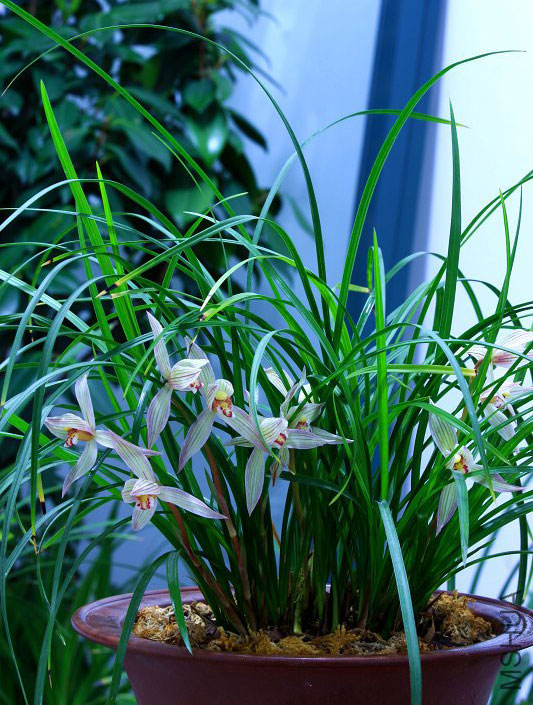
For the outdoor orchid shed part, black plastic pots are used when there are few seedlings, and black clay pots or larger purple clay pots are used when there are many seedlings. The growing medium is the same as that used for the balcony part, except that more red sandy soil is used (to help retain water). Throughout the four seasons, it is never covered (not sealed) and is left to be watered by the rain. In dry seasons, it is watered with tap water every week, sprayed with medicine once a month (three kinds of medicine used in rotation), and sprayed with fertilizer two to three times during the growing season.
Whether on the balcony or in the outdoor orchid shed, because of sufficient sunlight, ample ventilation and air movement, regular fertilizing and application of medicine, and management according to the growing medium and environment used, all kinds of orchids including Cymbidium tortisepalum grow very well, sending up shoots and flowering normally. For example, the three seedlings of Song Mei introduced from Zhejiang this year sent up four shoots and also produced one strong flower bud, which is truly delightful.
The general rules summarized above mainly refer to common patterns under natural home cultivation. Of course, as the climate differs from place to place, there are also slight differences.