How to grow Cymbidium faberi? Practical care tips shared
Some flower enthusiasts are not quite sure how to grow Cymbidium faberi. Most of them buy flowering, established Cymbidium faberi plants; after blooming once, they have to wait patiently for several years before it blooms again, and some even grow “thinner” and thinner until they fail, especially wild-collected plants. What is the reason?
In their native habitat, Cymbidium faberi mostly grows on mountain tops or upper slopes where there is more light. In Hubei, at higher altitudes, 2-4 strong plants are often seen blooming. Occasionally some grow in open crevices of rock walls on the lower middle slopes; because of strong light they also bloom easily, though the leaves are rather coarse. A small number grow in moso bamboo forests or in taller shrub thickets and dense sub-tree forests; because of insufficient light they do not easily produce buds. In some places there are more than 10 clumps of Cymbidium faberi, each clump with 4-5 plants or even 10 plants, with many roots and lush leaves, yet not a single clump has flower buds. The main reason is insufficient sunlight.
Regarding the lesson of Cymbidium faberi not blooming: a veteran grower of Cymbidium faberi kept 10 pots, all growing vigorously and sending up fragrant flowers every year. He said: one year 4 pots produced buds, while 6 pots, though growing well, showed no buds. He analyzed the reasons: 2 of the pots had been repotted twice the previous year, 2 pots had their positions changed many times, and 2 pots were old pots that had not been given fresh growing medium for more than 3 years, belonging to nutrient imbalance (in his early years he advocated the “clean growing method”).
Therefore, when growing Cymbidium faberi, you must pay attention to 4 points: 1. Appropriately increase sun exposure, (avoid the fierce midday sun in summer); 2. Do not repot frequently; normal care with repotting once every 2 years is quite enough (move to a larger pot and replenish fresh growing medium); 3. The placement of the pots should be stable; do not move them here and there; 4. When repotting after more than 3 years of growing, you must replace with fresh growing medium.
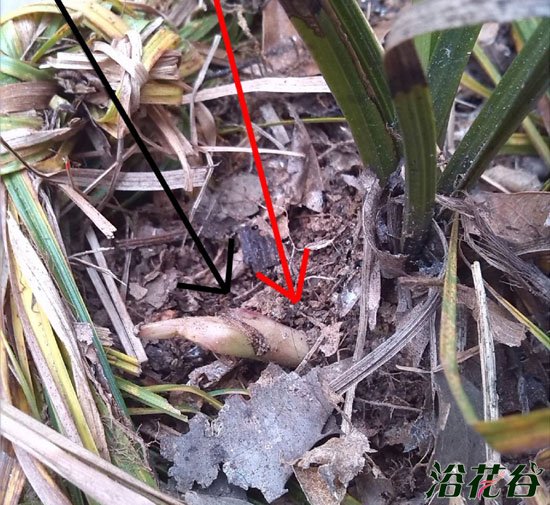
To go into detail, for amateur orchid growers to make “Cymbidium faberi” grow strong and bloom, the key points are as follows:
1. Fertilizing
Each year, after the new growth has developed to the point where the leaves have separated, apply a dilute fertilizer once every half month. The first fertilizing should be lighter, 0.5-1/1000, and afterward it can be gradually strengthened (twice as strong as the fertilizer used for Cymbidium goeringii, about 2-3/1000). In midsummer (when above 35 degrees Celsius) and in winter (when below 10 degrees Celsius), do not fertilize. If there is a warm winter, with daytime temperatures often at 15-20 and nighttime above 5 degrees, Cymbidium faberi is in a semi-dormant state and will consume a large amount of energy. To ensure that Cymbidium faberi can push up strongly in spring and produce flower buds with vigor, you should also apply some dilute fertilizer appropriately (spray 0.5-1/1000 on the leaves, and try to spray mainly on the undersides of the leaves to improve fertilizing efficiency and save costs!). In normal fertilizing, be careful not to let liquid fertilizer pour into the leaf center, especially in new seedlings. If you have many orchid pots, use a fan for half an hour after fertilizing; if you have few, use toilet paper to absorb the water droplets in the leaf centers.
If fertilizing by pouring, I recommend only one method: half an hour before pouring fertilizer, be sure to flush the pot once with clean water, and then pour the fertilizer. Pouring fertilizer is generally used 2-3 times a year: once 10 days after flowering, or when new shoots begin to separate leaves and new roots have grown 2-3 cm (nutrient consumption after flowering is especially large; generally, blooming one flower spike may cause 2-3 leaves to drop, or even one plant to die, so be careful to supplement fertilizer); once before Minor Heat and after Great Heat, when the temperature stays continuously below 30 degrees; once before entering winter (during the period when nighttime temperatures enter 8-10 degrees). Or use the observation method to pour fertilizer: often observe the leaf quality. If the leaves show loss of green and are thinner than before, it indicates a fertilizer deficiency, so pour a dilute fertilizer once; when new leaves fork and new roots grow, pour fertilizer once; in September-October, after buds become visible, and after a severe dry period (70-80% dry), pour fertilizer once. At other times, use the leaf-spraying method to fertilize.
2. Pot and plants
The plants in a pot must not be fewer than 3 connected plants, and each year there should be 2 new plants, because Cymbidium faberi mostly produces buds from new plants; more is even better.
3. Water
Normally, moisture should be controlled on the drier side, slightly drier than for Cymbidium goeringii. Control your own hands; do not look at it, see it is dry, and then be unable to resist watering a little every day, or it is finished! This is because Cymbidium faberi that blooms on the mountain basically grows at higher altitudes and in places with stronger sunlight, that is, the native habitat is relatively dry, and it relies on several autumn rains to produce buds. Therefore, potted Cymbidium faberi after the Start of Autumn should be kept severely dry (90% dry to the bottom of the pot; for soilless culture or coarse-particle material, dry for one week, and just spray normally at ordinary times), then watered thoroughly once after the severe dry period, using the same method twice in succession, with an interval of about 10 days. These 2 times can include “Zhiquan” 1/1000 full-element fertilizer to activate bud formation (activate the bud embryos hidden in the pseudobulbs).
4. Strengthening roots
It is very important to grow strong orchid roots, especially for wild-collected orchids, whose roots are severely damaged. After being collected from the mountain, the time from storage and transport to replanting is long, nutrient consumption is great, and the vitality is greatly damaged. It must go through a fairly long care cycle to recover its vitality, so you must be patient. So-called recovery of vitality means getting it to grow many roots. For newly potted wild-collected Cymbidium faberi, use coarse growing medium in the bottom 1/3. Use the upper 10 cm of a mineral water bottle, cut many small holes around it, and cover it over the bottom of the pot so that air can circulate in the center of the pot bottom. After planting the Cymbidium faberi, use coarse growing medium to press the roots down (as long as it does not fall over). If there are no roots, or few roots, you can make a “U” shape from thick iron wire and insert it upside down into the pot to fix the orchid plant; Cymbidium goeringii can also be fixed in the same way. Then add fine growing medium (30%) and a mix of peat soil plus coconut husk bran (half peat and half coconut bran) at 70%, covering all the way to the pseudobulb, press gently, and cover the surface with moisture-retaining material (sphagnum, Selaginella uncinata, fine Kanuma soil). Water once 3 days after potting to settle the roots, expose to sunlight after 10 days, place on a pot stand, and enter normal care. Coconut bran contains sugars (monosaccharides) suitable for absorption by Cymbidium faberi. At the flower neck of Cymbidium faberi there is often nectar, sweet in taste. Do not lick it! Marshal Zhu De liked to lick the nectar; once the nectar is gone, the flower bud is finished in 2 days. Try it if you do not believe it!
In addition, remember by all means that the environment must be ventilated, the orchid room must retain moisture, and do not keep moving the Cymbidium faberi pots.