How to Grow Orchids? Essential Care Methods for Beginners
■ How to grow orchids? Growing orchids is really difficult; they die after a while. What is the reason?
Compared with other flowers, orchids are indeed harder to grow. The difficulty lies in the fact that orchid roots are quite sensitive to water and are easily "drowned" or "killed by thirst." When the growing medium stays too wet or too dry for longer than the orchid roots can tolerate (more precisely, when the oxygen-deficient or water-deficient state in the growing medium lasts longer than the orchid roots can endure), it causes root rot or hollow roots; if it lasts even longer, the root problems show up on the leaves, and the plant eventually turns yellow and dies.
Because the orchid's pseudobulbs themselves contain water, and because whether the orchid roots are rotted or hollow, their remaining parts still retain some ability to absorb water, the orchid can linger for a while even when its roots have problems, making it hard to detect the issue promptly from the above-ground parts of the plant.
In fact, orchids are more often "drowned," that is, due to improper selection and mixing of the growing medium, too strong water retention, or overly frequent watering, the growing medium stays constantly soggy. When this overly wet state lasts beyond what the orchid can tolerate, the orchid roots rot and the plant eventually dies. In addition, some people hear that orchids "fear" water and therefore rarely water them, resulting in overcorrection, and the orchid is "killed by thirst" - this also happens. It can thus be seen that whether one can properly control the moisture content in the growing medium is the key to success or failure in growing orchids.
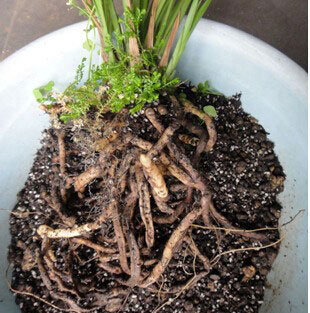
Overwatering causes root rot
Underwatering causes hollow roots
■ Why can't ordinary soil be used to grow orchids?
Let us first analyze the changes in the dry-wet state of soil after watering: "wet" → "slightly wet" → "moist" → "slightly dry" → "dry." Among these, "wet," "slightly wet," "dry," and "slightly dry" are all unfavorable to orchid root growth; only "moist" is most suitable for orchid growth. Ordinary soil, after watering, stays "wet" or "slightly wet" for too long, exceeding what the orchid can tolerate, so the tragedy naturally occurs. Therefore, ordinary soil is not suitable for growing orchids.
It can thus be seen that minimizing the time the growing medium spends in the "wet" and "dry" states, and extending the time it spends in the "moist" state, is the fundamental goal of orchid cultivation. Whether it is the selection and mixing of the growing medium, the choice of orchid pots (pot size and material also greatly affect the moisture content changes in the growing medium), or watering, all revolve around this goal.
From this it can also be seen that the water-retaining or water-draining characteristics of the growing medium itself largely determine the changes in its moisture content, and even determine success or failure in growing orchids. It can be said that watering is the external cause of changes in the growing medium's moisture content, while the growing medium itself is the internal cause. To control the moisture content of the growing medium well, the prerequisite is to select and mix the growing medium properly.
■ How do you judge the effectiveness of a growing medium for orchids?
The so-called effectiveness of a growing medium for orchids is, in other words, its effectiveness for growing roots. If the orchid roots grow well, the above-ground parts (leaves, shoots, etc.) will certainly grow well; if the orchid roots do not grow well, the above-ground parts will not be good either. Therefore, from the growth condition of the above-ground parts, one can judge the growth condition of the orchid roots.
For example, after potting, if an orchid recovers its vitality within 1 to 3 weeks (recovery is fast in spring and autumn, slow in summer and winter), the leaves are glossy, new growth is growing (noticeably taller), new shoots are emerging (as in spring), and the leaves feel resilient when brushed by hand, it indicates that the orchid roots are growing well, the growing medium is relatively ideal, and management (mainly watering) is also on point.
If after a period of time (about 1 month) in the growing medium, the leaves lack gloss, new growth stagnates (stunted seedlings), new shoots do not emerge or emerge sparsely (in spring), the leaves feel limp when brushed by hand, and black spots easily appear on the leaves when the temperature is slightly high, then the orchid roots certainly have problems, and the growing medium may not be ideal. In this case, the plant must be unpotted. If, at the time when watering would normally be due (for example, if watering is normally done once every 5 days, unpot before watering on the 5th day), the growing medium is found to be soggy and the roots have turned black entirely or partially, it indicates that the growing medium retains water too strongly, and some air-permeable, water-draining material should be added, such as granular medium, tree fern, decomposed peanut shells, etc. Of course, if the water-retaining and water-draining characteristics of the growing medium are already felt to be relatively ideal, then instead of improving the medium, simply extending the watering interval appropriately can also solve the problem. If, when unpotted, the roots and growing medium are found to be in a dry state, or even hollow roots have appeared, then some material with strong moisture-retaining ability should be added, such as leaf mold, perlite, etc.; if the growing medium is felt to be relatively ideal, then shortening the watering interval will also do.
Judging whether the underground parts (roots) are healthy from the growth condition of the above-ground parts of the orchid plant is somewhat difficult; the simplest and most intuitive method is still to unpot and look at the roots. There are two types of unpotting: surface unpotting and full unpotting. Surface unpotting means removing part of the growing medium from the pot surface, to a depth of 5 to 10 cm, to observe the growth state of roots around the pseudobulbs and at the surface layer of the growing medium. If new roots have grown or there are crystal-clear "crystal tips" on the root tips of old roots, it indicates that both the growing medium and management measures are relatively ideal; if there are no new roots, or the tips of old roots have turned black or even rotted, it indicates problems with the growing medium or watering. If you want to know the growth state of all the roots, then you can only do a full unpotting. Whether surface unpotting or full unpotting, be careful to avoid damaging the roots, especially the root tips. Although unpotting is a bit troublesome, it is the most intuitive and accurate way to understand the effectiveness of the growing medium for orchids, and it is also a necessary path for beginners to accumulate experience.
■ The orchid hasn't died, but it isn't growing new shoots either - it's half-dead. What should I do?
As mentioned earlier, if the above-ground parts of the orchid do not grow well, the orchid roots must have problems. If the above-ground parts are half-dead, it indicates that the underground parts are in bad shape - most of the roots are growing poorly, and perhaps only one or two roots remain to sustain the plant's life. In this case, the plant must be unpotted and repotted with an ideal growing medium.
■ How can I mix a good growing medium myself?
There are many materials that can be used for growing orchids, and each place can use local materials, but to mix an ideal growing medium, the following principles must be followed:
1. The physical structure of the growing medium should be ideal, air-permeable, and water-draining. Use granular medium; the gaps between granules give naturally good air permeability and water drainage. If using powdery medium such as leaf mold, add perlite, tree fern, and granular medium, etc., so that it becomes fluffy.
2. The chemical composition of the growing medium should be reliable, with no harmful components. Some organic growing media, such as peanut shells and pine bark, must be decomposed; otherwise, after use they break down into substances harmful to orchid roots.
3. The growing medium should have good moisture retention, both draining and holding water. An ideal growing medium should spend a short time "wet" and a long time "moist." That is, after watering, because the physical structure of the growing medium is good (there are gaps between the medium), a large portion of the water drains away; afterward, because the growing medium itself has absorbed a certain amount of water, it can maintain a "moist" state for a relatively long time, and then slowly changes from "moist" to "dry" (note: the growing medium does not suddenly change from "moist" to "dry," but changes slowly, that is, the growing medium spends a relatively long time in the "slightly dry" state between "moist" and "dry"). This has three major benefits: first, the growing medium stays "wet" for a short time, avoiding root rot; second, the growing medium stays "moist" for a relatively long time, creating favorable environmental conditions for orchid root growth; third, the growing medium stays in the "slightly dry" state for a relatively long time, and the ideal time to water is when the growing medium is in the "slightly dry" state - obviously, this makes watering easy, and watering a day or two earlier or later does not matter much. If the growing medium has poor moisture retention, it quickly changes from "dry" to "wet," and the "slightly dry" period lasts a short time, so the watering time must be judged relatively accurately to ensure that watering falls within the time range when the growing medium is in the "slightly dry" state; this is quite difficult, and watering is easily done too early or too late, which is unfavorable to orchid growth. In short, a growing medium with good moisture retention not only avoids orchid root rot but also reduces the difficulty of watering. Of course, to mix a growing medium with ideal moisture retention, before selecting and mixing, one must have a full understanding of the water-retaining and water-draining characteristics of each growing medium and the fluffy effect it can play in the mixed medium.
As long as these principles are followed, a good growing medium can be mixed. Of course, whether a growing medium is good or not can only be known after using it. It is worth noting that after mixing what you think is an ideal growing medium, do not rush to repot all your orchids with the new medium; you must first trial it on one or two pots, and only after the results are verified should you use it on a large scale.
■ Is there a formula for growing orchids that is easy to source or buy and has ideal results?
1. Classic formula: 65% Kanuma soil + 35% Sendou soil.(Volume ratio, same below)
This formula is widely used and has gained fairly general recognition among orchid growers. With this formula, the growing medium is air-permeable and water-draining, orchid roots generally will not have problems, and growing orchids is easy to succeed with. Note: the quality of commercially available Sendou soil varies greatly, so buy reliable quality; before use, both must be soaked through, that is, break open the granules and make sure the middle is moist before use.
With this formula, because nutrients are insufficient, about 30 granules of Osmocote or 10 to 30 granules (depending on pot size) of Magamp can be placed on the pot surface. In the south, where balconies have rather dry wind, the orchid pot can be slightly larger, and a layer of sphagnum moss can be placed on the pot surface to retain moisture.
2. Simple formula: 50% leaf mold + 50% perlite.
Leaf mold (or mountain surface soil) can be taken from the topsoil under broadleaf forests containing dead branches and fallen leaves (it also contains soil). This kind of soil is loose; when squeezed by hand it forms a ball, and when the hand is opened the soil crumbles apart. Adding an equal amount of perlite makes the leaf mold fluffier and prevents it from compacting. Perlite's fluffing effect is very strong, its moisture retention is also good, and its price is low, making it an ideal growing medium. On this basis, 20%-50% of other granular media can also be mixed in, such as coal cinder granules (granules after sieving the powder out of coal ash), decomposed peanut shells, decomposed pine bark, brick granules the size of soybean grains, small-grade pond foundation stone, small-grade Kanuma soil, etc. - one or several of these, or a mixture of several, gives even better results.
Leaf mold from the mountains
Leaf mold
50% leaf mold + 50% perlite
Orchid roots grown with 50% leaf mold + 50% perlite
It is worth mentioning that the leaf mold formula developed by Lin Shengzhou is easy to source, low in cost, and ideal in growing results. Its formula is: 50% leaf mold + 50% sandy loam. Sandy loam is a kind of soil half-decomposed into sandy texture, not prone to clumping.
Orchid roots grown with Lin Shengzhou's formula
Because leaf mold is rich and abundant in nutrients, no fertilization is needed, and the seedlings grown are all relatively sturdy. It is especially worth noting that some beginners always fear the orchid will be "starved to death" and like to apply all kinds of fertilizers to orchids, and the orchids are often "rotted to death" by fertilizer.
3. Commercial growing medium.
If you find mixing your own growing medium troublesome, you can buy ready-mixed commercial growing medium. The so-called orchid potting soil sold in flower and bird markets is not mixed very reasonably, and it is generally reported to give poor results. Local orchid growers in Fuzhou can buy commercial growing medium from Lin Yong. The growing medium sold by Lin Yong is mixed according to the "foolproof soil" formula developed by Zheng Weixin (Lanshan Siji). Its components are:
1 part leaf mold + 1 part perlite + 1 part tree fern fiber + 1 part pond foundation stone + 1 part Sendou soil + half part coconut coir (all by volume).
After years of trials, orchids cultivated with this growing medium have good roots and sturdy seedlings, with good results.
Orchid growers from other places can mix it themselves according to this formula; they can also adapt to local conditions, use local materials, and make appropriate improvements or substitute ingredients in Zheng's foolproof soil formula. The author uses Zheng's foolproof soil formula with the Sendou soil removed, and the cultivation results are also very good.
Shoot growth of orchids grown with Zheng Weixin's formula
Orchid roots grown with Zheng Weixin's formula
■ What should I do if my orchid keeps growing black spots?
When orchids grow black spots, it is mostly anthracnose, and there are mainly two deeper causes:
Anthracnose
1. The orchid seedlings are not sturdy enough, and the resistance of the seedlings is relatively weak. The root cause is still that the growing medium is not ideal and the orchid roots are not growing well, so effort must still be put into the growing medium.
Poor roots lead to black spots on leaves
2. The orchid is exposed to the sun at relatively high temperatures or the environment is relatively stuffy and hot. After the temperature exceeds 28°C, orchids should be shaded; at the same time, in high-temperature seasons, the environment should be ventilated, and stuffy, hot conditions must absolutely be avoided. The key is still to improve cultivation conditions - this is the fundamental solution. When necessary, spray 800-times-diluted Shibaogong (fenazaquin) or Score to stop the disease from developing.
■ The orchid leaves have turned yellow. What is the reason?
There are mainly two reasons why orchid leaves turn yellow:
1. Yellowing of leaves caused by natural aging. In spring and summer, orchid metabolism is vigorous, new shoots keep emerging, and at the same time some old seedlings that have grown for many years also wither and die. This kind of "old age death" yellow leaf has three characteristics: first, it occurs on old pseudobulbs; second, the pseudobulbs show nothing abnormal (such as turning black or rotting); third, the yellowing of leaves generally starts from the outer leaves of the orchid plant and then moves to the inner leaves, and from the leaf tip to the leaf base. In addition, there will be no black spots on the yellow leaves.
Natural aging of old leaves
2. Yellowing of leaves caused by disease. The orchid plant develops stem rot, bacterial soft rot, or southern blight. This kind of yellow leaf mostly occurs on new seedlings; the yellowing of leaves starts from the central leaf and develops toward the outer leaves, and from the leaf base toward the leaf tip, and there are often abnormal conditions on the pseudobulbs (such as turning black or rotting). In this case, the diseased plants must be broken off, and the roots and pseudobulbs of the remaining healthy plants should be soaked for 1 hour in a broad-spectrum fungicide (such as carbendazim, hymexazol, etc.), then repotted with fresh growing medium.
Yellowing of leaves caused by stem rot
■ I only keep a few ordinary orchids at home, and they never grow well. Is there any simple cultivation method?
Grasp the key points of growing orchids, and you can absolutely grow orchids easily and effortlessly:
1. Go to the nearby mountains and take some loose leaf mold or surface soil with dead branches and fallen leaves (it is fluffier only with dead branches and fallen leaves), and mix in an equal amount of perlite as described in the "simple formula" above; if perlite is not available at the moment, mix in an equal amount (by volume) of sandy loam, or mix in twice the amount of crushed brick granules or coal cinder, etc. (mixing two or more is even better). Mixing a fluffy, air-permeable, water-draining growing medium is the key to growing orchids well, and it should be done with care.
2. A medium-sized orchid pot is fine. If it is too large, the growing medium does not dry easily, which easily causes root rot; if it is too small, the growing medium dries too easily, which is hard to manage.
3. Place the orchid on a south-facing balcony or in a courtyard (do not put it on a north-facing balcony or keep it indoors for a long time). In spring and winter, let it get more sunlight; in summer and autumn, when people feel uncomfortable in the sun, do not let the orchid be directly exposed to the sun. No fertilization is needed.
4. Water when the growing medium is dry. If you are unsure, scrape open the growing medium on the pot surface two or three cm deep; if it is dry there, water immediately; if it is not yet dry, water after another day or two. When watering, water the whole pot thoroughly and water for a while longer, so that all the growing medium "drinks" water.
5. In the north, when the winter temperature is around 3°C, be careful to move the orchid indoors to avoid frost damage; south of Fujian, orchids can safely overwinter outdoors in winter.
Doing the above 5 points is not too difficult, is it? Growing orchids is actually just this simple! From now on, bring a good mood and set off confidently toward the fragrance-filled future ahead! (I hope this humble article can encourage and embolden beginners at growing orchids, and can provide some substantive help. Mr. Cai Shimin gave very good suggestions for this humble article, and I thank him here.)