Orchid Blooming Period Management Methods and Technical Key Points
Orchid blooming period management is very important; a single careless move can cause bud blast. For Cymbidium goeringii (spring orchid) and Cymbidium faberi (Hui orchid), from the emergence of flower buds from the soil to the full opening of the petals, the process lasts nearly half a year. During this period, meticulous care is essential, as it directly determines whether the buds can develop normally and whether they can produce beautiful blooms. It involves not only technical issues related to blooming period care, but is also a kind of artistic skill. The key points of blooming period care summarized from the author's orchid-growing practice are set out below:
1. After the flower buds emerge from the soil, never touch, squeeze or pinch them with your hands: beginning orchid growers, upon seeing new shoots emerge, cannot tell whether they are leaf buds or flower buds, and cannot resist touching and pinching them with their hands. Little do they know that the newly emerged shoots are extremely delicate; a single squeeze or pinch of the hand will cause the outer bracts to become "scorched," or even cause the flower buds to become "stunted." Therefore, one should only observe with the eyes, and must never squeeze or pinch them by hand.
2. After the flower buds have all emerged, thin the buds according to the number and vigor of the orchid plants, removing the weak and keeping the strong: for example, for a pot of a famous Cymbidium goeringii variety with only 4 or 5 growths, keeping one flower bud is entirely sufficient; 8 or 9 vigorous growths can keep 2 flower buds; more than ten growths can keep 3 without harm. The author has a pot of "Yipin" with 10 growths that produced 8 flower buds; 6 were thinned out, leaving only 2. This is to avoid consuming excessive nutrients. The principle of bud thinning is "remove the weak and keep the strong" - if both the front rhizome (the pseudobulb newly grown the previous year) and the back rhizome produce flower buds, it is better to keep the flower buds of the vigorous front rhizome and remove those of the back rhizome; if a single vigorous plant produces two flower buds, keep only one; flower buds produced by weak seedlings must be firmly removed and must not be retained; flower buds that emerge too late are also best removed; those squeezed among the orchid leaves are not as good as those kept around the periphery of the plant.
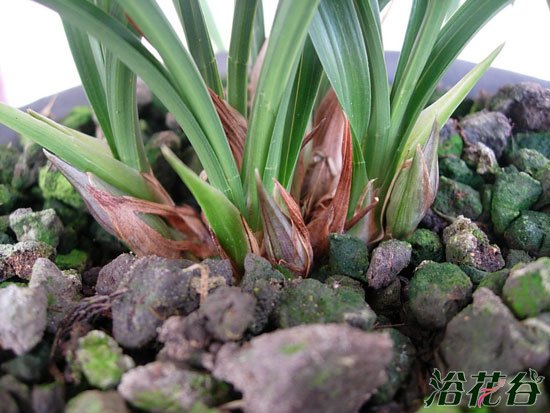
3. To prevent frost damage to the flower buds, they must be brought indoors to overwinter in cold winter: place the pots with flower buds in a sunny indoor spot so they can bask in warm sunlight. During the day, when the temperature rises a little, windows should be opened for ventilation to strengthen air circulation. When watering routinely, try to avoid water droplets intruding into the bracts, so as to prevent rot.
4. From stem elongation to petal opening, the moisture level should be appropriately controlled: when the orchid begins to elongate its stem, it needs a certain amount of water. If there is no moist environment in the pot, the flower stem will not grow tall and will remain stunted at the pot surface, hidden by the leaf cluster, harming its appearance. To make the flower scape grow tall, the pot must be kept moist and not too dry. But when it comes to the stage of the flower's core emerging and the petals opening, the pot should be somewhat dry. If the humidity in the pot is too high, although the flower scape may continue to grow taller, it often causes the side petals to "drop their shoulders," affecting the flower's appearance and quality. Therefore, before the petals open, water should be reduced. However, this cannot be generalized; for some unusual varieties, such as Cymbidium goeringii 'Yu Hudie', 'Liangxi Ruidie', 'Wu Die', etc., as well as Cymbidium faberi 'Duo Yun', 'Hai Ou', 'Feng Qiao', 'Lixing Ruodie', etc., not only should they not be kept slightly dry, but they should instead be kept even more moist, to encourage the unusual petal forms to be more fully displayed when the petals open.
5. When the flower scape rises and the tip of the flower core emerges from the bracts, light should immediately be controlled: placing it in a spot with diffused light is more suitable. If the light is too weak, the flower color will not be attractive later; if it is left in direct sunlight (light too strong), after the petals open the petal color will turn yellowish, and they may even be easily scorched and become "burnt," harming the flower's appearance. This is especially true for solid-color orchids (Suxin lan); with too strong light, the tongue coating takes on a slightly yellow color. Therefore, when the orchid's petals open, direct sunlight should be avoided and it should be placed in a spot with diffused light.
6. Cut the flowers at the appropriate time: the blooming period of orchids is generally just over ten days, and some last as long as about a month. Ordinary orchids can be allowed to bloom freely, but for precious and famous orchids, in order not to consume excessive nutrients and affect the growth of new shoots, Cymbidium goeringii should be cut at the appropriate time after the petals open, at most one week after full bloom. For Cymbidium faberi, which has multiple flowers on one stem, they should be cut promptly 5 or 6 days after the flowers have opened fully from bottom to top (unless needed for exhibition, which is a different matter). Method of cutting flowers: Cymbidium goeringii flowers can be pulled up together with the stem - pinch the flower stem with two fingers about one cun above the pot surface and quickly pull upward, so that the flower and stem are pulled up together, leaving no residual stem; Cymbidium faberi flowers cannot be pulled out, so use scissors to cut the flower scape at a slant about 2 cun above the pot surface. For the cut flowers, use a match to scorch the end of the flower scape to "seal" it, then keep them in a water-filled vase, and they can still be enjoyed for several days without wilting. There is also a simpler method: use a clean glass bottle, pour out any accumulated water, put the cut flowers into the bottle, and cover it tightly. Because there is a certain amount of moisture in the bottle, the flowers remain as pretty as ever, and can be enjoyed for half a month without fading.