What should you pay attention to when repotting orchids? Keep these key points in mind
Repotting orchids involves many considerations. This article summarizes and organizes some key points to note when repotting orchids, including choosing orchid pots, how often to repot orchids, and under what circumstances orchids need repotting. It is very helpful for novice orchid growers.
Because the environment for growing orchids differs, different materials and different planting methods must be used. We all know that orchid roots need air permeability, moisture-seeking tendency, and geotropism. As long as these characteristics can be satisfied, orchid roots will naturally grow well. Taking Japanese Kanuma akadama as an example, different environments naturally call for different planting methods, described separately as follows:
1. Humid environment: greenhouses, places with humidifiers, mountains, wooded areas, etc. If moss is seen in the environment, it belongs to the above environments. If not rained on, Kanuma akadama can be used in a large, medium, small arrangement (from bottom to top) for planting (a pot with holes may be chosen). This is the general planting method. Its advantage is good air permeability. Because the environment is humid, the roots have a moisture-seeking tendency, so they grow well.
2. Dry environment: strong wind, strong sunlight, high temperature, fast water evaporation, such as balconies and rooftops. If rain falls on them, the planting method is completely opposite to that for a humid environment. That is, use a pot without holes, and arrange the Kanuma akadama in the order of small, medium, large (from bottom to top). But the disadvantage of this method is poor air permeability and the plant will sway. So insert a bubble tea straw with holes punched all around into the pot, and use a very thin layer of sphagnum moss spread on the pot surface, pressing the sphagnum moss tightly against the pot rim to prevent the plant from swaying. Why plant this way? The reasons are as follows:
(1) Because roots have a moisture-seeking tendency, if the Kanuma akadama is arranged as large, medium, small (from bottom to top), the wet-dry condition of the water is dry at the bottom and wet at the top, because large stones absorb water slowly and dry quickly, while small stones absorb water quickly and dry slowly. The environment outside the pot is dry, so when growing orchids on a balcony, you will often find orchid roots at the surface of the pot (because the pot surface has sphagnum moss or fine stones that are more moist). So the roots naturally grow upward and cannot extend downward. Therefore, different environments naturally call for different planting methods.
(2) In the first planting method, the orchid stones go from small to large. If rain falls on them, the upper half of the pot will form waterlogged conditions because of the small stones. One month of plum rain season will rot the orchid roots, so no matter how you grow the orchids, they will not grow well. This is also why, if an orchid is bought and not repotted according to the environment, it will rot roots and die.
(3) Therefore, for different environments (use coarser material if rain falls on them, use finer material if rain does not fall on them), first choose a suitable pot (use a pot with holes for a humid environment, use a pot without holes for a dry environment), then choose suitable material (use finer material for a pot with holes, use coarser material for a pot without holes). Taking into account air permeability (drainage), the wet-dry condition of the material in the pot, whether it dries from top to bottom, that is, the bottom of the pot should be moist, and because materials differ, consider how to water and fertilize. Then the orchids will naturally grow well.
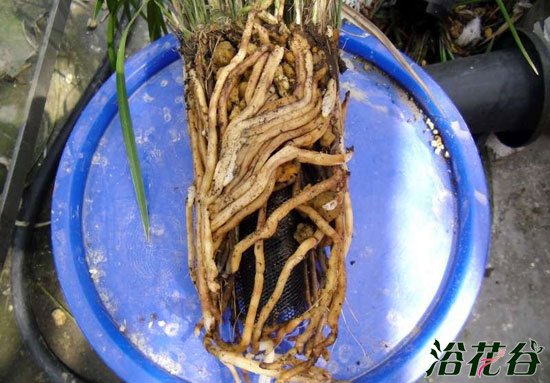
When repotting, the use of materials should take into account the following principles:
1. Material suited to the environment: Different environments have different planting methods. Consider whether the environment is dry or humid, whether ventilation is good (wind speed), whether rain falls on it, sunlight intensity and hours… and other factors, then choose appropriate materials to match the environment. The orchids will naturally grow well. For example, my environment is a second-floor rooftop, very windy, and rain falls on it. Therefore, I choose all large-grade Kanuma akadama as the material. The purpose of doing so is good drainage. Otherwise, when the plum rain season arrives, if a mixed material is used, because the gaps in the pot are smaller, after a month of rain, a waterlogged state will form in the orchid pot, rotting the orchid roots. But because large-grade Kanuma akadama drains quickly and does not easily absorb water, when watering, you must water back and forth more than five times to wet it. So how many times to water depends mainly on the water absorption rate of the material and personal experience. Therefore, as long as you can choose material suited to the environment, any method that grows orchids well is a good method.
2. Both moisture retention and air permeability: Orchid roots are semi-aerial roots, so they need moisture and good air for the orchid roots to grow well, but these two are contradictory. Good moisture retention sometimes means poor air permeability, and good air permeability sometimes makes moisture retention difficult. For example, when I used large-grade Japanese stone for planting and chose an orchid pot with holes, because moisture was lost quickly, the orchid roots lacked water and could not extend downward, so they only absorbed water at the upward sphagnum moss area where there was water. After switching to an orchid pot without holes, the situation improved. Therefore, the use of material in the pot must take into account both moisture retention and air permeability.
3. The material in the pot should dry from top to bottom: Because orchid roots have a moisture-seeking tendency, the lower half of the material should have a higher water absorption rate, so that in order to absorb water, the orchid roots will extend downward. When growing orchids on a balcony, you will sometimes find that the orchid roots are all on the pot surface, with no roots in the lower half of the pot. The main reason is that watering is not wet enough and the material used does not suit the environment. For example, in the general Kanuma akadama planting method, most are arranged as large, medium, small (from bottom to top). In this planting method, the material's drying condition is that the bottom dries first and the top dries later. In greenhouses, or on mountains, and in places with humidifiers, because the environmental humidity is higher than inside the pot, the roots' moisture-seeking tendency will make them extend downward. But if bought back and grown on a balcony, where the environment is windy, sunny, and low in humidity, the lower half of the pot is drier, so the roots cannot extend downward. Therefore, it should be repotted, arranging the Kanuma akadama as small, medium, large (from bottom to top), to improve the above shortcoming and allow the orchid to grow smoothly.
4. Moderate hardness and softness, with gaps: If rain does not fall on the orchids, there is greater room in using materials. Soft and hard materials can be used in combination, and gaps should be left between materials to facilitate air circulation. Then the orchid root growth will be relatively better. As for how to combine them, the main consideration is environmental factors, relying purely on personal experience and repeated experiments. As long as the orchid can grow well without root rot, it is a good material.
5. After planting, the plant should not sway: Due to the condition of the roots and the planting method, if the plant sways after planting, it should be improved. For example, old plants and small seedlings should be fixed with rust-proof iron wire. Also, if the Kanuma akadama is planted using the small, medium, large method, because the topmost layer is large, the plant will sway. So spread a thin layer of sphagnum moss on the pot surface, and press the sphagnum moss tightly downward at the pot rim, which can improve the swaying. But this planting method does not have very good air permeability and drainage in the pot, so place a bubble tea straw with holes punched all around in the center of the pot, which can improve the above shortcoming. This planting method is most suitable for orchids that are rained on and in a dry environment, because if fine-grade stone is used in the upper part of the orchid pot, if rain falls for a long time, most will rot the orchid roots due to waterlogging. So how to grow orchids depends on the environment, and selecting appropriate materials truly is a matter of ingenious application, all in the mind.
6. Materials must be clean: Japanese stone and Puli stone have a lot of dust. It is best to wash them clean with water, then soak them in water for a day. After planting, wait until completely dry before watering, which can avoid root rot. When first using Japanese stone for planting, people often plant directly with dry stone, then water after planting to wash away the dust, but possibly it is not washed clean. The orchid's aerial roots are wrapped by dust, affecting air and water exchange, causing root rot.
7. Roots are best placed close to the pot rim: When watering, water flows down along the pot edge. On hot days, water vapor forms droplets on the pot edge, so the pot edge is where there is the most water in the pot. Therefore, when planting, the roots are best placed around the pot, pressed close to the pot wall. Then the orchid's water absorption will be better, and the orchid roots will grow more robustly.
How often should you repot, and under what conditions do you need to repot?
1. How often to repot depends mainly on the degree of acidification and salinization of the material in the pot, and how quickly the material ages is related to the concentration and frequency of your own fertilizing, pesticide spraying, and sterilization. The higher the concentration and the more frequent, the faster the acidification and salinization. Some people need to repot every half year. As for foliar feeding, as long as the orchid can grow normally, repotting once every three years is also fine. Therefore, the length of time between repotting is related to individual management, and when to repot depends on personal experience.
2. Under what conditions do you need to repot?
(1) Disease: When an orchid is sick, it will produce black spots or discoloration and other abnormal conditions on the leaf surface. If not repotted, new shoots will still get sick when they grow. So take advantage of the Beginning of Spring timing: the day before, water the orchid very wet; the next day, pull out the orchid, rinse it clean with water, remove the dried leaf sheaths, then put it into 100-fold diluted Xinqi bleach water, soak the whole plant for 10 to 15 minutes, then put it into clean water and soak for 15 minutes, and the new shoots will no longer have disease symptoms. (This method can only be used at the Beginning of Spring, because sterilization greatly damages orchid roots. But because the Beginning of Spring is the start of the orchid's growth period, with low temperature and high humidity, the orchid has time to grow new roots before summer. If done at other times, the orchid may die.)
(2) Poor growth: If the orchid grows poorly, each generation becomes smaller than the last, new shoots have no glossy sheen, leaf tips scorch, roots rot or turn black, then consider whether the wrong material is used, making the pot too dry or too wet, unable to retain moisture and ventilate, causing poor orchid growth. Then you need to rethink and use different materials to repot. If an orchid does not grow well, there must be a reason.
(3) Too dense: If the orchid grows too vigorously, ventilation is poor, and it easily develops scale insects. Therefore, take advantage of the Beginning of Spring and after Mid-Autumn, when the temperature is cooler, to divide into pots with three plants per pot, which is beneficial for later management.
(4) Material aging: The material on the pot surface is most easily aged due to the effects of fertilizing and sterilization. It is best to replace it three times a year. If the lower material has a sour smell, mold, is sticky, or turns green, then consider replacing the upper one-third of the material or all of it with new material, to benefit orchid growth.