When is the best time to repot orchids? Master the best repotting timing
Some orchid growers are thinking about repotting their orchids, but are troubled by not knowing when to repot orchids. Repotting also has its seasonality, and mastering the suitable timing for repotting and planting orchids is an important part of growing orchids well. In the orchid classic "Linghai Lanyan," the "six taboos" of planting orchids are mentioned: "Taboo to plant in severe summer heat, taboo to plant in severe cold, taboo to plant under scorching sun, taboo to plant weak shoots, taboo to plant when orchid buds are opening, taboo to plant in heavy rain (shoots: orchid plants)." Division and planting should avoid these conditions.
The "six taboos" clearly tell us that under these six conditions, it is not suitable to plant orchids and they should be avoided. "Linghai Lanyan" also says: "Dividing and planting orchids in pots is like people living apart. If they are too crowded and not divided, the roots wither; if they are not yet crowded and are divided repeatedly, the leaves weaken. With proper cultivation, generally ordinary varieties are divided once every three years, and premium varieties once every five years, which is most appropriate (ordinary varieties: common orchids, premium varieties: high-grade orchids). Divide spring orchids after the Spring Equinox, and divide autumn orchids after Minor Cold. At this time the old leaves have shed completely and new buds are about to grow, so there is no failure in a hundred attempts." This clearly points out the suitable timing for planting orchids. The summaries of predecessors have important guiding significance for the division and planting of orchids.
Generally, the traditional repotting season should be at the Spring Equinox or Autumn Equinox. In the north, it should be after the Spring Equinox or before the Autumn Equinox. Due to differences in climate among regions, we can also judge by temperature. Generally, a low temperature above 10°C and a high temperature below 30°C are suitable temperatures for normal repotting.
Accordingly, the time for repotting orchids is generally most suitable in spring and autumn. At this time orchid plants are in their mature stage, and the damage rate can be reduced to the minimum. In the first half of the year, it is best from the Spring Equinox to Grain Rain. At this time the flowering period has ended, leaf buds have not yet sprouted, and they are not easily damaged by freezing, so repotting can be done at the right time. In the second half of the year, it is best from the Autumn Equinox to Frost's Descent. Orchids will enter a dormant state, and repotting at this time will have less impact on orchid growth. After resting and recuperating through winter and accumulating nutrients, they can flower and sprout well in spring. Mastering the timing of orchid division and propagation is also an important part of caring for orchids well.
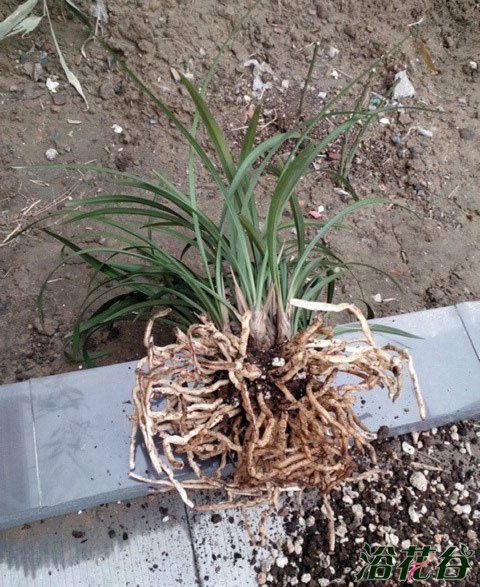
Repotting is an important measure in orchid care, because during the cultivation of orchids, there will always be some phenomena that hinder orchid growth, which must be solved by changing the medium. Generally, there are seven situations that require repotting:
First, after two or three years in a pot, because the nutrients in the growing medium have been exhausted and cannot meet the needs of continued development of orchid seedlings, the orchid seedlings appear thin, weak and short;
Second, after years of water and sun exposure, the structure of the orchid soil has changed, the growing medium has become compacted, affecting air permeability and drainage;
Third, too many orchid seedlings have grown, with tangled roots, leaving no space for new seedlings and new roots to continue developing, which also affects the normal growth environment of old seedlings;
Fourth, the growing medium has been infected by bacteria, fungi or viruses, bringing a survival crisis to the orchid plants;
Fifth, "repotting" is done for the coordination and uniformity of pots and growing medium;
Sixth, repotting is done to produce more seedlings for planting, and seventh, repotting is done for division, exchange or sale. But by no means should you repot frequently at will. Repot what should be repotted, and try not to repot what should not be repotted.
At the same time, repotting cannot be done in a rigid, formulaic way. You must grasp the condition of the orchids and carry out different repotting treatments according to different orchid conditions. Repot with purpose and focus. For example: for diseased orchids, the focus of "repotting" is sterilization and disinfection. Diseased plants must be strictly pruned, cleaned, disinfected, air-dried at the roots, and soaked in root-promoting solution. Then air-dry the roots again, pot them, and replace with fresh growing medium. Not one step can be omitted. Although sterilization also kills the beneficial orchid fungi symbiotic with orchids, leading to the negative effect of a temporary pause in orchid growth, that is, the potting-in period, exchanging sterilization and pest elimination for the life of the orchid is completely worthwhile.
For disease-free weak orchids: the focus of repotting is to supplement nutrient supply. In this case there is no need to disinfect the substrate. Only simple pruning, soaking in root-promoting growth hormone, and repotting with nutrient-rich growing medium are needed. Water with "root-setting water" after two days. This both supplements fertility and reduces damage to beneficial symbiotic bacteria, shortening the potting-in period.
For disease-free strong orchids, the focus of repotting is to solve the problem of expanding a small pot, so there is no need to be overly meticulous. Simply rinse, prune, divide, and repot with part of the substrate replaced. However, for some that have been diseased or whose roots are mostly damaged, it is still necessary to soak them in medicinal solution for a period of time. But before soaking in medicine, there is no need to rinse with clear water, because orchid roots rinsed with clear water will rapidly expand in a short time, hindering the absorption and effect of the medicine. If they have been rinsed with clear water, they need to be dried before soaking in medicinal solution.
Therefore, repotting is simple, but its operation has its complexity and scientific nature. Proper repotting can promote active vegetative growth, improve the disease resistance, rejuvenation ability and sprouting rate of orchid plants, and bring vigorous vitality to orchids. If repotting is improper, it can also bring potential crisis to orchids. Especially for some diseased and weak seedlings, it will accelerate their death. For this reason, repotting is not only an important part of orchid care, but also an orchid-growing technique that every orchid grower must experience and master. If you do not follow its habits and requirements and operate arbitrarily, you will also fail to repot well, and the orchids will instead suffer. Therefore, you must work hard on repotting and planting, adopt the guiding ideology of "seven parts planting, three parts management," and not blindly repot at will.