Analysis of the causes of orchids dropping flower buds and buds turning black and drying up
Some orchid growers find that their orchids drop their flower buds, with the early symptom being the buds turning black and drying up. This condition is in fact orchid bud blasting. Flower bud differentiation in orchids occurs during the maturation period of the new shoot and lasts nearly 1 year. Generally, after a year of nutrient accumulation, the orchid's flower buds emerge from the soil. The flowering period differs among varieties. After the buds of Cymbidium goeringii, Cymbidium faberi, Cymbidium sinense, Cymbidium kanran, Chun Jian and Lian Ban Lan emerge from the soil, there is a relatively long process of growth, bud development and vernalization. This process lasts as little as five or six months, or as long as 7 months. For Sijilan, Xia Hanlan and others, the time from the buds emerging from the soil to flowering is not long, as short as about 20 days, or as long as 30 days to 40 days.
Whether a variety has a vernalization period or not, attention must be paid to the management of fertilizer, water and light during both the vegetative growth period and the reproductive growth period. There are many reasons why flower buds turn black, scorch and dry up and die; most are caused by excessive humidity, too much fertilizer, poor ventilation and similar factors. Generally, flower bud differentiation is enough to show that nutrition is sufficient, so there is no need to continue applying fertilizer to the roots; foliar topdressing alone will do. The so-called attention to fertilizer and water management during the flowering period is meant to promote the flower buds to swell and reach full size, that is, attention to foliar topdressing. At the same time, during this period the temperature is on the high side and the orchid is still growing, so sterilization and disinfection should be strengthened. After the flower buds emerge from the soil, if fertilizer and water are applied indiscriminately, and this coincides with high temperature, muggy heat, poor ventilation and similar conditions, the flower buds will turn black, scorch and dry up and die.
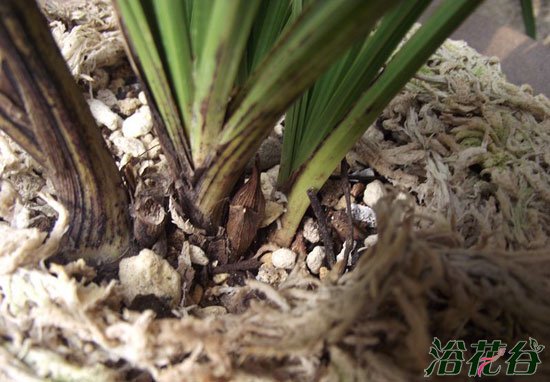
During the orchid's bud development period, from the start of autumn to before the winter solstice, topdressing with phosphorus and potassium fertilizer should be strengthened to promote the flower buds to swell and reach full size. Whether for sterilization and disinfection or for spraying dilute fertilizer, the interval should be 7 days to 10 days; it must not be done too frequently or in too high a concentration, and the plants should get a proper amount of sunlight, otherwise the flower buds will be damaged and the hearts will rot. In addition, attention should be paid to controlling water and fertilizer before flowering. When the flower buds are small, water should be withheld once or twice, which is directly related to the quality of flowering later. If there is no rush to take part in an orchid exhibition, do not deliberately adjust the temperature and humidity; let them open naturally.
During the vegetative growth period of the new shoot, multi-element fertilizer based mainly on nitrogen fertilizer should be applied to promote robust plant growth, achieve disease resistance and drought resistance, and ensure the conditions for flower bud growth. Therefore, whether the flower buds can bloom normally is inseparable from the earlier management.