Orchid Care Key Point: Ventilation Must Not Be Excessive
Many orchid growers learn from online searches that the first principle of growing orchids is ventilation. Reading carefully through many articles, they all discuss orchid ventilation, how to enhance orchid ventilation, how ventilation can reduce diseases, and so on. Many new orchid growers, based on their own understanding and growing environment, ventilate as much as possible and lavish care on their orchids, and so on. After doing this, they believe their orchids have fine leaves, many flowers, strong seedlings, vigorous roots, and no diseases. However, after observing for a period of time, orchid growers find that even after meeting the above requirements, the results do not meet expectations, or fall far short. The main problems causing this are as follows: poor choice of potting medium, poor soft-to-hard ratio and poor water retention, inadequate or excessive disinfection and sterilization at planting, inadequate or excessive lighting, and poor temperature, humidity, ventilation and light, and so on.
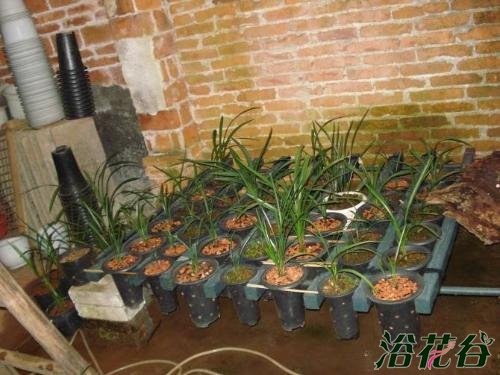
Through 5 years of observing and summarizing orchid cultivation, and through exchanges, discussions and learning with fellow orchid growers, the author has found that temperature, humidity and ventilation have the following relationship: when the temperature is high and ventilation is strong, the humidity is low (in the orchid room); conversely, it is high. This article mainly discusses the adverse effects of strong ventilation on orchids, as follows:
1. Excessive ventilation causes scorched leaf tips on orchids: The humidity orchids need is between 50-80% (some say 40-80%). Generally, the humidity in the orchid growing environment (microenvironment) is higher than the outside humidity. Increased air convection accelerates the loss of moisture from the air in the microenvironment, and the humidity drops quickly. Generally, in an orchid room the temperature is high above and low below, and the air humidity above is even lower. Low humidity at the leaf tips causes localized water loss, and since orchid leaf tips have strong respiration, long-term water shortage at the leaf tips leads to scorched tips.
2. Excessive ventilation causes mechanical damage to orchid leaves: There is a poem that says “The spring breeze of February is like scissors.” It can be seen that strong wind makes orchid leaves sway violently, orchid leaves rub against each other, orchid leaves collide with equipment, orchid leaf stems and veins break, and so on. After orchid leaves suffer mechanical damage, bacteria and pathogens in the air very easily enter the orchid's interior, causing pathogens and bacteria to grow on orchid leaves, and then through reverse transport in the leaves, the entire orchid carries pathogens and bacteria. Over time, quantitative change leads to qualitative change. In mild cases, orchid leaves are damaged, develop black spots, or break; in severe cases, soft rot and stem rot occur. (This paragraph is not accepted. The meaning of "the spring breeze of February is like scissors" is not like this. Too much wind in spring easily causes scorched leaf tips on orchids and dried-out bud points on new shoots, and saying ventilation causes the two rots is even more fallacious. I have grown orchids for many years and have never seen strong wind blow the grass into rot.)
3. Excessive ventilation easily causes empty roots: Orchid leaves lose water, water from the roots and pseudobulbs is transported upward, and the potting medium dries faster than under normal conditions. In addition, the capillaries between the potting medium and the pot wall are relatively coarser than those in the middle of the potting medium, or the ventilation capacity is stronger, so water exchange between the environment and the inside of the pot is fast. These two points cause the potting medium to go from wet to moist, and from moist to dry, in a short time. Under previous watering methods, the potting medium around the pot wall has long since dried completely, and the roots and potting medium undergo reverse osmosis. If this lasts a little longer, the roots suffer severe water loss, causing orchid roots to die of dryness, and finally empty roots. (Ventilation and watering are like a married couple. If either side is too strong, there will be quarrels and disharmony. I said before in a post that in a well-ventilated environment you just water more. Empty roots occur because the microenvironment around the roots is unsuitable. Both severe drying and severe wetting can cause empty roots, and there is no direct relationship with ventilation. In a sealed environment without watering for 1 month, empty roots will likewise occur.)
4. Excessive ventilation easily leads to fertilizer burn: Under normal fertilization, the potting medium takes a long time to go from moist to dry, and the orchid absorbs and digests over a long period, so the fertility in the potting medium declines. But if the potting medium dries too quickly and the orchid cannot absorb and consume it in time, the fertilizer ratio in the potting medium increases in concentration as water decreases, exceeding the orchid's tolerance range and causing fertilizer burn, and finally black roots, root rot and other diseases. (Same as point 3. The root cause of fertilizer burn is the inorganic salt content of the potting medium and the concentration of later topdressing, and there is no direct relationship with ventilation. As for saying the orchid cannot consume it in time, that is even more of a flight of fancy. For example, to ruin a pot of grass takes only 10 minutes: pour on excessively heavy fertilizer, and even if you flush it back 10 minutes later it is too late. The absorption capacity of orchid roots is extremely strong, and real fertilizer burn takes half a year to several years to show. As I said before, orchids are plants with a very high tolerance range.)
In short, orchid ventilation should be moderate. After growing orchids for several years, the sign for judging suitable orchid ventilation is: orchid leaves sway gently without colliding with other orchid leaves. I believe orchid growers can easily master this through observation. Because I have grown orchids at home for a short time and my orchid-growing skills still need improvement, the above views are based on my own experience, and given my limited knowledge, there are certainly inappropriate points. I hope the broad community of orchid growers will kindly correct them, and the author will be deeply grateful!