Methods and Precautions for Growing Orchids on a Balcony
Growing orchids on a balcony is a trend, and how to use a balcony to grow the orchids you like is the tireless pursuit of orchid enthusiasts! But many flower lovers are beginners, and growing orchids blindly may lead them down the wrong path. This article will discuss some matters related to growing orchids on a balcony, in the hope that it will be helpful to orchid enthusiasts.
1. First, selecting varieties is the primary factor
Many orchid enthusiasts make their first mistake here: the balcony area is small but there are many orchid varieties, with few premium plants, and some varieties are a pity to discard but cost labor and water to grow. Varieties should be chosen according to regional characteristics, such as choosing Cymbidium faberi in Shandong and Jiangsu, Cymbidium goeringii in Zhejiang, Cymbidium kanran and Cymbidium sinense in Fujian and Guangdong, Cymbidium ensifolium in Guangxi, Cymbidium sichuanicum and Cymbidium ensifolium in Sichuan and Guizhou, and Cymbidium lianpan in Yunnan.
Orchids should also follow the crowd; choosing locally popular orchid varieties facilitates communication and trading. Following the choice of the masses and going from ordinary to premium is actually a wrong choice! Always focus on premium varieties! Adjust your own orchid varieties in a timely manner according to the market and improvements in appreciation standards!
Based on my personal experience, I believe: for orchids, choose strong seedlings, give up introduced seedlings and backward rhizome seedlings, and try not to choose gamble grasses and wild-collected grasses. After all, balcony space is limited, and growing them costs labor and time. Of course, some anticipated varieties can be grown as appropriate according to your own situation!
So-called premium varieties: this type of variety is constituted by market price and appreciation value. Choose varieties that will not be outdated in three to five years. Orchids need communication and circulation; do not cling stubbornly to them. Promoting your own varieties and introducing the ones you like is the goal.
2. Second, determine growing techniques according to the balcony environment of your region
Balconies are generally dry, with small temperature differences, weak light, and poor ventilation. Improving the balcony environment to benefit orchid cultivation is the prerequisite for growing orchids. Build orchid racks and add fans for ventilation, make water-catching trays, raise the temperature during the day and lower it at night to achieve a temperature difference of 8 to 10 degrees, and keep humidity low during the day and high at night. Only then can the healthy growth of orchids be maintained. Improving the balcony environment to benefit orchid growth is important; one-sidedly pursuing natural cultivation is a morbid way of growing orchids. Growing methods with healthy leaf growth and a high rate of new shoot production are absolutely superior to natural cultivation. Some so-called natural cultivation with shrunken heads, black spots, and dormant buds is actually torturing orchids!
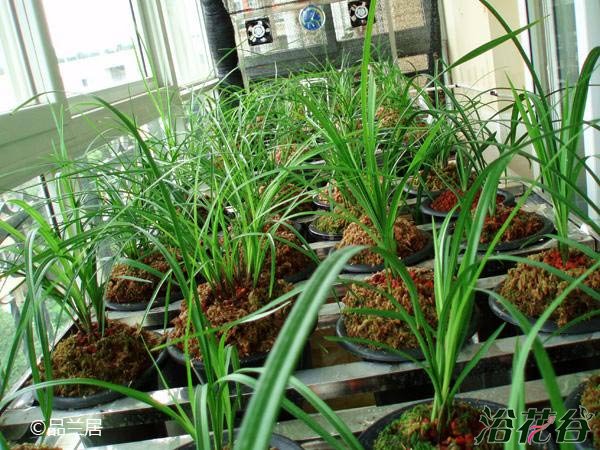
3. About pots
Clay pots with soft potting media, purple clay pots and plastic pots with granular media. No matter which kind of pot is used, do not let the pot walls receive strong light. A balcony is different from greenhouse cultivation; the environment is small, so water frequently and ventilate more. In particular, the bottom of the pot is the key to ventilation. Never water only after the medium has dried out completely. After watering, ventilate strongly, and never expose to blazing sun. Keep it moist whether in spring, summer, autumn, or winter.
4. Grow few but fine plants; fewer plants are easier to manage, and for varieties of the same type, choose premium ones to grow!
5. To prevent anthracnose and black spot disease, give priority to prevention. To kill pests, give priority to mechanical pest control, such as sticky insect boards. When applying pesticides and fertilizers, avoid high temperatures, and never apply pesticides or fertilizers during the day.
6. For watering, if conditions permit, you can store water. When watering, water thoroughly, and never water only halfway. When watering over the top of the plant, strong ventilation must be provided, and never allow water to accumulate in the leaf axils!
7. Fertilization should mainly be pot-surface fertilization and foliar fertilization. No matter which kind of fertilization, only apply it to strong seedlings; never fertilize small or weak seedlings.
8. The phototropism of balcony orchids easily causes orchid seedlings to grow slanting, so adjust the pots in a timely manner. After new buds emerge from the soil, adjusting the direction of light can promote the growth of hidden buds.